

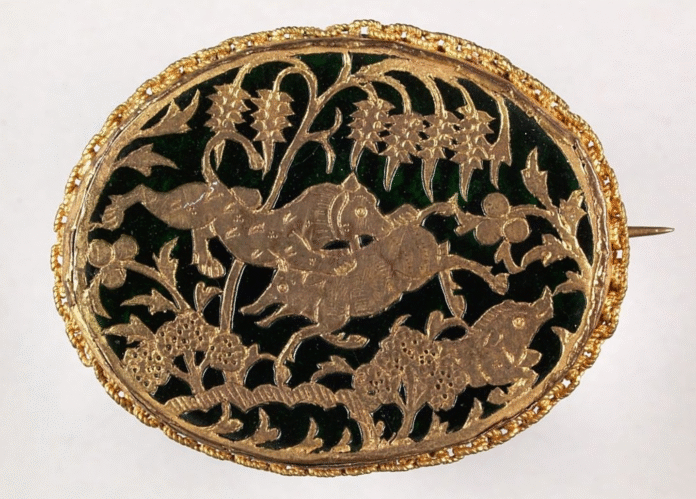
In the world of high jewelry, where pieces often rely on sheer carat weight or celebrity endorsements, one Indian art form stands apart. It is a masterpiece of light, color, and painstaking precision: Thewa jewelry.
Born in a small corner of Rajasthan and kept secret for over 250 years, Thewa has transcended its royal origins to become an international sensation, celebrated not for its size, but for its mesmerizing technique.
1. Thewa: Origin and Legacy of a Secret Art
Thewa’s story begins and remains centered in one city: Pratapgarh, Rajasthan.
This unique craft originated in the late 18th century (around 1765 AD) under the patronage of the local royal family. Thewa translates literally to ‘setting’ or ‘a pattern on a thick piece of glass’. Historically, the process was so closely guarded that the techniques were passed down only to the family’s sons, and the secrets of the craft were not even shared with the family’s daughters for fear of the technique leaving the household through marriage.
2. The Meticulous Process: Gold as Thin as a Thread
Thewa is the art of fusing intricately worked 23-carat gold sheets onto colorful, usually red, green, or blue, Belgian glass. The beauty lies in the impossible thinness and detailing of the gold foil.
The process is incredibly labor-intensive, requiring a high degree of skill and absolute concentration:
1. Preparation of the Glass: The Belgian glass is cut into the required shape (oval, round, or rectangular) and treated. The color of the glass acts as the backdrop, highlighting the gold work.
2. The Gold Foil: A 23K gold sheet, often no thicker than a single strand of thread (about 40 microns), is taken. The motifs—often depicting scenes from Hindu mythology (like Radha-Krishna or the Ramayana), hunting scenes, or intricate Mughal florals—are etched onto the gold sheet.
3. The Filing (Chitai): The most complex part. The artisan uses extremely fine tools to cut, shape, and file the delicate gold foil, creating a detailed lattice-like pattern.
4. Fusion (Jadaai): The fragile gold sheet is then meticulously pressed and fused onto the hot glass. Because the gold is so thin, it adheres perfectly to the surface, creating a stunning three-dimensional relief where the gold pattern stands out against the colored glass background. The glass provides the strength, while the gold provides the artistry.
This painstaking method means a single, complex pendant can take up to a month to complete.
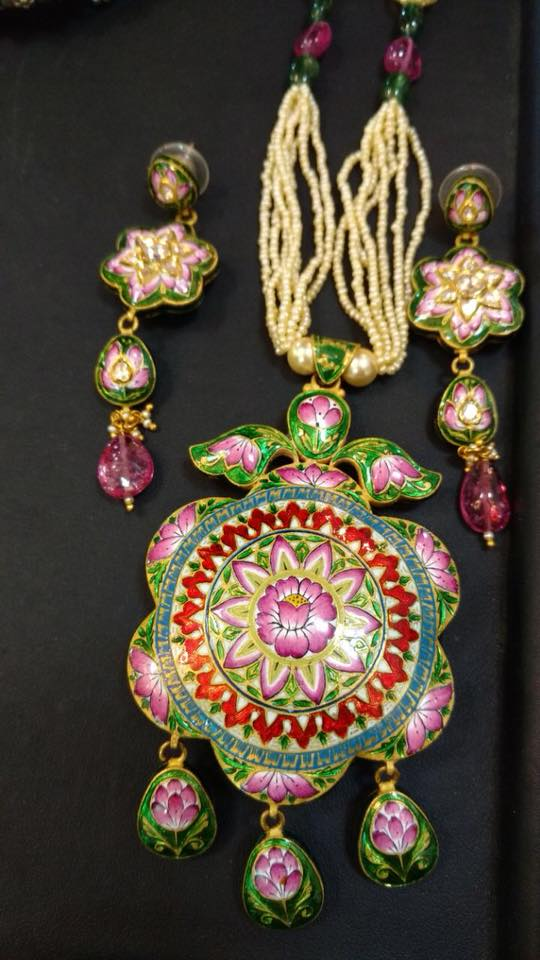
3. From Royal Court to Red Carpet: The Global Glory
Thewa’s path to global recognition was cemented by two key factors: royal patronage and international exhibitions.
While initially confined to the royal court, Thewa soon caught the eye of Western connoisseurs. In the late 19th and early 20th centuries, Thewa pieces were exhibited at various world fairs, earning medals and high praise for their originality.
Today, its global appeal is due to its unique duality:
• Antique Appeal: The rich colors, mythological themes, and fine gold filigree give it an immediate antique and cultural depth that mass-produced jewelry lacks.
• Versatility: Modern Thewa artists have adapted the technique to create lighter, more contemporary pieces, such as cuff links, watch dials, and minimalistic pendants, making it accessible for daily wear while retaining its artistic value.
The Indian government recognized the art form’s national importance by issuing a commemorative stamp and honoring Thewa artists with prestigious awards, including multiple National Awards and a Padma Shri, ensuring that this ancestral secret continues to dazzle the world.
The Jeweler’s Perspective
“I have been practicing this art for over thirty years, inheriting the secrets of my father and his father before him. Thewa, this meticulous fusion of 23-carat gold and colored Belgian glass, is not mere jewelry; it is a painstaking dance between fire and foil. Even a single, minimal pendant, cut from a gold sheet thinner than a strand of hair, demands at least ten days of focused effort. We capture a whole story in a speck of glass, ensuring the 250-year legacy continues to shine,” says Hardik Soni, a jeweller.
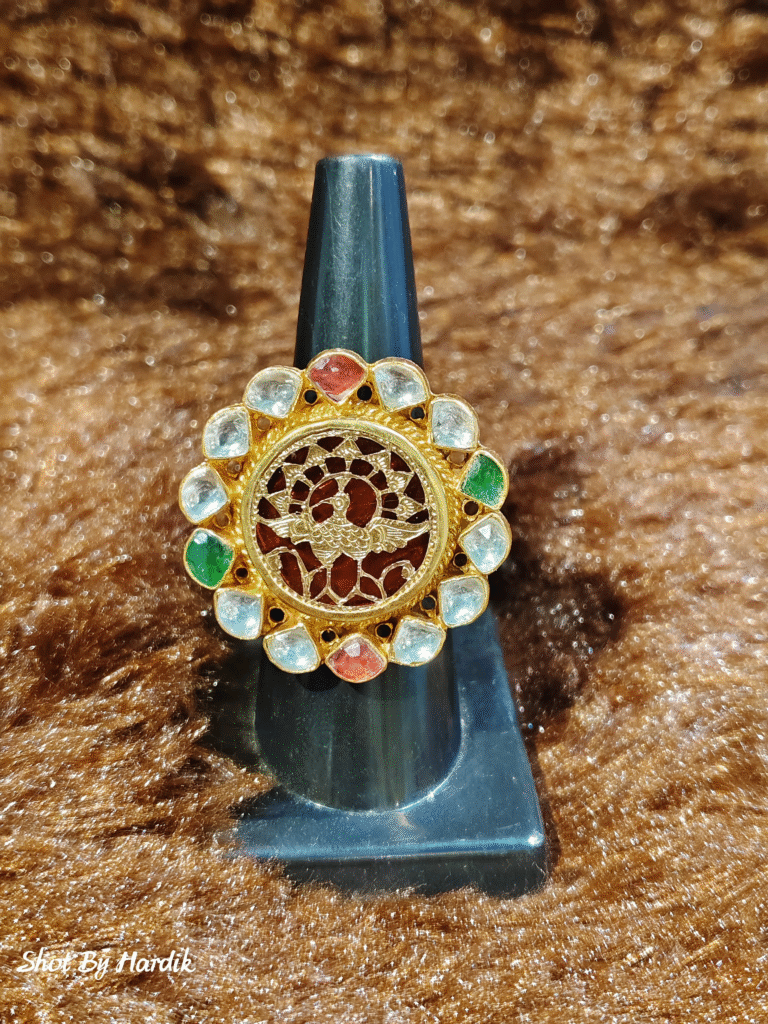
“It’s not just jewelry. It’s a dance between fire and foil.”
That’s how master artisan Hardik Soni describes Thewa, the rare and radiant art form born in the royal courts of Pratapgarh, Rajasthan.
We caught up with Hardik in his sunlit workshop, where a single pendant can take up to a month to complete — and where every speck of glass tells a story.
What makes Thewa so unique?
Hardik Soni: “Thewa is unlike anything else. We take 23-carat gold, thinner than a strand of hair, and fuse it onto colored Belgian glass — red, green, blue. The motifs? Scenes from the Ramayana, Radha-Krishna, Mughal gardens. It’s storytelling in gold.”
How long have you been practicing this art?
“Over 30 years. I learned it from my father, who learned it from his. The technique was always passed from father to son — never written down, never shared outside the family. Even daughters weren’t taught, for fear the secret would leave through marriage.”
What’s the most challenging part?
“The chitai — the filing. We use tools finer than needles to carve the gold into lace-like patterns. One wrong move, and the whole piece is ruined. It’s ten days of meditation for a single pendant.”
And yet, Thewa is going global now.
“Yes! From royal courts to red carpets. We’ve shown at world fairs, won national awards, even got a commemorative stamp. Today, we’re making cufflinks, watch dials, minimal pendants — keeping the soul of Thewa, but adapting it for the world.”
In a world chasing carats and celebrity endorsements, Thewa stands apart — not for its size, but for its soul. It’s heritage you can wear. A 250-year-old secret that still shines.
(The writer of this story is Anjali Solanki)