

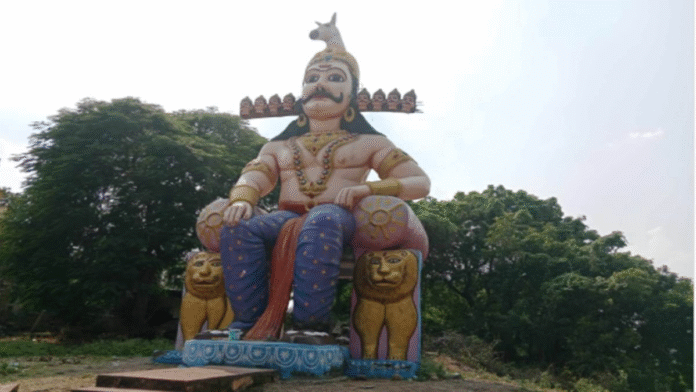
Every year, across India, the skies blaze with fire as effigies of Ravana fall to ash. But in one quiet village of Madhya Pradesh, the story takes a stunning turn. Welcome to Khanpura, nestled in the heart of Mandsaur, where Ravana is not burnt—but worshipped. Here, he’s not the ten-headed villain of Ramayana. He’s Mandodari’s husband, the son-in-law of the soil, and the villagers treat him with reverence, not rage. On Dussehra morning, the streets come alive—not with cries of war, but with bhajans and dhol beats. Women walk past his towering 51-foot statue, heads bowed, faces veiled in ghoonghat—a gesture of respect reserved for family elders. Children tie red threads to his legs, seeking protection. Elders offer dal-baati and laddoos, not fire. The statue, believed to be over 300 years old, stands tall—not as a symbol of defeat, but of intellect, devotion, and ancestral pride.
“Ravana was a great scholar,” say the locals. “A Shiva bhakt. A daamad of our land. Why should we burn him?”
In Khanpura, Dussehra isn’t about destroying evil. It’s about honoring legacy. About remembering that every story has another side
The Legend Behind the Worship
- Locals believe that Mandodari, Ravana’s wife, was born in Khanpura.
- That makes Ravana their “daamad” (son-in-law)—and burning his effigy would be a grave insult.
- Instead of flames, Ravana receives dal-baati and laddoo as offerings, and his towering 51-foot statue, said to be 300 years old, becomes the center of devotion.
Women’s Ritual: Ghoonghat of Respect
- As a mark of reverence, women cover their heads (do ghoonghat) while passing Ravana’s statue.
- It’s a gesture of respect for the village’s daamad, blending cultural pride with familial honor.