

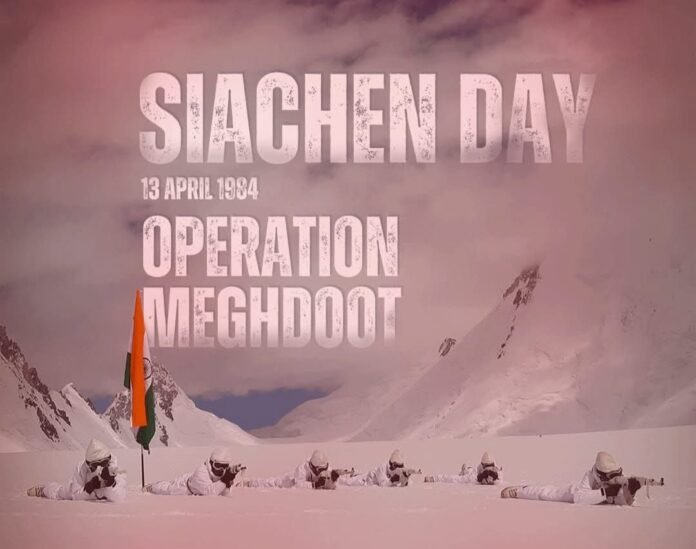
A Day of Courage and National Pride
Every year on April 13, India observes Siachen Day to honour the extraordinary courage, resilience, and sacrifice of soldiers guarding the icy heights of the Siachen Glacier—the highest and one of the most inhospitable battlefields in the world. The year 2026 marks the 42nd anniversary of this historic occasion, commemorating the launch of Operation Meghdoot in 1984.
What is Siachen Day and Why It is Celebrated
Siachen Day is observed to remember the success of Operation Meghdoot and to pay tribute to the soldiers who continue to serve in extreme conditions at altitudes of around 20,000 feet in the Karakoram Range.
It is not just a commemoration of a military victory but also a solemn reminder of the sacrifices made by soldiers who battle not only enemies but also nature—facing sub-zero temperatures, avalanches, and oxygen scarcity.
Operation Meghdoot: A Historic Military Achievement
Launched on April 13, 1984, Operation Meghdoot was a bold and pre-emptive military operation by the Indian Army, supported by the Indian Air Force. Its objective was to secure strategic dominance over the Siachen Glacier and the surrounding heights before Pakistan could establish its presence in the region.
The operation involved the airlifting of troops to glacial heights, a remarkable logistical and military feat under extreme weather conditions.
Indian forces successfully captured key passes along the Saltoro Ridge, including:
●Bilafond La
●Sia La
●Gyong La
This gave India a crucial strategic advantage by securing the higher ground and effectively controlling the glacier and its approaches.
Key Facts and Figures
●Siachen is the world’s highest battlefield, with deployments reaching over 6,000 meters.
●India gained control of approximately 70 km long glacier and surrounding areas after the operation.
●The region holds immense strategic importance as it overlooks routes connecting Ladakh, Gilgit-Baltistan, and the Karakoram Pass.
●Thousands of soldiers have served here, with many casualties caused not just by conflict but by harsh climatic conditions.
Strategic and National Significance
Operation Meghdoot marked a decisive moment in India’s defence history. By securing the Siachen Glacier, India ensured control over a region that is critical to its northern borders and strategic stability.
The operation also demonstrated exceptional coordination between the Army and the Air Force and showcased India’s capability to conduct military operations in extreme environments.
A Tribute to the ‘Siachen Warriors’
Siachen Day is ultimately about the soldiers—often called the “Siachen Warriors”—who endure unimaginable hardships to safeguard the nation. Their spirit is captured in the famous line: “Quartered in snow, silent to remain… when the bugle calls, they shall rise and march again.”
Across India, the day is marked by tributes, ceremonies, and remembrance events, honouring those who have served and those who made the ultimate sacrifice.
Enduring Legacy
More than four decades after Operation Meghdoot, Siachen continues to stand as a symbol of India’s military resolve, strategic foresight, and the indomitable spirit of its soldiers. Siachen Day reminds the nation that freedom and security are often defended in the harshest and most unforgiving corners of the world—far away from the public eye, yet vital to the country’s sovereignty.