

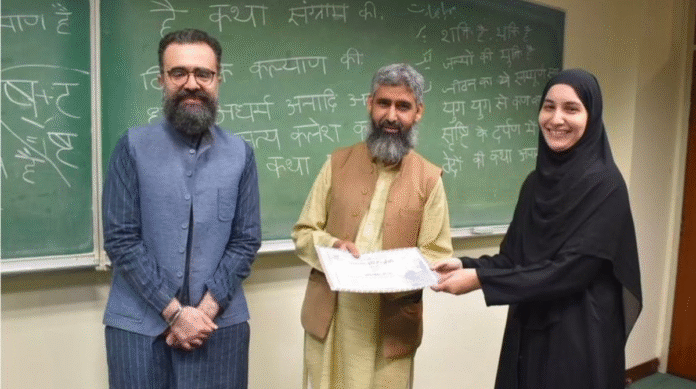
In a move that has drawn attention across South Asia, a Pakistani university is set to introduce Sanskrit as an academic subject, marking the first such initiative since the Partition of India in 1947. The decision is being viewed as a significant cultural and educational moment, especially given the complex political and historical relationship between India and Pakistan.
The Initiative has been announced by the University of Engineering and Technology (UET), Lahore, which plans to offer Sanskrit as part of its academic curriculum.
The course is expected to include the study of classical texts such as the Mahabharata and the Bhagavad Gita, approached from literary, historical and philosophical perspectives rather than religious instruction. University officials have emphasised that the subject will be taught purely as a language and civilizational study.
Why Sanskrit matters in the Pakistani context
Sanskrit is one of the oldest classical languages in the world and has deep roots across the Indian subcontinent, including regions that are now part of Pakistan. Ancient centres of learning like Taxila once thrived in this region, where Sanskrit and related languages were used in scholarly discourse. Studying Sanskrit allows access to a vast body of knowledge on ancient science, mathematics, philosophy and governance that shaped early South Asian civilisation.
An academic move, not a religious one
Authorities involved in the programme have clarified that the introduction of Sanskrit is not meant to promote religious beliefs. Instead, it aims to help students, historians and researchers engage directly with original historical texts, inscriptions and manuscripts. This academic framing has helped position the initiative as an intellectual expansion rather than a cultural provocation.
A break from post-partition educational trends
After Partition, Sanskrit gradually vanished from Pakistan’s education system as curricula evolved around Islamic studies and Persian-Arabic literary traditions. Reintroducing the language after nearly eight decades is therefore symbolically significant. It suggests a willingness within academic spaces to explore shared heritage and pre-partition history without ideological barriers.
Mixed reactions, wider implications
The announcement has been welcomed by scholars in India and abroad, who see it as a step toward cultural openness and academic collaboration.
Within Pakistan, reactions have been mixed, with appreciation from academic circles and scepticism from more conservative voices. Despite this, the move highlights how education can create space for dialogue beyond political divides.
While the number of students enrolled may be limited initially, the decision carries broader meaning. It underlines the idea that languages and knowledge transcend borders, and that revisiting history academically can open new paths for understanding in a divided region.