

Also known as: Battle of the Jhelum
Date: 326 BCE
Location: Jhelum River (Hydaspes), near Chenab River, modern-day Pakistan
Key Participants: Alexander the Great (Macedonia) vs. King Porus (India)
Notable Figures: Alexander the Great, Porus (Paurava), Craterus, Seleucus I Nicator
The Battle of the Hydaspes (326 BCE) was the last great confrontation of Alexander the Great’s Asian campaign. Fought on the banks of the Jhelum (ancient Hydaspes) in present-day Pakistan, it pitted Alexander’s disciplined Macedonian army against the powerful forces of King Porus, ruler of the region between the Jhelum and Chenab rivers. The battle not only tested Alexander’s tactical brilliance but also highlighted the resilience and valor of Porus, whose defiance earned him the conqueror’s respect.
Background: Alexander’s March to India
By 331 BCE, Alexander had destroyed the Persian Empire and extended his rule across much of Asia. In 327 BCE, he crossed the Hindu Kush into India. Local rulers, including Ambhi of Taxila, allied with him against Porus. Refusing to submit, Porus—believed to be the king of the Purus tribe from ancient Vedic tradition—chose to meet Alexander on the battlefield.
The Battle
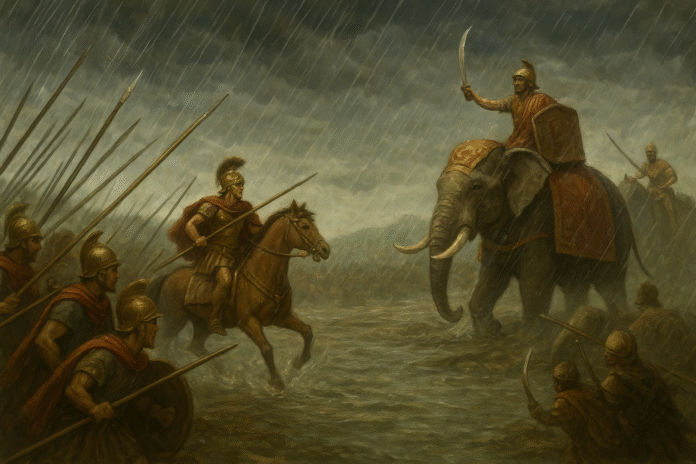
The Hydaspes River, swollen by monsoon rains, separated the two armies. Porus positioned himself on the eastern bank with a formidable force: thousands of infantry, cavalry, chariots, and most notably, war elephants—a weapon unfamiliar to Macedonian troops.
Alexander staged a clever deception, making it seem he would wait for calmer waters. Instead, under cover of a storm, he marched 18 miles upstream and secretly crossed with part of his army. Porus’s son attempted to repel them but was killed in battle.
As Porus advanced to meet Alexander, the remaining Macedonian forces crossed the river and struck from behind. Macedonian pikes (sarissas) neutralized the elephants, while Porus’s chariots bogged down in mud. Attacked on two fronts, Porus’s army was overwhelmed despite fierce resistance.
Aftermath and Respect for Porus
Porus was captured but refused to bow, asking to be “treated as a king.” Impressed by his courage, Alexander restored him as satrap and even granted him additional territory. Two cities were founded nearby: Nicaea (to commemorate victory) and Bucephala (in honor of Bucephalus, Alexander’s horse, who died in the battle).
This was Alexander’s final major battle in India. His troops, exhausted and unwilling to march further into the powerful Nanda Empire beyond the Beas River, mutinied. Alexander turned back, and within three years, he died in Babylon (323 BCE), leaving his empire to be divided among his generals.
Legacy
The Battle of the Hydaspes marked the easternmost expansion of Alexander’s conquests. It showcased his unmatched tactical skill but also his ability to recognize greatness in his adversaries. Some historians suggest that the invasion influenced Chandragupta Maurya, who soon rose to power and founded the Mauryan dynasty, shaping Indian history for centuries.