

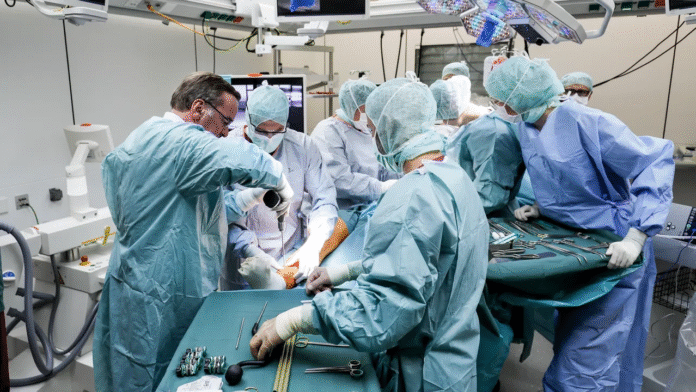
In a groundbreaking medical milestone, doctors have successfully performed the world’s first transatlantic remote surgery, connecting Scotland and the United States through cutting-edge robotic technology. The achievement marks a transformative moment in stroke care and telemedicine, opening new possibilities for life-saving treatment across continents.
Breakthrough in Robotic Stroke Procedure
The historic operation was conducted between the University of Dundee in Scotland and Jacksonville, Florida, by Professor Iris Grunwald, an interventional neuroradiologist at Dundee, and Dr. Ricardo Hanel in the United States.
Professor Grunwald performed a remote thrombectomy—a procedure to remove blood clots from the brain after a stroke—on a human cadaver from 4,000 miles away. Hours later, Dr. Hanel performed a corresponding operation from Florida on a body in Dundee. Together, they achieved the first-ever transatlantic robotic surgery, setting a precedent in global healthcare connectivity.
Technology Behind the Innovation
The operations used advanced robotic systems developed by Lithuanian firm Sentante, supported by Nvidia and Ericsson’s ultra-low-latency network technology.
The robotic arm, equipped with standard catheters and wires, was remotely controlled with just a 120-millisecond delay over 4,000 miles—nearly imperceptible to the human operator. Surgeons viewed real-time X-rays and imaging while a local assistant handled the initial setup. Astonishingly, the system required only 20 minutes of training to master.
This breakthrough demonstrates how AI-powered robotics and 5G-speed communication can revolutionize complex medical procedures.
Global Implications for Stroke Care
Stroke treatment is a race against time—every six-minute delay can reduce a patient’s recovery chances by one percent. The ability to perform thrombectomies remotely could dramatically expand access to expert care, particularly in rural and under-resourced regions where specialists are scarce.
Medical experts hailed the achievement as a turning point for emergency medicine, suggesting that future patients could receive expert intervention within minutes—no matter where they are in the world.
Key Facts
- World’s first transatlantic robotic surgery between Scotland and the US.
- Conducted by Prof. Iris Grunwald (Dundee) and Dr. Ricardo Hanel (Florida).
- Supported by Sentante robotics, Nvidia, and Ericsson connectivity.
- Procedure showed a 120 ms lag over 4,000 miles.
Future of Remote and Robotic Medicine
The University of Dundee, a leading centre for interventional stroke research, hosted the experiment as part of ongoing efforts to expand tele-robotic healthcare.
Clinical trials are planned for 2026, with the goal of making remote thrombectomy accessible globally. Experts predict this innovation could soon allow a patient in a remote village to receive real-time expert treatment from the world’s top surgeons — revolutionising emergency and precision medicine forever.