

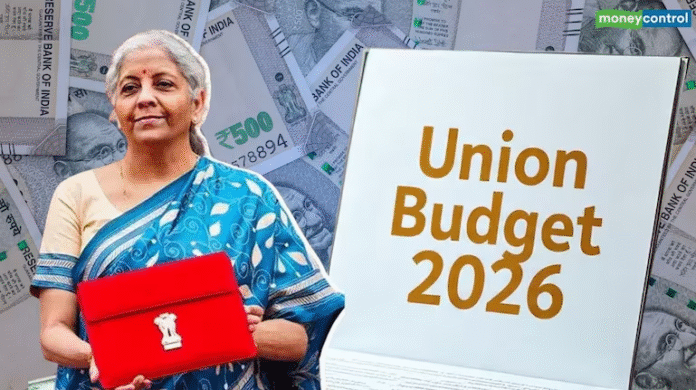
The Union Budget was presented on the auspicious occasion of Magh Purnima and Guru Ravidas Jayanti, as stated by Finance Minister Nirmala Sitharaman. It was highlighted that over the past twelve years, despite various uncertainties, a stable economy has been maintained. Far-reaching structural reforms were said to have been implemented, with self-reliance being kept as a primary objective. It was further stated that dependence on imports has been reduced and that measures have been ensured so that citizens benefit, agricultural productivity increases, and families’ purchasing power rises.
According to Nirmala Sitharaman, these measures have resulted in a 7% growth rate, enabling poverty reduction and improvement in people’s lives.
“The Union Budget for the year 2026–27 has instilled confidence in the nation that the light of development will reach every household and new opportunities for progress will emerge in every life.”
The Union Budget for the year 2026–27 was prepared by the Ministry of Finance of India and was presented by the Finance Minister in the Lok Sabha on 1 February 2026. It was formulated under the Government of India to outline the estimated revenue and planned expenditure for the financial year from April 1, 2026 to March 31, 2027. Through this budget, priorities related to economic growth, infrastructure development, employment generation, and inclusive progress were highlighted, reflecting the government’s vision for national development.
Prepared for first time in Kartavya bhawan , the budget outlines the government’s economic priorities amid global uncertainty and domestic growth imperatives.
With the total expenditure at ₹53.5 lakh crore and a financial deficit estimated at 4.3% of GDP the budget to sustain GDP growth while adhering to financial discipline. It reflects the Indian governments effort to balance public investment, social spending and microeconomics stability.
The budget is anchored around 3 kartavyas accelerating economic growth building human capacity and ensuring inclusive development. These pillar align with the broader objective of transforming India into a developed economy by 2047.
1. Kartavya to Accelerate Economic Stability and Growth
The first Kartavya focuses on maintaining a stable and resilient economy in the face of global and domestic challenges. Through structural reforms and prudent financial management, this duty aims to sustain steady economic growth and build a strong foundation for long-term national development.
2. Kartavya of Self-Reliance
The second Kartavya emphasizes strengthening self-reliance by reducing dependence on imports and encouraging domestic production. Special attention is given to agriculture, manufacturing, and local industries so that the Indian economy grows stronger from within and becomes more competitive globally.
3. Kartavya of Welfare and Inclusive Development.
The third kartavya focuses on inclusive development aligned with Sabka Saath, Sabka Vikas. In agriculture, Bharat-VISTAAR (Virtually Integrated System to Access Agricultural Resources), an AI-based multilingual advisory platform, will integrate AgriStack databases with ICAR practices to provide farm-level decision support.
Tax Reforms
The New Income Tax Act, 2025, effective from April 2026, aims to simplify tax compliance through simpler rules, redesigned forms, and easier procedures. For the IT sector, software development, IT-enabled services, and contract R&D services have been merged into a single category of Information Technology Services with a common safe harbour margin of 15.5%. The eligibility threshold has been raised to ₹2,000 crore.
In indirect taxes, customs duty on personal imports has been reduced to 10%. Duties on 17 medicines have been exempted.
Conclusion
The Union Budget 2026–27, read alongside the Economic Survey, outlines a structured approach to growth, inclusion, and fiscal consolidation. Its focus on manufacturing, infrastructure, MSMEs, and human capital addresses both immediate economic needs and long-term structural priorities. The three-kartavya framework offers a useful lens to understand evolving policy direction.

(The article has been written by Vanshika Soni)