

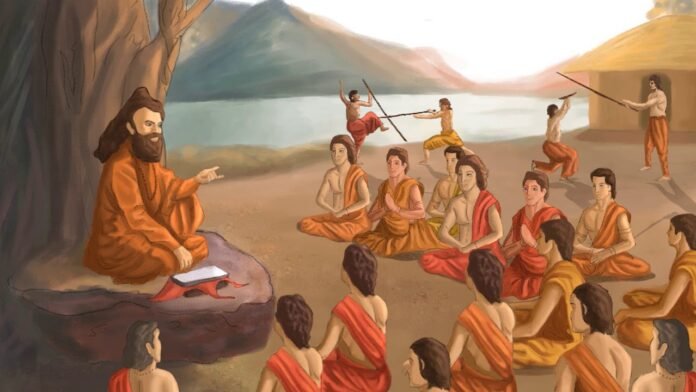
Long before modern classrooms and digital learning, ancient India developed one of the most profound and holistic education systems in the world—the Gurukul system. Rooted in the Vedic age, this system was not merely about acquiring knowledge but about shaping individuals into responsible, wise, and balanced human beings.
What Was the Gurukul System?
The Gurukul system was a residential form of education where students (shishyas) lived with their teacher (guru) in an ashram-like environment, often surrounded by nature. Education was not limited to fixed hours or textbooks; it was a continuous process integrated into daily life.
The guru-shishya relationship formed the core of this system. The guru was not just an instructor but a mentor, guide, and moral compass, responsible for the student’s intellectual, emotional, and spiritual growth.
A Truly Holistic Education
What made the Gurukul system exceptional was its holistic approach. It focused equally on:
●Intellectual learning (Vedas, philosophy, mathematics, astronomy)
●Physical training (martial arts, discipline, daily chores)
●Moral and ethical values (truth, humility, respect)
●Spiritual development (meditation, self-realisation)
Education was not about memorisation but experiential learning—students learned through observation, discussions, storytelling, and real-life practice.
Values and Life Skills Taught
The Gurukul system aimed to create not just scholars, but complete individuals. Students were taught:
●Self-discipline and simplicity through a structured daily routine
●Self-reliance by performing chores like cooking, cleaning, and gathering resources
●Respect and humility towards teachers and society
●Social responsibility and community living
●Critical thinking and debate, encouraging intellectual growth
This emphasis on life skills made education practical and deeply meaningful.
Why India Was Ahead of Its Time
The Gurukul system was far ahead of its time because it viewed education as a way of life, not just a means to a career. While many modern systems focus on exams and grades, Gurukul education aimed at character-building, inner development, and societal contribution.
It also promoted personalised learning, where each student was guided according to their abilities and interests—something modern education is only now striving to achieve.
Legacy and Relevance Today
Though the Gurukul system declined with the advent of colonial education models, its principles remain highly relevant. Concepts like mentorship, experiential learning, and value-based education are increasingly being recognised as essential even today.
Gautam Adani on Gurukuls: Bridging Ancient Wisdom and AI
This continuing relevance of the Gurukul system finds resonance even in contemporary discourse. During a recent visit to Ayodhya, Gautam Adani visited Shri Nishulk Gurukul Mahavidyalaya and reflected on the importance of such institutions in today’s world. Calling Gurukuls vital for preserving India’s cultural and knowledge traditions, he remarked,
“When education is rooted in values, it doesn’t just shape individuals, it shapes the future of the nation.”
He further emphasised that in an era rapidly moving towards artificial intelligence, it is essential to both preserve and strengthen India’s traditional knowledge systems, even as they evolve with modern tools.
Highlighting this balance between tradition and innovation, he also announced support for setting up an AI-based laboratory at the Gurukul—an effort aimed at bringing together ancient wisdom and contemporary technology.
A Timeless Inspiration
The ancient Gurukul system stands as a powerful reminder that true education goes beyond books—it shapes character, builds wisdom, and prepares individuals for life. In many ways, it reflects an ideal that modern education systems are still trying to rediscover.