

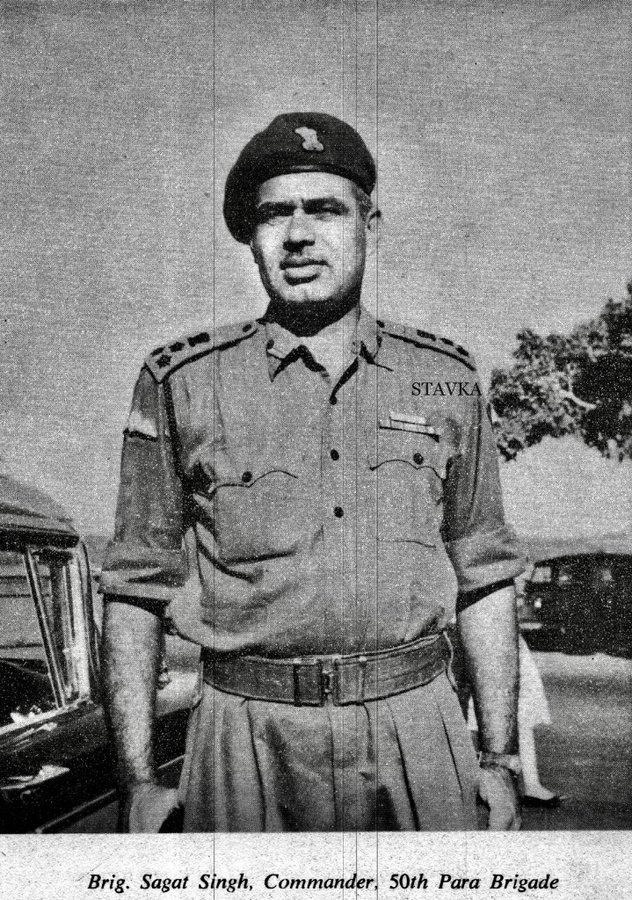
Lt Gen Sagat Singh occupies a unique place in India’s military history—not merely as a victorious commander, but as a leader who consistently altered the course of campaigns through audacity, speed and an instinctive understanding of terrain and timing. From the liberation of Goa in 1961 to the creation of Bangladesh in 1971, Sagat Singh’s career offers a study in unconventional leadership, operational clarity and strategic courage.
A Soldier Shaped Outside the Mainstream
Born in Churu, Rajasthan, Sagat Singh did not emerge from the traditional British Indian Army officer pipeline. He began his career in the Bikaner State Forces as a Jamedar in 1938, a background that gave him a practical, field-oriented outlook rather than a doctrinaire one. His World War II experience further hardened his understanding of real combat—where improvisation matters more than manuals.
This outsider trajectory shaped his leadership style. Sagat Singh valued results over hierarchy, speed over hesitation, and battlefield reality over theoretical caution.
Goa 1961: Speed as Strategy
Operation Vijay, the military action to liberate Goa, is often described as swift—but its success owed much to Sagat Singh’s decisions on the ground. Commanding the 50th Para Brigade, he rejected predictable routes and ordered his troops to advance through smugglers’ paths, bypassing Portuguese defences.
His most symbolic act—ordering soldiers to replace steel helmets with maroon berets while entering Panjim—was not theatrics. It was psychological warfare. It signalled confidence, reduced the appearance of occupation, and reassured the civilian population. Within 36 hours, Goa was liberated, and Sagat Singh emerged as the operational face of the victory.
Yet, the Indian state did not award gallantry medals for the Goa operation—an early indication of how political caution sometimes eclipsed military achievement.
1971: The Meghna Gamble
Sagat Singh’s finest hour came during the 1971 Bangladesh Liberation War, where his command of IV Corps demonstrated his genius for manoeuvre warfare. While conventional wisdom dictated slow advances with secure supply lines, Sagat Singh ordered a bold helicopter-borne crossing of the Meghna River—deep into enemy territory.
This move shattered Pakistani defensive planning. By bypassing strongholds instead of confronting them head-on, Sagat Singh accelerated the collapse of Pakistani resistance in eastern theatre. The fall of Dhaka soon followed.
The “Meghna Helibridge” is now studied as a classic example of operational audacity—where risk, when calculated correctly, shortens wars and saves lives.
Leadership Traits That Set Him Apart
Sagat Singh’s leadership was defined by three core traits:
- Decentralised Command: He trusted junior officers, empowering them to act independently within a clear intent.
- Terrain Mastery: Rivers, jungles and unconventional routes were not obstacles but tools.
- Moral Courage: He took responsibility for bold decisions, understanding that indecision often costs more than failure.
Ironically, such qualities also made him uncomfortable within rigid bureaucratic systems. Despite his achievements, his post-war career did not match his battlefield stature, and he retired without ever commanding the Army as Chief.
Recognition Abroad, Ambivalence at Home
While India awarded him the Padma Bhushan, Bangladesh formally acknowledged his decisive role in its liberation decades later. Within India, however, Sagat Singh remains underrepresented in textbooks and public memory—overshadowed by political narratives and more institutionally favoured figures.
His life highlights a recurring paradox in Indian military history: commanders who deliver decisive victories are often celebrated selectively, depending on political context rather than strategic impact.
Why Sagat Singh Matters Today
In an era where warfare increasingly values speed, integration and joint operations, Sagat Singh’s campaigns feel strikingly modern. His belief that wars should be ended quickly, decisively and humanely—by collapsing enemy will rather than engaging in attrition—offers enduring lessons for military planners and policymakers alike.
Lt Gen Sagat Singh was not merely a general who won wars. He was a commander who changed how India fought them. Remembering him is not about nostalgia—it is about recognising the kind of leadership that secures nations when history demands bold choices.