

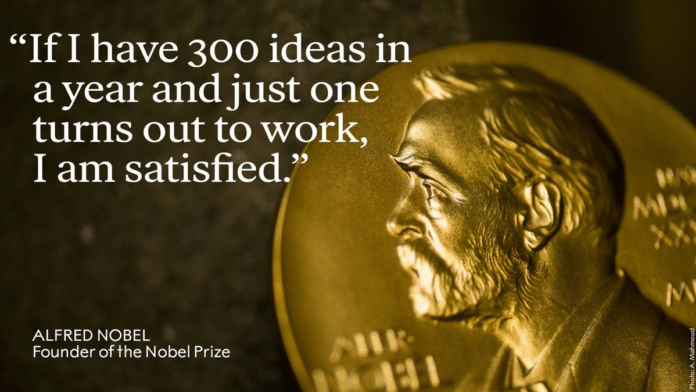
Alfred Bernhard Nobel, a chemist, engineer, inventor, industrialist, and founder of the world’s most prestigious awards, was born on October 21, 1833, in Stockholm, Sweden, and died on December 10, 1896, in San Remo, Italy. Best known for inventing dynamite, he earned immense wealth during his lifetime—only to devote it all, unexpectedly, to the creation of the Nobel Prizes. His life is a remarkable journey of innovation, introspection, and a final act that transformed his legacy forever.
Early Life and Education: A Childhood of Curiosity and Movement
Alfred Nobel was born into a family of engineers and builders. His father, Immanuel Nobel, was an innovator who constructed bridges and experimented with new blasting techniques. Young Alfred was often sick but possessed a restless intellect and a strong attachment to his mother, Andriette Ahlsell Nobel.
Financial difficulties forced Immanuel to move to St. Petersburg, Russia, where he revived his fortunes manufacturing explosive mines and machinery. The family joined him in 1842. Growing up in Russia, Alfred flourished academically—by age 17, he was fluent in Swedish, Russian, French, English, and German.
A budding scientist, Alfred left Russia in 1850 to study chemistry in Paris, later working in the United States under renowned engineer John Ericsson. He returned to St. Petersburg in 1852 to help in the family’s factory during the Crimean War.
But when the war ended in 1856, business collapsed. By 1859, the factory went bankrupt, forcing the Nobels to return to Sweden—an event that would shape Alfred’s future in explosives research.
Inventions: The Explosive Legacy
Back in Sweden, Alfred’s fascination with explosives deepened. Nitroglycerin—powerful but dangerously unstable—became the center of his experiments.
Major Breakthroughs
- 1863: Invented the first practical detonator.
- 1865: Improved it with the blasting cap, revolutionizing modern explosives use.
- 1867: Invented dynamite, earning him worldwide fame and enormous wealth.
- 1875: Created blasting gelatin, a more powerful and stable explosive.
- 1887: Developed ballistite, an early smokeless powder and precursor to cordite.
Over his lifetime, Nobel built a network of factories across Europe and registered more than 350 patents, ranging from explosives to artificial silk and leather. Despite his financial success, he never married and often lived a solitary, introspective life.
A Literary Soul Behind the Scientist
Nobel’s interests extended beyond science. He wrote plays, poems, and novels, though most remained unpublished. His love for literature later influenced one of the Nobel Prize categories.
How Alfred Nobel Created the Nobel Prize: The Story Behind the Will
The turning point came in 1888, when a French newspaper mistakenly published his obituary titled “The Merchant of Death is Dead.” It condemned Nobel for profiting from explosives. Shaken by how history might remember him, Alfred became determined to redefine his legacy.
His close friendship with Bertha von Suttner, a leading Austrian pacifist, further influenced him. Her ideas on peace profoundly affected Nobel and ultimately inspired the creation of the Nobel Peace Prize.
The Final Will That Shocked the World
In 1895, suffering from angina, Nobel drafted his will—one of the most consequential documents in modern history. When he died in 1896 from a cerebral hemorrhage, the world was stunned.
Nobel had left virtually his entire fortune to establish five international prizes in:
- Physics
- Chemistry
- Physiology or Medicine
- Literature
- Peace
His vast industrial empire—over 90 factories—was placed into a trust to fund these awards. Despite legal challenges and family objections, the Nobel Foundation was formally established in 1900.
Today, the Nobel Prizes are celebrated annually on 10 December, the anniversary of Alfred Nobel’s death.
Why the Nobel Prizes Endure
The awards reflect Nobel’s belief in:
- The power of scientific advancement
- The importance of humanistic literature
- The need for global peace
More than a century later, the Nobel Prizes remain the world’s highest honor in science, literature, and peace—born from the introspection of a man determined to leave humanity better than he found it.