

By Soniya Yadav
In 2011, the Supreme Court of India delivered a historic judgment in Nandini Sundar & Others vs State of Chhattisgarh, striking down the state-backed militia movement known as Salwa Judum. What seemed at the time like a decisive closure has resurfaced now, as political debates drag this verdict back into controversy.
This case was not just about one state or one conflict—it was about the very foundations of India’s constitutional democracy. At its heart lay a difficult question: how far can the state go in the name of security, and at what cost to fundamental rights?

Salwa Judum, initiated in 2005, was promoted as a “people’s movement” against Maoist insurgency in Chhattisgarh. Supporters claimed it was a grassroots uprising where tribal communities themselves had decided to fight back against Naxalite domination. However, the ground reality turned out to be very different.
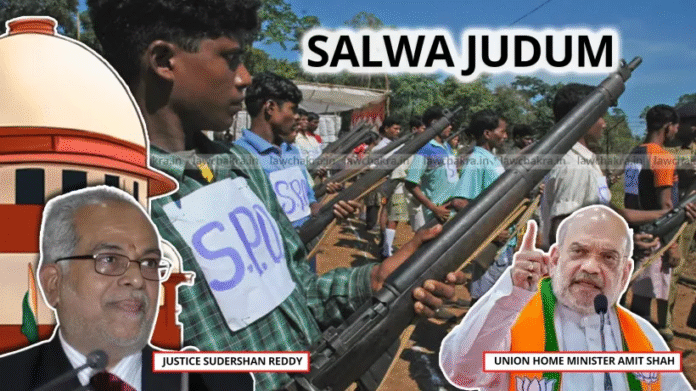
Under this initiative, the state armed tribal youth by designating them as Special Police Officers (SPOs) and pushed them into direct conflict with the Maoists. With little to no training and minimal accountability, these young men became foot soldiers in a brutal war. Very soon, reports began to emerge of large-scale human rights violations: villages being burnt down, families being displaced, and innocents being caught in the crossfire.
Instead of providing protection, Salwa Judum left vulnerable communities trapped between two forces—on one side the violence of Naxal insurgents, and on the other the coercion of state-backed vigilantism. What was presented as empowerment soon turned into exploitation of tribal populations who were already among the most marginalized groups in the country.
The 2011 Supreme Court Verdict
On 5 July 2011, Justices B. Sudershan Reddy and S.S. Nijjar declared Salwa Judum unconstitutional. Their judgment was a landmark because it firmly reminded the state that in a democracy, the end can never justify the means.
The Court held that:
Arming untrained civilians violated the Right to Equality (Article 14) and the Right to Life (Article 21) guaranteed by the Constitution.
The state cannot outsource policing to civilians; the duty to protect citizens lies solely with the government and its trained institutions.
All weapons issued to SPOs must be withdrawn immediately, and the movement itself had to be disbanded.
This was not merely a technical legal ruling. It was a powerful reminder that constitutional morality cannot be sacrificed even in the name of fighting extremism. The verdict reaffirmed that in India, rule of law stands above expediency, and even the state cannot bend constitutional principles to serve short-term goals.
The Recent Controversy
The Salwa Judum verdict entered the spotlight again more than a decade later when Union Home Minister Amit Shah publicly criticised Justice B. Sudershan Reddy, one of the judges behind the ruling. Shah argued that the judgment had harmed India’s fight against Naxalism. His remarks came in the context of Justice Reddy’s nomination as the opposition’s Vice-Presidential candidate.
This statement reignited old debates and shifted the focus from the legal principles of the case to a political tug-of-war. What was once a judicial decision rooted in constitutional values was suddenly turned into a tool for political scoring. Instead of debating policy choices, the conversation became about questioning the wisdom of judges who upheld fundamental rights.
By criticising a decade-old judgment in this manner, the controversy blurred the boundary between judicial independence and political rivalry. It sent a message that constitutional decisions could be reopened, not through the judicial process, but through political attacks.
—
My View
To me, this controversy highlights an important principle: judicial judgments and political conflicts should never be mixed.
The Supreme Court’s verdict in 2011 was not about supporting Maoists or opposing the state—it was about protecting the Constitution. The judgment emphasised that even when the nation faces grave security threats, we cannot allow fear or politics to erode the rights and dignity of citizens.
When political leaders attack judicial rulings for short-term gains, it weakens both institutions—the judiciary and politics itself. Such statements risk creating a precedent where leaders may casually undermine judicial decisions, shaking public trust in the impartiality of the courts.
Amit Shah’s remarks may set a dangerous example, encouraging future leaders to exploit judicial decisions for partisan advantage. If judicial verdicts are dragged into political mudslinging, the very independence of justice is threatened. The judiciary is meant to be the guardian of the Constitution, not an arena for political battles. Mixing these two spheres endangers the balance of democracy itself.
Conclusion
The Salwa Judum verdict of 2011 remains a landmark in Indian constitutional history. It was not just about dismantling a controversial movement—it was about reaffirming that the Constitution stands above the state’s convenience. Even in the toughest of times, humanity, dignity, and rights cannot be compromised.
Today, as this judgment is once again drawn into political controversies, we must remember its deeper lesson. Democracy thrives when institutions respect their boundaries: politics may debate policies, but the judiciary must always stand above partisanship.
Ultimately, respecting judicial independence is not about protecting judges—it is about protecting democracy itself
(Written by Soniya Yadav, B.A pass course, Kanoriya College)