

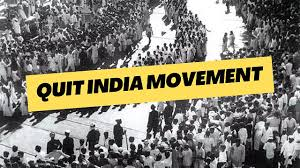
On 8th August 1942, the Quit India Movement became one of the boldest chapters in India’s freedom struggle. Launched by Mahatma Gandhi in Mumbai during a meeting of the All India Congress Committee, it was not just a protest – it was a clarion call for complete and immediate independence from British colonial rule. This movement marked a turning point, as it united millions of Indians in a decisive push toward freedom.
Background – A Nation’s Patience Runs Out
Before 1942, India had already witnessed waves of protests, civil disobedience, and reformist struggles. However, World War II changed the political landscape. The British had dragged India into the war without consulting Indian leaders, promising little in return for Indian support. The failure of the Cripps Mission in March 1942 – sent by Britain to negotiate terms for self-governance – further deepened public frustration. People realized that partial reforms and promises were not enough; the time had come for a final, all-out demand for independence.
The Launch – Gandhi’s ‘Do or Die’ Call
On the evening of 8th August 1942 at Mumbai’s Gowalia Tank Maidan (now August Kranti Maidan), Gandhi gave his historic speech, famously urging Indians to “Do or Die” in the quest for freedom. The call was clear: the British must quit India immediately, and the people must be prepared for any sacrifice necessary to achieve this goal. The movement was to be non‑violent, but it demanded uncompromising determination.
Nationwide Uprising and Repression
Within hours of the announcement, British authorities arrested Gandhi, Jawaharlal Nehru, Sardar Patel, and other top Congress leaders to crush the movement at its roots. But the arrests had the opposite effect – they ignited a spontaneous wave of protests across the country. Students boycotted classes, workers went on strike, and rural communities disrupted railways and communication lines. Though Gandhi had called for non‑violence, in some places anger boiled over, leading to clashes, police firing, and destruction of government property.
Impact on the Freedom Struggle
The Quit India Movement may not have achieved immediate independence – British repression was swift and brutal – but it accomplished something equally significant: it broke the myth that British rule could last forever. The movement demonstrated the unity and resolve of Indians, cutting across regional, religious, and social lines. It also signaled to the world, especially to a war‑weary Britain, that India would not settle for anything less than complete freedom.
The Road to Independence
Although it took five more years for India to finally achieve independence on 15th August 1947, the Quit India Movement of 1942 acted as the final mass awakening. It weakened Britain’s grip politically, economically, and morally. When World War II ended in 1945, Britain faced immense pressure at home and abroad to decolonize. By then, the Quit India uprising had ensured that the demand for independence was irreversible.
Conclusion
The Quit India Movement was more than a protest—it was a mass awakening that transformed the independence struggle into an unstoppable force. Gandhi’s “Do or Die” call still echoes as a reminder of the power of collective action and the courage of ordinary people. It stands as one of the most inspiring episodes in India’s journey toward freedom.