

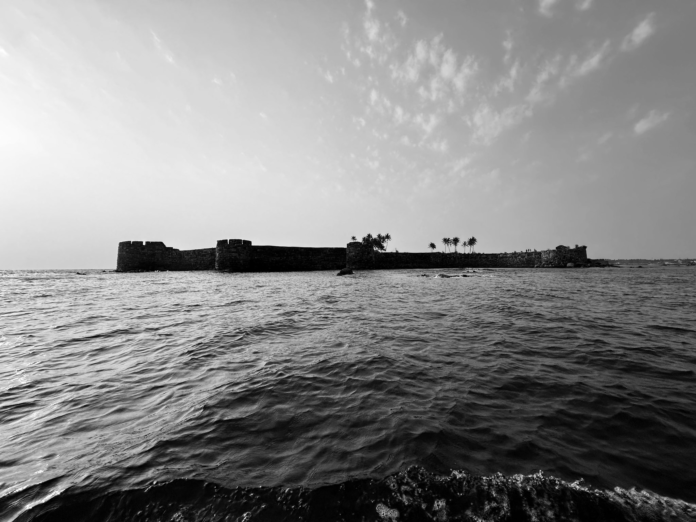
A Fort in sea water! This might surprise you. But then you should visit Maharashtra’ Raigarh district and explore the Sindhudurg Fort situated on an island which was constructed by Chhatrapati Shivaji Maharaj, a brilliant defense strategist and visionary, who recognised the importance of naval power and began building the Maratha Navy between 1657 and 1659. After multiple unsuccessful attempts to conquer Murud Janjira Fort, which was under Siddi control, he decided to construct a new fort that would serve as the Maratha naval headquarters. He identified a strategically positioned uninhabited island, Kurte Bet, as the perfect site for this stronghold.
Thus, Sindhudurg Fort came into existence. Located on a small island in the Arabian Sea near Malvan, the fort sprawls across 48 acres. Designed by Hiroji Indulkar, the chief architect of several Maratha forts, its construction began in 1664 and was completed in 1667. The project required the expertise of 100 architects and a workforce of 3,000. Sindhudurg was envisioned as the headquarters of the Maratha Navy and a stronghold for protecting the coastal region.
A Marvel of Military Engineering
Shivaji Maharaj built forts with a keen understanding of defense strategies. As Sindhudurg was constructed on an isolated island, it was vulnerable to enemy attacks. To fortify its security, he established smaller coastal forts—Padmadurg, Rajkot, and Sarjekot.
Sindhudurg’s defenses are remarkable. It features a four-kilometer-long, zigzagging rampart that is nine meters high and three meters wide, reinforced by 42 bastions. The fort’s irregular shape, with numerous projections and deep indentations, ensures command over all approaches. More than 4,000 pounds of iron were used in its construction, with foundation stones firmly embedded in lead. To simplify logistics, Shivaji Maharaj set up a quarry on the island itself rather than transporting stones from the mainland.
The Ingenious Hidden Entrance
One of Sindhudurg Fort’s most fascinating aspects is its entrance. Designed to be nearly invisible from the outside, it is concealed between two bastions. The passage is so narrow that only four to five people can enter at a time. In the event of an attack, this design would slow down enemy troops, allowing Maratha soldiers positioned atop the bastions to strike them down before they could breach the fort.
The Iconic Nishan Buruj
A distinctive feature of Sindhudurg is the Nishan Buruj (Flag Bastion), also known as Nishan Kathicha Buruj or Jhenda Buruj. Unlike most forts, where the flag is hoisted at the entrance, Sindhudurg’s flag flies from a centrally located bastion, ensuring visibility from all directions. Visitors standing within the fort can witness the awe-inspiring sight of the vast sea, the towering fort walls, and the iconic Bhagwa Dhwaj (the saffron Maratha flag) soaring against the sky.
A 17th-Century Underwater Escape Route
Perhaps the most astonishing feature of Sindhudurg is its hidden underwater passage, an engineering feat of the 17th century. This passage begins from what appears to be a water reservoir inside the fort. It extends underground for three kilometers before surfacing in a village 12 kilometers away. This secret escape route was a safeguard for the Marathas in times of emergency.
The Three Eternal Wells
Sindhudurg Fort also boasts three freshwater wells: Dudh Baav (Milk Well), Sakhar Baav (Sugar Well), and Dahi Baav (Curd Well). Remarkably, these wells never dry up, even when nearby coastal reservoirs evaporate during summer, a testament to the advanced water management practices of the Marathas.
A Shrine to the Great Warrior King
Sindhudurg is home to the only temple dedicated to Chhatrapati Shivaji Maharaj. The temple houses his statue, his original sword, and even domes built over his palm and footprints, which were accidentally embedded in lime during construction. These relics have been preserved by generations of families who continue to reside within the fort premises.
A Living Legacy
Shivaji Maharaj was far more than just a warrior king—his strategic brilliance, foresight, and dedication to his people made him an unparalleled ruler. Even today, he is revered throughout Maharashtra. Sindhudurg stands as a testament to his legacy, drawing lakhs of visitors who come to admire its architectural genius and historical significance.
Visitors can reach the fort via ferries from the mainland, though it remains closed to tourists for three months during the monsoon season. Even today, 15-20 families reside within its walls, preserving its heritage. The Archaeological Survey of India and the Government of Maharashtra oversee its maintenance, ensuring that Sindhudurg remains an unparalleled symbol of Maratha naval supremacy and military ingenuity.