

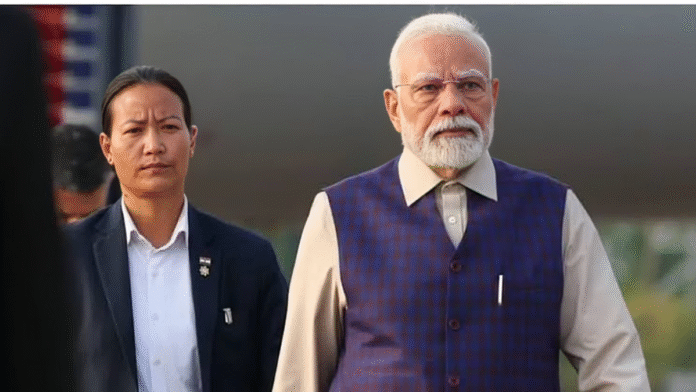
In the highlands of Manipur, where tradition meets quiet ambition, a young girl once watched border patrols through fog-laced mornings, dreaming not of princesses or podiums—but of purpose. That girl, Adaso Kapesa, would go on to guard one of the most powerful figures in the country, becoming India’s first female SPG bodyguard to the Prime Minister.
Roots of Resolve: The Girl from Kaibi
Born in Kaibi village, tucked within Senapati district, Adaso’s childhood was shaped by nature’s embrace and a deep sense of community. Her early days were far from the glitz of Delhi, yet her aspirations roared beneath her quiet demeanor. Discipline and service weren’t taught—they were lived.
Marching into the Forces: Her First Step Toward Legacy
Her journey into uniform began with the Sashastra Seema Bal (SSB), where she proved that leadership has no gender. Posted at the 55th Battalion in Pithoragarh, her sharpness in operations and deep focus quickly earned her respect—not as a woman in the force, but as a force herself.
Breaking Protocol: A Woman in the SPG
The Special Protection Group (SPG) demands elite precision. Entry is rare, retention rarer. Adaso rose through its rigorous training, its endless drills, and its mental tests with a calm so powerful it became her signature. She wasn’t just joining ranks—she was rewriting the rules. During PM Narendra Modi’s UK visit, her presence at his side made headlines, not for theatrics, but for her quiet composure. The nation saw a woman in black glasses and bulletproof gear—and saw strength without spectacle.
Power in Precision: What Made Her Different
What distinguished Adaso wasn’t just physical prowess. It was her emotional resilience, her quick reflexes, and her ability to stay poised when surrounded by chaos. In the SPG, strength isn’t just about muscle—it’s about mental clarity. And hers was crystalline.
Changing the Narrative: A Role Model in Action
Adaso’s story isn’t only hers. It’s for every girl in every remote village who’s told her dreams are too big, too bold. She didn’t ask for permission—she earned her place. And she became more than a bodyguard—she became a symbol of possibility.
Legacy in Motion: Not Just a Role, but a Message
Even today, as she quietly continues her duties, her presence speaks volumes. She’s become an unwritten chapter in India’s evolving story of women in uniform—living proof that duty, strength, and national service are not bound by gender.