

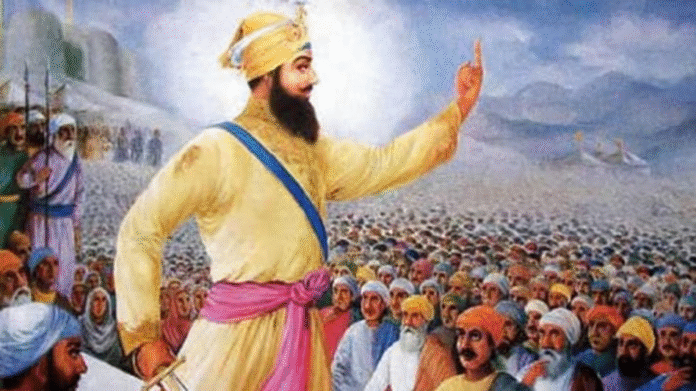
Guru Gobind Singh, the tenth Sikh Guru, stands as one of the most influential spiritual leaders, warriors, poets, and reformers in Indian history. Known for founding the Khalsa Panth, defending religious freedom, and finalising the Guru Granth Sahib, his life represents courage, sacrifice, and unwavering commitment to justice.
Early Life of Guru Gobind Singh
Guru Gobind Singh was born as Gobind Das (also known as Gobind Rai) in Patna, Bihar, to Mata Gujri and Guru Tegh Bahadur, the ninth Sikh Guru. His birth took place at a time of growing religious intolerance under Mughal rule.
In 1670, the family moved to Punjab and later, in 1672, settled near the Shivalik range in the Himalayan foothills. This region would later shape Guru Gobind Singh’s education, spirituality, and martial training.
Martyrdom of Guru Tegh Bahadur
A defining moment in Guru Gobind Singh’s early life was the martyrdom of his father. Guru Tegh Bahadur was approached by Kashmiri Pandits, who sought protection against forced religious conversions under the Mughal emperor Aurangzeb.
Despite warnings that his life was in danger, Guru Tegh Bahadur stood firm for religious freedom. He was publicly beheaded in Delhi on Aurangzeb’s orders, becoming a symbol of sacrifice for human rights and faith.
Becoming the 10th Sikh Guru
After his father’s martyrdom, Gobind Rai became Guru Gobind Singh on March 29, 1676, at the age of just nine—making him a remarkable child prodigy in Sikh history.
His education continued extensively:
- Mastery of reading and writing
- Training in martial arts
- Expertise in archery and horse riding
- Knowledge of philosophy, poetry, and warfare
Foundation of the Khalsa (1699)
One of the most transformative events in Sikh history occurred in 1699, during the festival of Vaisakhi.
Guru Gobind Singh called upon Sikhs to gather and founded the Khalsa Panth—a disciplined, egalitarian community of saint-soldiers.
Creation of the Khalsa
- He initiated five devoted Sikhs, known as the Panj Pyare
- He then asked to be baptised by them, becoming the sixth Khalsa
- He gave all Khalsa members the surname “Singh” (Lion)
From that moment, Gobind Rai became Guru Gobind Singh, symbolising equality, courage, and unity.
The Five Ks of Sikhism
Guru Gobind Singh established the Five Ks, central to Sikh identity:
- Kesh – Uncut hair (spiritual strength)
- Kangha – Wooden comb (cleanliness and discipline)
- Kara – Steel bracelet (self-restraint and unity with God)
- Kacchera – Soldier’s shorts (readiness and moral control)
- Kirpan – Sword (defense of righteousness)
Dharma Yudh: His Philosophy of War
Guru Gobind Singh believed in “Dharma Yudh”—a righteous war fought only as a last resort to defend justice and faith.
Despite leading around 13 battles, he:
- Never attacked places of worship
- Never took hostages
- Never fought for political power
- Fought solely against tyranny and oppression
Major Battles of Guru Gobind Singh (Timeline)
1688 – Battle of Bhangani
His first major battle, fought bravely against hostile hill rulers.
1691 – Battle of Nadaun
A significant battle against Mughal-supported Islamic forces.
1702 – Resistance Against Aurangzeb
Guru Gobind Singh confronted the tyranny of the Mughal Empire.
1705 – Final Battles
He fought his last major battles against Mughal forces, showcasing unmatched resilience.
Supreme Sacrifice of His Family
One of the most heart-wrenching aspects of Guru Gobind Singh’s life is that all four of his sons (Sahibzadas) were martyred:
- Two were killed in battle
- Two were executed alive by the Mughals
Despite this unimaginable loss, Guru Gobind Singh remained steadfast in faith and duty.
Assassination and Martyrdom (1708)
Guru Gobind Singh was assassinated in 1708, but before his death, he made a historic declaration:
- Guru Granth Sahib would be the eternal Guru of the Sikhs
- No human Guru would succeed him
This decision permanently shaped Sikhism.
Why Guru Gobind Singh Is Loved and Revered
A True Leader
He never sought power or wealth. He even placed himself below his own initiated followers, merging his identity with the Khalsa.
A Master Warrior and Artist
- Expert in weaponry and archery
- Legends speak of him stopping a rampaging elephant with a javelin
- A gifted poet and philosopher
A Multilingual Scholar
He mastered Hindi, Sanskrit, Urdu, Persian, Gurmukhi, and Braj.
Contributor to Arts and Music
He invented musical instruments like Taus and Dilruba, reflecting his love for art and culture.
Legacy of Guru Gobind Singh
Guru Gobind Singh’s legacy lives on through:
- The Khalsa Panth
- The Five Ks
- The eternal authority of the Guru Granth Sahib
- His message of equality, courage, and resistance against injustice
Conclusion
Guru Gobind Singh was not only a religious leader but a visionary reformer, fearless warrior, poet, and humanitarian. His life teaches that standing for truth may demand sacrifice—but righteousness must never be abandoned.