

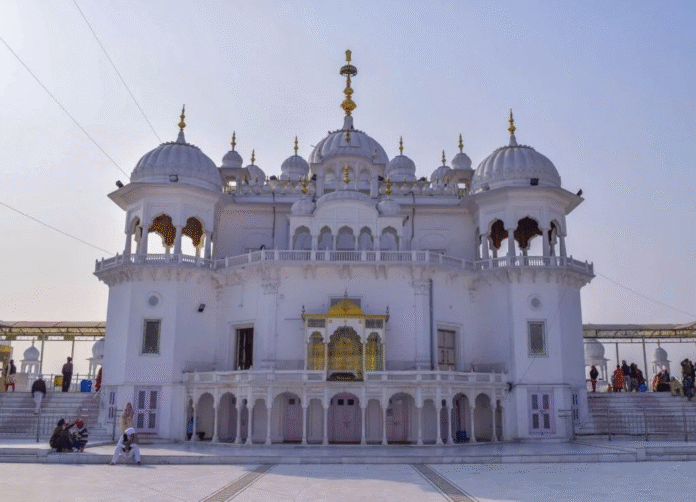
Anandpur Sahib—often referred to simply as Anandpur, meaning “City of Bliss”—is one of the most sacred places in Sikhism. Located on the edge of the Shivalik Hills near the Sutlej River, it holds immense religious, cultural, and historical significance. It is the city where the ninth Guru, Guru Tegh Bahadur, lived and where Guru Gobind Singh spent many years. Most notably, it is the birthplace of the Khalsa Panth, founded here during Vaisakhi in 1699.
The city is also home to Takht Sri Kesgarh Sahib, one of the five Sikh Takhts, making it a major pilgrimage centre. Every spring, it hosts Hola Mohalla, one of the largest Sikh festivals, drawing devotees from around the world.
Location
Anandpur Sahib lies on National Highway 503, connecting Kiratpur Sahib and Chandigarh to Nangal, Una, and Kangra (Himachal Pradesh). The city sits close to the Sutlej—the longest of Punjab’s five rivers.
A rare 19th-century photograph titled “The Sikh Town of Anundpore, Punjaub” by Francis Frith captures its early landscape.
History
Foundation
Anandpur Sahib was founded in June 1665 by Guru Tegh Bahadur, who established a settlement called Chakk Nanaki, named after his mother, Mata Nanaki. It evolved into a dharamshal—a spiritual retreat with tented encampments, clay hutments (known as bungas), orchards, gardens, and a gurgling stream near the present-day Gurdwara Bhora Sahib.

In 1675, Guru Tegh Bahadur was executed in Delhi by the Mughal emperor Aurangzeb for refusing to convert to Islam. Following his martyrdom, the Sikh community renamed the town Anandpur, and his son Gobind Rai—later Guru Gobind Singh—became the tenth Guru.
With growing Sikh numbers near the Guru’s residence, Anandpur expanded quickly, drawing attention from surrounding hill chiefs and the Mughal administration.
Birth of the Khalsa (1699)
On Vaisakhi day in 1699, Guru Gobind Singh summoned Sikh congregations from across the region and founded the Khalsa Panth. This moment transformed the Sikh community into a unified martial order. The event triggered hostility from Mughal forces and local hill rulers, leading to multiple battles.
Major Battles
- First Battle of Anandpur (1700)
The Mughal army, led by Painda Khan and Dina Beg, attacked with 10,000 soldiers. Guru Gobind Singh killed Painda Khan in direct combat, causing the Mughal army to retreat. - Second Battle of Anandpur (1704)
Mughal generals Saiyad Khan and Ramzan Khan failed to subdue the Sikhs. Aurangzeb then sent Wazir Khan and Zaberdast Khan. A prolonged siege from May to December 1704 cut off supplies, leading many Sikhs to desert. Some later returned and died fighting alongside the Guru in 1705.
A promise of safe passage was deceitfully broken. During the escape, the Guru’s two younger sons—Zorawar Singh (8) and Fateh Singh (5)—along with their grandmother Mata Gujari, were captured. The children were executed by entombment, and Mata Gujari passed away shortly after.
After Anandpur fell, the city changed hands multiple times—eventually coming under Patiala State and later being settled by the Sodhi families, leading to the formation of four sarkars (estates).
Modern Developments
Urban Transformation and Virasat-e-Khalsa
The Virasat-e-Khalsa Museum, designed by Israeli architect Moshe Safdie and commissioned in 1999, has become a major landmark, drawing global attention and tourism. Its creation reflects Anandpur’s shift toward large-scale commemorative architecture.
Heritage Conservation
Many original 17th- and 18th-century structures have been lost due to neglect, urbanisation, and repeated reconstruction. Historical forts, such as Anandgarh Qila, have been demolished or drastically remodelled, often encased in marble.
Key observations:
- Vernacular hutments (bungas) and natural landscapes associated with the Gurus have largely disappeared.
- The original Chak Nanaki and Akal Bunga structures were lost during the era of Maharaja Ranjit Singh.
- By the 20th century, nearly all major shrines had been rebuilt, especially during the Singh Sabha movement.
- Modern Kar Sewa drives have replaced many heritage features—including natural springs, stone steps, and ancient masonry.
- As of 2025, only a small section of 19th-century Nanakshahi brick survives, preserved behind glass in Quila Anandgarh Sahib.
Anandpur today is a thriving pilgrimage city but has minimal physical heritage from the Guru period.
Landmarks
Anandpur’s distinct urban identity is shaped by:
- The monumental centre around Takht Kesgarh Sahib
- Five historical forts (mostly reconstructed)
- The Khalsa Heritage Museum
- Dense overlapping residential and commercial clusters
- A cityscape where building heights peak near the sacred centre
Gurdwaras
Anandpur is rich in Sikh shrines, many tied to the lives of Guru Tegh Bahadur, Guru Gobind Singh, and key historical events. Though their forms have changed over time, they remain vital sites of devotion and collective memory.