

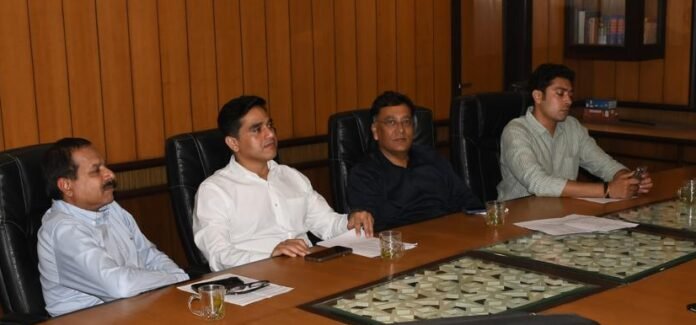
At a time when the Trump Tariff is being widely debated across the world, office bearers of FORHEX in Jaipur have termed it a “big shocker” and described it as a deliberate attempt to derail India’s dream of becoming a larger economy. While they accepted that they stand strong and will find newer markets being in New India, they also requested to handhold them in this crisis time to ensure they continue going ahead with workforce and work to explore new markets.
Sunit Jain, CEO Ratan Textiles and President Forhex called the tariff a “double-edged sword,” saying, “It’s not only going to hurt us but will also bleed American consumers. Once tariffs kick in, the cost of living in the U.S. will rise sharply, triggering backlash. The market players hence will also run for new markets triggerting competition. Eventually, many of us cannot handle this crisis alone — we need government handholding to protect employment and stability.”
Urging the government for immediate handholding, the officials said they are not sitting idle and have already started exploring newer markets. However, they cautioned that such an exercise will take time and requested the introduction of more business-friendly policies to help the export community survive this difficult period.
Ravi Utmani –CEO Laxmi Ideal , Secretary FORHEX , added, “It’s shocking and unjustified that India has been put under 50% tariff just because we are buying oil from Russia. China and Europe are doing the same, yet their tariffs are far lower. There is no logical reason; this looks political. It seems like an attempt to kill our ambition of becoming a major economy. We have already lost 52% share in isometrics, and finding new markets is not easy. Around 500,000 people may lose jobs. We need government assistance to help exporters survive.”
Atul Poddar, Founder, Partner Poddar Associates who is VP, Forhex, said, “First of all, it was shocking — we were not prepared for it. It is not justified. Earlier, 10% tariff was manageable, but 25% came as a shocker, and now another 25% makes it a double shocker. We are trying to figure out strategically how to survive in this scenario. Orders will not flow, and that is a dangerous condition unless the government gives full support. A tariff of 15–20% would be more reasonable.
We have learnt a lesson. Dont put all eggs in one basket. Now we will put eggs in different baskets in latin america, uk, gulf countries and so on, he concluded.
Rajat Mathur from Credence International also said that it is a par of geopolitics which has been deliberated on India. However, what we need is to stand strong intact to battle this crisis.
Karan Meel, Partner, Hasthkala: Forhex Young Brigade echoed similar concerns: “This looks more like a political tactic than economic logic. With 50% of exports impacted, nearly 1 million workers will suffer. It satisfies someone’s ego, but we need survival support from the government.”
Despite the challenges, exporters emphasized resilience. Poddar said, “This is a lesson for us — we will not put all eggs in one basket again. We must diversify into Europe, the UK, Japan, Australia, and the Gulf. Enhancing productivity and designing market-specific products is the way forward.”
Sunit also stressed, “Rhetoric aside, business runs on facts. We will rise to the occasion, explore new markets, and prove our strength through quality products. But this transition needs time. Right now, there is panic, but we must think strategically. The U.S. wants a bigger share of India’s market, but why shouldn’t we expand in our own domestic market as well?”
Ravi concluded, “It’s good to stay positive and see this as an opportunity. Latin America and other regions may open up, though economies of scale and ease of doing business differ. The ‘Make in India’ initiative has given us growth, but exporters with heavy loans need urgent relief. This could be a blessing in disguise in the long run, but survival in the short term requires government support. Innovation, cost easing, and compassionate policies are critical now.”
Exporters have already sent representations to the Rajasthan government seeking intervention. With September approaching, they warn that without immediate measures, the industry could face a severe crisis.