

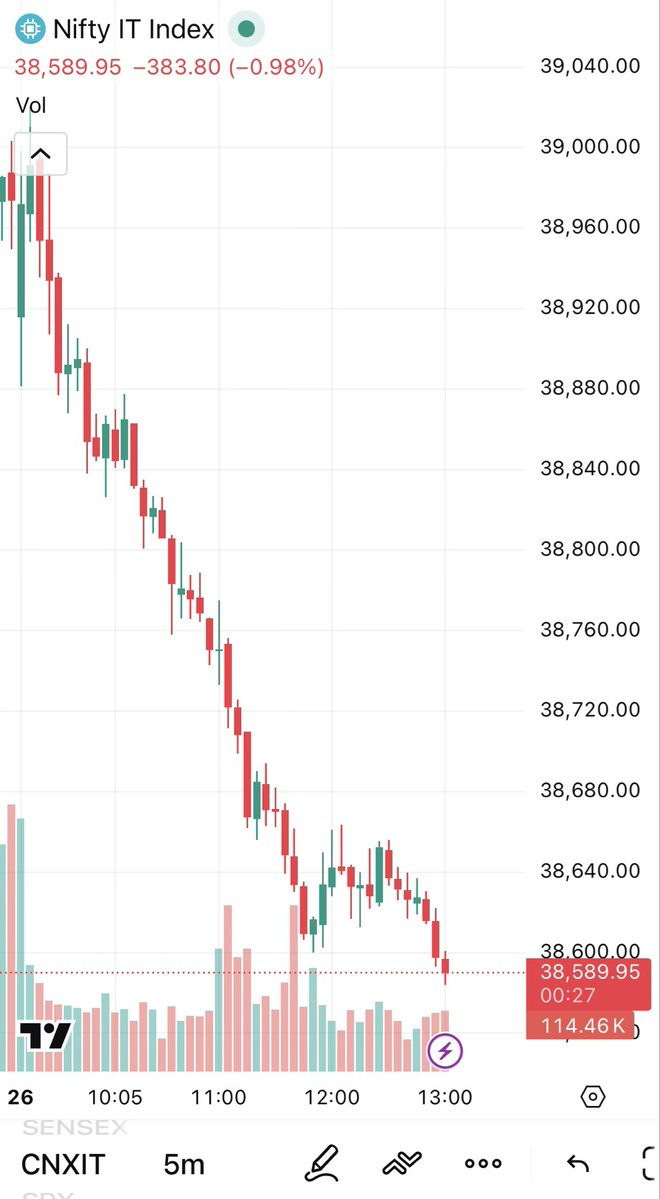
Tech Sector Outlook: How Nifty IT Moves in Sync With Nifty 50 Today
Over the past few decades, India’s IT sector has evolved from a back-office service provider to a major force in global innovation. Leading technology businesses are tracked by the Nifty IT index, while the Nifty 50 represents the market as a whole across a number of industries. Fascinating insights about market dynamics and sector-specific issues can be gained by observing how these indices move together or apart. The trading patterns between these benchmarks today provide interesting insights on global trends, economic factors, and investor psychology. Let’s look at key elements that explain their coordinated motions.
- Global Cues Impact Technology Stocks Disproportionately
Technology businesses are sensitive to events abroad since they rely heavily on foreign markets, especially those in the United States and Europe. Nifty IT frequently beats Nifty 50 when international markets surge on good economic news because investors expect higher demand for Indian tech services. On the other hand, IT equities are more instantly impacted than domestic-focused businesses by recession concerns or slowdown signals from outside. Because of this worldwide connection, Nifty IT occasionally leads or lags Nifty 50 depending on overnight changes in the world market rather than just domestic emotion influencing today’s trading.
- Currency Fluctuations Create Unique Price Dynamics
Since most sales are priced in dollars and expenditures are still based in rupees, the rupee-dollar exchange rate has a significant impact on the earnings of IT companies. IT firms profit from currency translation gains when the rupee declines, which frequently raises Nifty IT even if Nifty 50 stays muted. As a result, during times of currency volatility, technology equities exhibit intriguing divergences. Nonetheless, both indices typically move in unison during stable currency periods as overall market sentiment overrides sector-specific characteristics, indicating a shared level of investor confidence or caution.
- Heavyweight Stocks Bridge Both Indices Together
There is a natural association between the movements of the Nifty 50 and Nifty IT indices due to the strong presence of several large technology companies. Due to their high weighting in computations, these IT giants have a simultaneous impact on both benchmarks when their prices fluctuate significantly. Leading IT companies’ strong results dominate Nifty IT movements and significantly raise the Nifty 50. Because of this structural commonality, total divergence between indexes is uncommon because significant technology stocks serve as the threads that bind the two benchmarks together through their shared constituent influence.
- Domestic Economic Indicators Affect Synchronization Levels
The link between Nifty IT and Nifty 50 is strengthened when strong domestic economic data is released because investor optimism extends universally across sectors. Regardless of sector-specific realities, overall market sentiment is raised by budget announcements, GDP growth statistics, or policy initiatives. Despite their worldwide focus, technology stocks take part in larger rallies during these times. However, divergences arise as IT stocks pursue their own trajectory irrespective of the overall direction of the market when domestic variables notably favor or challenge some sectors while leaving others unscathed.
- Risk Appetite Determines Sector Rotation Patterns
Within the Nifty 50 mix, technology firms are generally more volatile than conservative industries like pharmaceuticals or consumer staples. Nifty IT surpasses Nifty 50 during risk-on periods when investors actively pursue growth because capital flows disproportionately into high-beta IT firms. On the other hand, Nifty IT underperforms the overall index when investors shift from risky technology equities to safer options amid market corrections or uncertainty. Based solely on the existing risk emotion, these rotation dynamics produce times of strong correlation that alternate with phases of divergence.
Conclusion
Global effects, currency fluctuations, structural overlaps, domestic considerations, and investor risk preferences all play a complex role in the relationship between Nifty IT and Nifty 50 today. Sector-specific drivers can produce significant divergences, even if they frequently move together because of common elements and general market mood. In order to make superior portfolio positioning decisions, astute investors monitor both indices to see if technology stocks are driving market trends or reacting to certain sectoral pressures.