

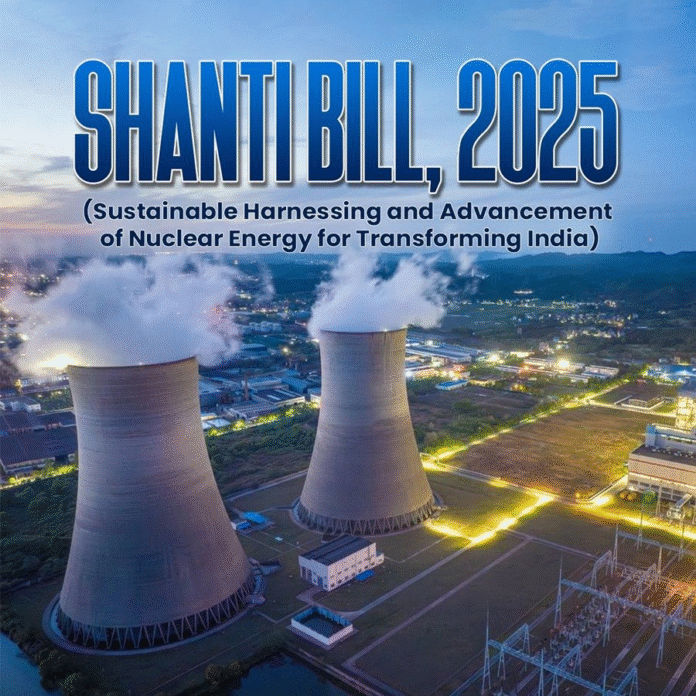
India’s nuclear power programme has long carried the weight of unrealised potential. Despite early technological ambition, legal complexity, liability fears and regulatory uncertainty kept private capital and global partners at arm’s length. Parliament’s passage of the “Sustainable Harnessing and Advancement of Nuclear Energy for Transforming India (SHANTI) Bill” marks an attempt to correct that trajectory. The legislation seeks not merely to amend but to reset India’s nuclear architecture, with the stated ambition of making nuclear energy a core pillar of clean, reliable power — targeting 100 GW by 2047 as part of India’s long-term decarbonisation strategy.
Why India Needed a Nuclear Reset
For over a decade, India’s civil nuclear programme has been constrained by a fragmented legal framework. The Atomic Energy Act and the Civil Liability for Nuclear Damage Act together created uncertainty over who could build, who would regulate, and who would pay if something went wrong.
The liability law, shaped by the moral memory of the Bhopal gas tragedy, placed unusually expansive responsibility on suppliers. While ethically compelling, this made India an outlier in global nuclear commerce, deterring investment and freezing projects. SHANTI replaces this patchwork with a single umbrella law designed to align India with international practice without abandoning sovereign control.
Who Can Build — And Who Cannot
SHANTI is pragmatic about expanding capacity. It explicitly allows participation by both public and private Indian entities, recognising that scaling nuclear power requires capital, manufacturing depth and execution capacity beyond the state alone.
However, the opening is carefully bounded. Foreign-incorporated companies are excluded as licensees, preserving sovereign control. The most sensitive elements of the nuclear fuel cycle — enrichment, reprocessing and spent fuel management — remain the exclusive domain of the central government. This calibrated openness reflects a strategic instinct: invite investment and capability where it helps, but retain control where national security demands it.
Fixing the Institutional Architecture
A major structural reform lies in clearer institutional separation. Licensing authority remains with the government, but safety oversight is vested in a strengthened Atomic Energy Regulatory Board, now placed on a firmer statutory footing.
This matters. A credible nuclear expansion requires a regulator that can independently set standards from design to decommissioning, inspect emergency preparedness, and engage transparently with the public. Whether SHANTI succeeds will depend less on legislative intent and more on regulatory capacity — more inspectors, faster rule-making, and the confidence to enforce compliance without fear or favour.
Liability: From Moral Exceptionalism to Predictability
Liability has always been the most politically sensitive aspect of nuclear policy. The 2010 law prioritised victim protection but created uncertainty that scared away suppliers and insurers. SHANTI rebalances the framework toward global norms while retaining safeguards.
The overall liability cap remains at 300 million Special Drawing Rights (SDR). The operator’s right of recourse is narrowed largely to contractual terms or cases of intentional wrongdoing. A new Nuclear Liability Fund shifts part of the burden beyond the operator’s cap to the central government, with additional support envisaged through the Convention on Supplementary Compensation (CSC) if claims exceed that level.
Terrorism as a Sovereign Risk
One of the Bill’s most consequential shifts is its treatment of terrorism. Nuclear damage caused by terrorist acts is explicitly excluded from operator liability and placed on the central government.
The policy logic is clear: terrorism is an uninsurable sovereign risk, and victims should not be left uncompensated because liability frameworks collapse. The political implication is equally clear — if the state assumes last-resort liability, it must also be the visible guarantor of rigorous security, preparedness and accountability.
Graded Liability and the Fear of Dilution
SHANTI moves away from a single uniform operator cap and instead grades liability by category of installation. Not all nuclear facilities pose the same risk, and mature nuclear systems do differentiate accordingly.