

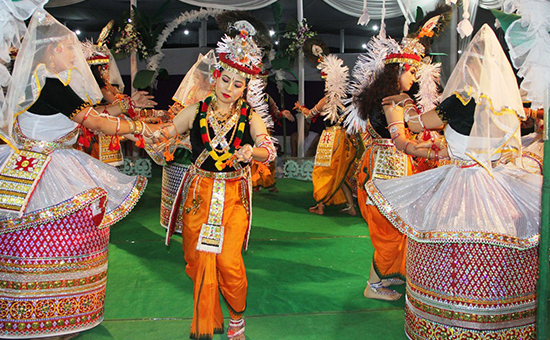
Jagoi Raas, the distinctive form of Manipuri Raas Lila, has once again drawn attention for its rare blend of devotion, discipline, and cultural continuity. A classical dance-drama rooted in the Radha-Krishna tradition, Jagoi Raas stands apart for preserving deep links with Manipur’s indigenous folk rituals and martial heritage, even as it evolves on contemporary stages. More than a performance, it remains a living expression of spiritual love and Manipuri identity.
Among India’s eight classical dance forms, Manipuri Raas Lila stands apart—not for spectacle or virtuosity alone, but for its quiet spiritual power. Rooted in devotion and community memory, this dance form is less a performance and more a living prayer, where movement becomes meditation and rhythm becomes remembrance.
Manipuri Raas Lila is a dance-drama that enacts the divine love of Radha and Krishna, drawing inspiration from the Vaishnavite Bhakti tradition that took deep root in Manipur in the 18th century. Yet, unlike other classical forms that evolved largely within courtly or temple frameworks, Raas Lila—also known as Jagoi Raas—has never severed its ties with indigenous traditions. Its aesthetic and spirit remain deeply intertwined with Lai Haraoba, the ancient folk ritual celebrating local deities and the creation of the universe.
This fusion of the classical and the indigenous gives Manipuri Raas Lila its distinctive character. Performed as a collective ensemble, the dance follows strict conventions of costume, movement, and spatial design. The iconic cylindrical skirts of the female dancers, the translucent veils, and the soft footwork create an illusion of floating grace. Every gesture is restrained, every movement inward-looking, reflecting the Manipuri worldview where devotion is expressed through subtlety rather than spectacle.
While the dance draws heavily on Abhinaya as described in the Natya Sastra, its vocabulary is uniquely enriched by Manipur’s ethnic martial arts culture. The rounded torso movements, controlled spins, and poised stances echo the discipline of traditional martial practices, lending the dance a quiet strength beneath its lyrical softness. This synthesis of grace and vigour mirrors the cultural fabric of Manipur itself—resilient, layered, and deeply rooted.
Over time, Manipuri Raas Lila has undergone a significant transformation. What began as a sacred ritual within temple spaces gradually found its way onto secular and commercial proscenium stages. This transition did more than widen its audience; it redefined the dance as a marker of cultural identity. Even outside its ritual setting, Raas Lila continues to carry the spiritual and philosophical ethos of Manipur, preserving its uniqueness amid changing times.
Today, Manipuri Raas Lila stands as a testament to how tradition can evolve without losing its soul—a dance form that continues to speak, softly yet profoundly, of love, devotion, and belonging.