

A World Before the Click
Today, photography is everywhere. A swipe, a tap, a filter — and suddenly, a moment is immortalized. From selfies to sunsets, it’s a daily ritual, a creative outlet, a favorite pastime. But rewind a century, and photography was anything but casual. It was a craft wrapped in complexity, a pursuit reserved for the privileged few — and almost exclusively men.
Imagine a time when cameras were bulky contraptions, film had to be developed in darkrooms, and society frowned upon women stepping beyond the domestic threshold. In that world, one woman dared to lift the lens and point it toward history. Her name was Annapurna Dutta, and she didn’t just take photographs — she shattered norms.
Who Was Annapurna Dutta?
Born in 1894 in undivided Bengal, Annapurna Dutta grew up in a society where women were expected to remain behind the purdah, confined to domestic life. At just 12 years old, she was married to Upendranath Dutta, a lawyer and amateur photographer. It was through him that she first encountered the magic of the camera — not as a passive observer, but as a curious learner. By the age of 25, Annapurna had mastered the art of photography and turned it into her profession. But unlike her male counterparts who operated studios, she didn’t own one. Instead, she traveled to the homes of affluent families, often photographing women who lived in seclusion. Her subjects were captured in their natural domestic environments — surrounded by loved ones, heirlooms, and tradition.
She developed and printed the photographs herself, often working late into the night. Her lens didn’t discriminate — she photographed Hindu and Muslim elites, including notable figures like Hassan Suhrawardy, Jasimuddin, and Abbas Uddin Ahmed.
The title : Photographer Mashima
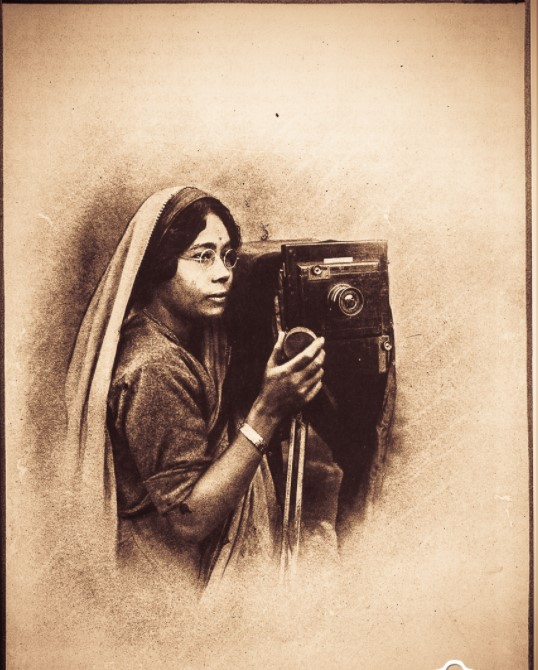
In an era when women were rarely seen in professional spaces, Annapurna became known as “Photographer Mashima” — a respectful title that blended familial warmth with professional admiration. Her work was more than portraiture; it was a quiet rebellion. She gained access to spaces where even male photographers were denied entry, photographing women in purdah with grace and sensitivity.
Her most iconic image? A self-portrait, standing beside her plate camera, dressed in traditional attire, holding the lens cap — a symbol of her dual identity as a homemaker and a pioneer.
The Landscape of Female Photographers Today
Fast forward to the present, and the scene has transformed. Women photographers are now celebrated across genres — from fashion and wildlife to war journalism and documentary. Names like Homai Vyarawalla, Dayanita Singh, and Rathika Ramasamy have carved their own legacies. Yet, challenges remain. Gender bias, safety concerns, and unequal opportunities still shadow the industry. But thanks to trailblazers like Annapurna, the path is clearer, the lens more inclusive.
Annapurna Dutta didn’t just take photographs — she captured courage. Her story is a reminder that creativity often blooms in resistance. In a time when photography was a male-dominated fortress, she built her own doorway — not with bricks, but with light, shadow, and vision. So the next time you snap a photo, remember: behind that simple click lies a century of struggle, artistry, and the quiet defiance of a woman who saw the world differently — and dared to show it.