

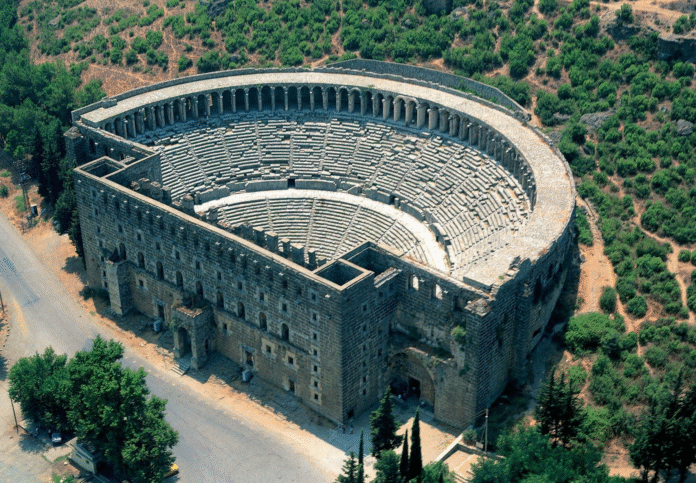
Aspendos: “This is unlike anything I have ever seen before.” With these words in 1909, British archaeologist David George Hogarth described the Aspendos Theatre—adding: “You may have seen amphitheatres in Italy, France, Dalmatia and Africa; temples in Egypt and Greece; palaces in Crete. You may be sated with antiquity, or scornful of it. But you have not seen the theatre of Aspendos.”
More than a century later, Hogarth’s impression remains accurate. Aspendos houses the best-preserved ancient theatre in the world—an architectural masterpiece reflecting traces of Roman ambition and later Seljuk intervention. Built during the reign of Emperor Marcus Aurelius between 160 and 180 A.D., the theatre bears an inscription crediting its architect Zenon, son of Theodorus, and naming its benefactors: the wealthy brothers A. Curtius Crispinus Arruntianus and A. Curtius Crispinus.
Like many theatres in Asia Minor, the lower part of the cavea (audience seating) is carved directly into the eastern slope of the acropolis, while the upper section sits atop a system of stone arches and vaults. The theatre is monumental in scale, with a façade approximately 100 meters wide and 22 meters high. Its exceptional state of preservation and elaborate architectural detailing distinguish it from all others. Recent studies estimate the theatre’s capacity at 7,300–7,600 spectators—assuming 45 cm of seating width per person—though in crowded events this may have reached up to 8,500.
The cavea is divided by a diazoma (horizontal walkway), with 20 seating rows below and 21 above. Two vaulted parodoi serve as the main entrances to the lower cavea, while multiple gates along the exterior wall provided additional access routes. A rare covered gallery encircles the cavea, offering shade and shelter—making it the best-preserved example of its kind in Asia Minor and beyond.
The two-storied stage building (scaenae frons) still rises to its full height. Five doors opened onto the stage, the largest at centre and framed by progressively smaller doors. The richly decorated façade featured monolithic columns, carved friezes, garlands hanging from bucrania, tendril motifs, cornices, and pediments. Though many projecting architectural elements are lost, what survives offers a remarkable sense of its original splendour. The theatre’s design demonstrates sophisticated acoustic engineering and may once have been topped with a wooden roof.
The theatre owes much of its preservation to 13th-century Seljuk reuse under Sultan Alaeddin Keykubat, when it briefly served as a palace. Traces of this period survive in red zigzag wall paintings and modifications to windows and internal access routes.
While most visitors know Aspendos for its theatre, the city’s aqueducts—with two exceptionally preserved siphons—are equally significant. Carrying water from mountain sources 15–19 km away at an elevation of roughly 500 meters, the system sustained both the city and the fertile Pamphylian plain. Epigraphic evidence suggests it was built in the 2nd century A.D. by Tiberius Claudius Italicus at a cost of 2 million denarii. The inverted siphons, each around 30 meters high, enabled water to cross a 1.7 km-wide valley. Their stone channels measure 55–60 cm wide and 90 cm high. Rising at a 55-degree incline, the channels span the valley via arches 5.5 meters apart and up to 15 meters high—making this one of the tallest Roman hydraulic constructions still preserved.
Aspendos’ aqueducts can be compared to the Pont du Gard in France and the aqueducts of Segovia in Spain—both UNESCO-listed—yet Aspendos surpasses them in length and uniquely preserves two hydraulic siphons. Although siphons exist near Lyon (Mont d’Or, Brévenne, Gier), none provide such clarity regarding construction or function.
Outstanding Universal Value
Aspendos embodies exceptional cultural and technological achievement. The theatre is among the most complete Roman theatres globally, retaining its original form, decoration, and layered historical character—from Roman engineering mastery to Seljuk adaptation. The aqueducts stand as a rare and invaluable example of advanced hydraulic engineering, preserved to a degree that continues to inform modern research.
Criteria Justification
Criterion (i):
Both the theatre and aqueducts represent exceptional craftsmanship, technological innovation and intellectual accomplishment.
Criterion (ii):
Aspendos illustrates cultural continuity and adaptation—from Roman construction to Seljuk reuse—providing a rare dialogue between civilizations.
Criterion (iv):
Aspendos offers a unique opportunity to study an exceptionally intact Roman theatre with visible architectural phases, including its transformation into a medieval palace.
Authenticity and Protection
The site is protected under Turkish Law No. 2863 for the protection of cultural and natural heritage. It has been registered since 8 September 1994 as a 1st-degree archaeological and 3rd-degree natural site.
Comparative Analysis
Only two comparable Roman theatres survive: the Theatre of Orange (France) and Aspendos—of which Aspendos retains the greatest amount of original material and presents multiple historical layers, including Seljuk modifications and reused earlier architectural fragments.
Likewise, the aqueducts stand apart from other major Roman hydraulic structures due to their preserved siphons, construction materials—including brick, an unusual choice for Asia Minor—and overall scale.