

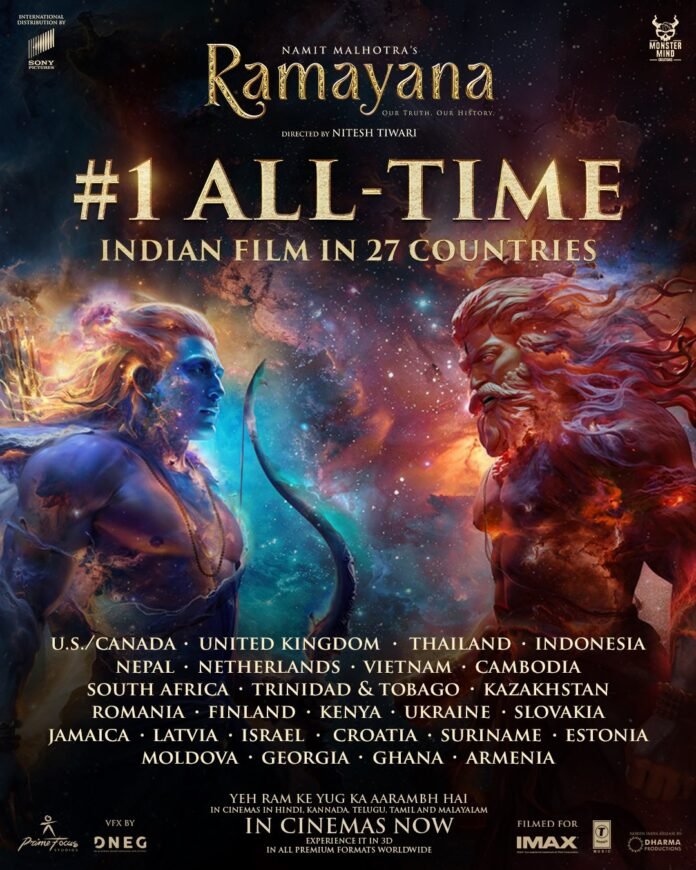
Directed by Nitesh Tiwari, the mythological epic starring Ranbir Kapoor, Sai Pallavi and Yash has emerged as one of the biggest cinematic successes of 2026, while its visual effects gain international attention and its interpretation of the Ramayana sparks debate.
Nitesh Tiwari’s ambitious mythological film Ramayana: Part 1 continues to make headlines with its remarkable box-office performance, international recognition and ongoing discussions surrounding its portrayal of the ancient Indian epic. Starring Ranbir Kapoor as Lord Rama, Sai Pallavi as Goddess Sita and Yash as Ravana, the film has collected approximately ₹1,755.60 crore worldwide within 21 days of its theatrical release, making it one of the highest-grossing Indian films of all time.
Released on November 5, 2026, the film completed three weeks in theatres on November 25, recording an estimated India net collection of ₹982.55 crore and a worldwide gross of ₹1,755.60 crore, according to trade estimates. On its 21st day, the film earned approximately ₹9.60 crore net in India, registering a decline of around 45.1 per cent compared with the previous day’s collection. Despite the slowdown in its third week, the film has maintained a strong theatrical presence across Hindi, Tamil, Telugu, Kannada and Malayalam markets.
Its worldwide collection has also placed it ahead of several major Indian productions, strengthening its position among the country’s biggest cinematic successes. The film’s commercial performance reflects the scale of audience interest in the adaptation of one of India’s most celebrated epics.
The film’s technical achievements have also attracted international attention. Its visual effects team has reportedly secured a place among the top 20 contenders in the Best Visual Effects category at the 99th Academy Awards (Oscars 2027). This development has brought international recognition to India’s growing visual effects and filmmaking industry. However, being among the contenders does not mean the film has received an Oscar nomination; the final shortlist and nominations are yet to be announced.
Adding to the film’s recent achievements, Union Home Minister Amit Shah met director Nitesh Tiwari, producer Namit Malhotra and actors Ranbir Kapoor and Sai Pallavi in New Delhi on November 26. He congratulated the team for bringing the ideals of duty, sacrifice and integrity associated with Lord Rama to younger generations through modern filmmaking technology. The meeting highlighted the film’s growing cultural significance alongside its commercial success.
However, the film has also generated discussions and criticism over its interpretation of the Ramayana. The Hindu Janajagruti Samiti has reportedly filed a police complaint in Mumbai, alleging deviations from Maharishi Valmiki’s original narrative and objecting to certain character portrayals and scenes. Among its objections are the depiction of Ravana, the portrayal of Lord Rama and the representation of interactions between Sita and Lakshmana. The organisation has sought legal action and an investigation into the film’s screenplay and dialogues. These remain allegations raised by the organisation and have also sparked wider discussions about the creative freedom and cultural responsibilities involved in adapting revered religious and literary texts for contemporary cinema.
Meanwhile, audiences can expect the story to continue in the second instalment. Producer Namit Malhotra has indicated that Ramayana: Part 2 is scheduled for a theatrical release during Diwali 2028. The additional production time is expected to allow the team to work further on the film’s scale, storytelling and visual effects.
With its impressive worldwide collections, reported progress in the Oscars’ visual effects race and conversations surrounding its artistic interpretation, Ramayana: Part 1 has become one of the most talked-about Indian films of the year. Beyond its box-office achievements, the film represents an ambitious attempt to bring one of India’s most enduring epics to an international cinematic audience. As anticipation builds for its second instalment, its journey continues to highlight the growing scale, technological capabilities and global ambitions of Indian filmmaking.