

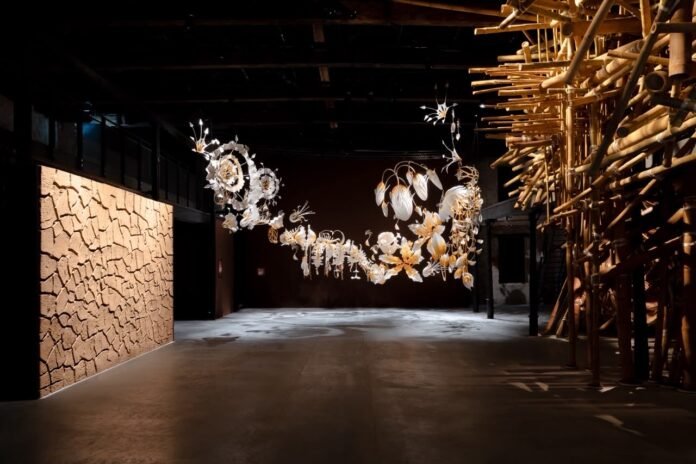
India’s return to the prestigious international art exhibition after seven years receives global recognition as its pavilion, ‘Geographies of Distance: Remembering Home’, wins the public-voted award for its exploration of memory, identity and belonging.
India has achieved a significant milestone in the international art world by winning the Visitors’ Lion for Best National Participation at the 61st International Art Exhibition of La Biennale di Venezia, popularly known as the Venice Art Biennale 2026. Announced on November 25, the recognition was awarded to India’s National Pavilion for its exhibition titled Geographies of Distance: Remembering Home, marking a remarkable achievement on the country’s return to one of the world’s most prestigious contemporary art platforms after a gap of seven years.
The award holds particular significance as it was decided through public voting, reflecting the appreciation and response of visitors from across the world. The Visitors’ Lions were introduced for the 2026 edition, with audiences voting for the Best Participant in the main exhibition and the Best National Participation among the national pavilions. Visitors who toured both the Giardini and Arsenale exhibition venues were eligible to participate in the voting.
According to the Ministry of Culture, approximately 4.5 lakh people visited the Indian Pavilion during the exhibition, making it one of the most visited national pavilions at this year’s Biennale.
Housed at the historic Arsenale in Venice, the Indian Pavilion presented an artistic exploration of the idea of home through memory, migration, identity, cultural roots and belonging. Curated by Dr Amin Jaffer, the exhibition brought together five contemporary Indian artists: Alwar Balasubramaniam, Ranjani Shettar, Sumakshi Singh, Skarma Sonam Tashi and Asim Waqif.
Through sculptures, installations and experimental use of materials, the artists presented different interpretations of how people remain connected to their homes, landscapes and cultural identities despite geographical distance and changing circumstances.
Each artist contributed a distinctive perspective to the exhibition. Alwar Balasubramaniam presented clay-based works exploring materiality and the relationship between human beings and their surroundings. Ranjani Shettar created an immersive suspended installation inspired by natural forms and organic growth, while Sumakshi Singh presented Permanent Address, a life-sized recreation of her demolished family home in New Delhi using intricate embroidered thread. Skarma Sonam Tashi’s papier-mâché installation drew inspiration from Ladakhi architecture and explored cultural continuity and ecological connections. Asim Waqif presented Chaal, a large-scale bamboo installation inspired by urban scaffolding, reflecting ideas of transition, renewal and transformation in contemporary cities.
The exhibition was commissioned by the National Gallery of Modern Art (NGMA) under the Ministry of Culture, Government of India, with the Indira Gandhi National Centre for the Arts (IGNCA) serving as the implementing agency. The presentation was organised in collaboration with the Nita Mukesh Ambani Cultural Centre (NMACC) and Serendipity Arts. Alongside the visual exhibition, Serendipity Arts also curated a performance programme featuring music, movement, storytelling and interdisciplinary presentations inspired by Indian cultural traditions.
The 2026 participation marked India’s return to the Venice Art Biennale after its previous pavilion in 2019. The achievement has been welcomed as an important moment for India’s contemporary art community and its growing cultural engagement with international audiences. Prime Minister Narendra Modi congratulated the artists and described the recognition as a proud moment for the country’s art and cultural world. Union Culture Minister Gajendra Singh Shekhawat also welcomed the achievement, highlighting the international appreciation of India’s artistic diversity and cultural influence.
The recognition is also significant for India’s broader cultural diplomacy, demonstrating how contemporary art can communicate the country’s diverse histories, traditions and evolving identities to a global audience. The pavilion’s success highlights the ability of Indian artists to bring together traditional materials, regional influences and contemporary artistic expressions while addressing themes that resonate across geographical and cultural boundaries.
Following this international recognition, the Ministry of Culture is set to organise The India Biennale in New Delhi from December 4, 2026, to March 21, 2027. With its principal venue at Purana Qila and programmes planned across several historic monuments and cultural spaces, the initiative aims to bring contemporary art into dialogue with India’s architectural and cultural heritage.
India’s Visitors’ Lion victory at Venice is more than an international award; it represents the growing visibility of Indian contemporary art and the ability of its artists to connect local experiences with universal human emotions. By exploring the meaning of home through memory, distance and belonging, Geographies of Distance: Remembering Home has presented an artistic narrative that transcends borders and places India’s creative expressions firmly on the global cultural map.