

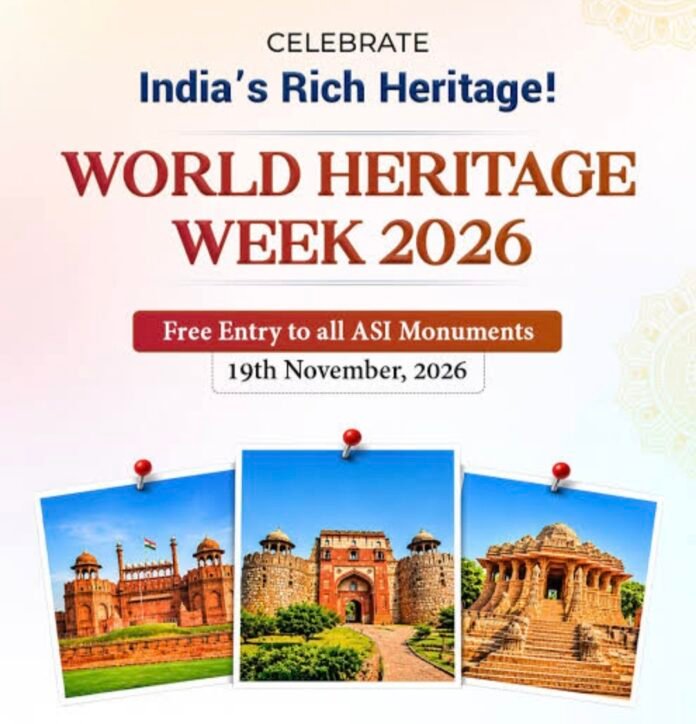
World Heritage Week is observed every year from November 19 to 25 to celebrate the rich historical, cultural and archaeological heritage of the world and spread awareness about the importance of its preservation. The week provides an opportunity to recognise the historical significance of monuments, ancient structures, archaeological sites, museums, traditions and cultural practices that connect present generations with the past. In India, the observance holds particular importance given the country’s extraordinary diversity of heritage, reflecting thousands of years of civilisation, art, architecture, literature, traditions and cultural achievements.
India is home to an extensive collection of historical monuments and archaeological sites that represent different periods of its history. From the ancient civilisation of the Indus Valley to the architectural achievements of the Mauryas, Guptas, Cholas, Mughals and Rajputs, every period has contributed to the country’s cultural landscape. Magnificent structures such as the Taj Mahal, Red Fort, Qutub Minar, Ajanta and Ellora Caves, Hampi and Konark Sun Temple reflect the artistic excellence, engineering knowledge and cultural influences of their respective eras. These monuments are not merely tourist attractions but valuable records of India’s social, political, religious and architectural history.
The Archaeological Survey of India (ASI), under the Ministry of Culture, plays a significant role in protecting and maintaining India’s archaeological heritage. Established in 1861, the organisation is responsible for archaeological research, conservation, preservation and maintenance of centrally protected monuments and sites across the country. Its work includes structural conservation, documentation, excavation and efforts to protect historical structures from environmental damage, urbanisation and other threats.
An important initiative marking the beginning of World Heritage Week 2026 in India is the decision by the ASI to provide free entry to all centrally protected monuments and archaeological sites on November 19. The waiver covers all 143 ticketed monuments and sites under the organisation, including popular destinations such as the Taj Mahal, Agra Fort, Fatehpur Sikri, Red Fort and Qutub Minar. The initiative aims to encourage more people, particularly students and young visitors, to explore India’s historical treasures and develop a deeper appreciation of the country’s heritage. The exemption is limited to November 19, with regular entry charges resuming from November 20. At the Taj Mahal, the separate charge of ₹200 for entering the main mausoleum continues to apply. The waiver does not extend to state-protected monuments, private museums or parks.
Throughout the week, various cultural institutions, museums and heritage organisations organise exhibitions, educational programmes, awareness campaigns, competitions and guided visits to encourage public participation in heritage conservation. These activities help students, researchers and visitors understand the historical importance of monuments and the need to protect them for future generations. Such initiatives also provide opportunities for people to engage with local history, traditional crafts, folk art and intangible cultural heritage.
India’s cultural heritage extends far beyond its monuments and archaeological structures. Traditional music, dance forms, festivals, languages, handicrafts, culinary practices, oral traditions and indigenous knowledge systems are equally important parts of its identity. Practices such as yoga, Kumbh Mela, traditional craftsmanship and classical dance forms reflect the continuity of cultural knowledge passed down through generations. Preserving these traditions is as important as maintaining physical monuments because they represent the living heritage of communities.
At the international level, UNESCO plays a major role in identifying and protecting sites of outstanding universal value through its World Heritage programme. The World Heritage Convention was adopted in 1972 to encourage international cooperation in safeguarding cultural and natural heritage. India has several sites recognised on the UNESCO World Heritage List, highlighting the global significance of its historical monuments, natural landscapes and cultural achievements.
However, heritage conservation faces several challenges, including pollution, climate change, uncontrolled tourism, encroachment, neglect and the gradual disappearance of traditional knowledge. Protecting historical sites requires continuous conservation efforts, responsible tourism, public awareness and cooperation between government institutions, local communities and citizens. Visitors also have an important responsibility to respect monuments, avoid littering, refrain from damaging structures and follow conservation guidelines.
World Heritage Week serves as a reminder that heritage is not simply a record of the past but an important foundation for understanding the present and shaping the future. Every monument, archaeological discovery, traditional art form and cultural practice carries stories of human achievement, creativity and collective memory. Preserving these treasures is a shared responsibility that ensures future generations can experience, understand and take pride in the legacy inherited from their ancestors.