

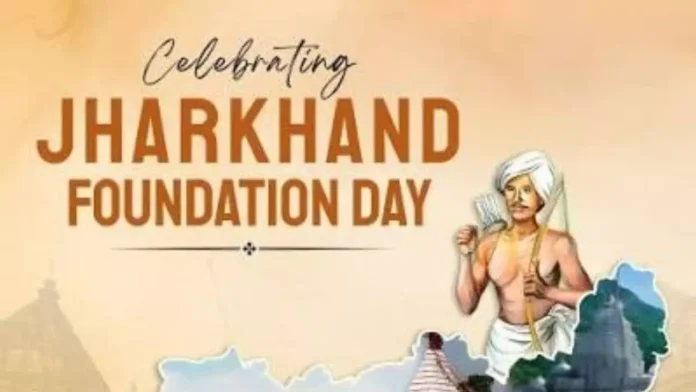
Every year, November 15 is celebrated as Jharkhand Foundation Day, marking the formation of the state of Jharkhand in eastern India. Known for its rich tribal heritage, dense forests, mineral resources and cultural diversity, Jharkhand holds a distinctive place in the country’s geographical, historical and cultural landscape. The day commemorates the long struggle for a separate state and recognises the identity, aspirations and contributions of the people of the region.
Jharkhand was officially formed on November 15, 2000, becoming the 28th state of India after being separated from Bihar under the Bihar Reorganisation Act, 2000. The date was deliberately chosen to coincide with the birth anniversary of Bhagwan Birsa Munda, the legendary tribal freedom fighter who fought against British rule and exploitation. His struggle for tribal rights, land and self-governance became an important source of inspiration for the movement demanding a separate state.
The demand for a separate Jharkhand had deep historical roots. For decades, tribal communities and regional leaders had sought greater political representation, control over local resources and protection of their cultural identity. The region had a distinct social and cultural character, with a large tribal population and a history of resistance against colonial exploitation. Leaders such as Jaipal Singh Munda, a prominent tribal leader and the first president of the Adivasi Mahasabha, played an important role in giving political direction to the demand. The movement gradually gained strength through public campaigns, organisations and sustained political efforts, eventually leading to the creation of the state in 2000.
Jharkhand, whose name broadly means ‘Land of Forests’, is known for its extensive forest cover, hills, waterfalls and mineral wealth. Ranchi serves as its capital, while Dumka is its sub-capital. The state is home to important rivers such as the Damodar, Subarnarekha and Barakar. Its natural attractions include Hundru Falls, Dassam Falls, Betla National Park and Netarhat, often known for its scenic landscapes and sunrise views.
The state is also one of India’s major mineral-producing regions, with significant reserves of coal, iron ore, copper, uranium, bauxite and mica. Its industrial landscape includes important centres such as Jamshedpur, Bokaro and Dhanbad. Jamshedpur is particularly known for its steel industry and the Tata Steel legacy, while Bokaro is an important industrial and steel-producing centre. Dhanbad, widely recognised as the coal capital of India, has played a major role in the country’s energy sector.
Jharkhand’s identity is closely connected with its diverse tribal communities, including the Santhals, Mundas, Oraons, Hos, Kharias and Birhors. These communities have distinct languages, customs, festivals, art forms and traditional knowledge systems. Sarhul, Karma and Sohrai are among the important festivals celebrated across the state. Folk dances such as Chhau and traditional music reflect the region’s cultural richness. Its handicrafts, tribal paintings, bamboo work and traditional textiles also represent a vibrant artistic heritage
Despite its natural and mineral wealth, Jharkhand continues to face challenges related to poverty, education, healthcare, infrastructure and sustainable development. Ensuring that local communities benefit from the state’s resources while protecting forests, biodiversity and tribal rights remains an important priority. Balanced development, better opportunities for young people and the preservation of indigenous traditions are essential to its future progress.
Jharkhand Foundation Day is therefore more than a celebration of the state’s formation. It is an occasion to remember the struggles of those who worked towards its creation, honour the legacy of tribal leaders such as Bhagwan Birsa Munda and celebrate the cultural identity of its people. As the state continues its journey of development, the day serves as a reminder of the importance of inclusive growth, social justice and preserving the rich heritage that makes Jharkhand unique.