

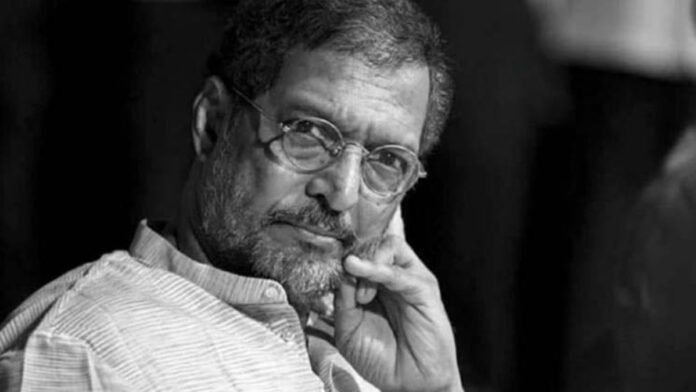
Indian cinema has lost one of its most distinctive performers. Veteran actor Nana Patekar died on October 8, 2026, at the age of 75, after suffering a cardiac arrest in Goa. He was taken to Manipal Hospital, where doctors attempted to revive him, but he could not be saved.
Born Vishwanath Patekar on January 1, 1951, in Murud-Janjira, Maharashtra, Nana Patekar built a career that spanned nearly five decades across Hindi and Marathi cinema. He was not an actor who depended on conventional Bollywood stardom. His powerful voice, expressive face, distinctive dialogue delivery and ability to inhabit complicated characters made him one of the most recognisable performers in Indian cinema.
From Theatre to the Big Screen
Patekar’s journey began with theatre before he moved into films. He made his Hindi film debut with Gaman in 1978, gradually gaining recognition through a series of intense supporting performances. Films such as Aaj Ki Awaz, Ankush, Pratighaat, Andha Yudh and Mohre established him as an actor capable of bringing considerable depth to difficult and unconventional roles.
His international visibility grew with Mira Nair’s Salaam Bombay! (1988), which received an Academy Award nomination for Best Foreign Language Film. The following year, Patekar delivered one of the defining performances of his career in Parinda, earning the National Film Award for Best Supporting Actor and a Filmfare Award.
The 1990s Made Him a Major Star
The 1990s proved to be a particularly important period in Patekar’s career. He appeared in films including Raju Ban Gaya Gentleman, Angaar, Tirangaa, Krantiveer, Agni Sakshi and Khamoshi: The Musical.
In Angaar, he won the Filmfare Award for Best Villain, demonstrating his ability to make even morally dark characters compelling. In Krantiveer (1994), he played Pratap Narayan Tilak, a disillusioned man who transforms into a revolutionary figure. The performance earned him the National Film Award for Best Actor as well as the Filmfare Award for Best Actor.
His performance in Agni Sakshi brought another National Film Award for Best Supporting Actor, further establishing his reputation as one of India’s most powerful dramatic actors.
A Career Beyond One Genre
Patekar never allowed himself to be confined to serious or intense cinema. His filmography moved across crime dramas, political films, action films, social dramas and comedy.
He received widespread acclaim for films such as Ab Tak Chhappan, where he portrayed a police officer, and Apaharan, for which he won another Filmfare Award for Best Villain. His performance in Raajneeti further demonstrated his ability to command complex political and dramatic roles.
But for an entirely different generation of viewers, Patekar became unforgettable as Uday Shetty in Welcome (2007). His comic timing, deadpan delivery and chemistry with the ensemble transformed the gangster character into one of Hindi cinema’s most memorable comic roles. He reprised the character in Welcome Back in 2015.
His Marathi Cinema Legacy
While Bollywood brought him nationwide recognition, Marathi cinema remained an important part of Patekar’s artistic identity.
His performance in Natsamrat (2016), in which he portrayed a retired stage actor confronting loneliness and the loss of his place in the world, received widespread acclaim. The film showcased the theatrical intensity that had been central to Patekar’s artistic journey.
He also worked as a filmmaker, writer and director. His directorial debut, Prahaar: The Final Attack (1991), reflected his long-standing interest in the armed forces. He subsequently developed a connection with the Territorial Army and was associated with the Maratha Light Infantry.
Awards and Recognition
Over a career spanning decades, Patekar received three National Film Awards and four Filmfare Awards, along with Maharashtra State and other regional honours. In 2013, he was awarded the Padma Shri by the Government of India for his contribution to cinema and the arts.
Yet his legacy was never defined solely by awards.
Patekar’s appeal came from an unmistakable authenticity. Whether playing a revolutionary, police officer, villain, politician, retired theatre actor or comic gangster, he brought an individuality that made his characters difficult to forget.
An Unmistakable Legacy
Nana Patekar belonged to a generation of performers who demonstrated that an actor did not need the conventional image of a Bollywood hero to become a star. His performances were often driven by voice, silence, expression and sheer emotional force.
From Parinda and Krantiveer to Ab Tak Chhappan, Raajneeti, Natsamrat and Welcome, his career crossed genres, languages and generations.
With his passing, Indian cinema loses an actor whose presence could transform a scene simply through the way he looked, spoke or paused.
Nana Patekar leaves behind more than a filmography. He leaves behind a collection of characters that audiences will continue to remember, quote and revisit, a legacy built not on glamour, but on craft, intensity and an unmistakable screen presence.