

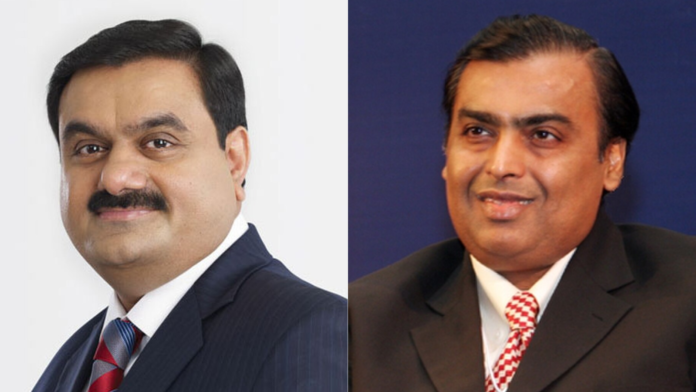
Gautam Adani and his family have reclaimed the position of India’s richest, overtaking Mukesh Ambani and family, according to the M3M Hurun India Rich List 2026. The latest edition not only highlights the changing fortunes of India’s biggest business families but also points to a broader shift in the sources of wealth, with sectors such as artificial intelligence, defence, manufacturing and green energy gaining prominence.
Adani and his family topped the list with a wealth of ₹9.23 lakh crore, marking a 13 per cent increase from the previous year. Mukesh Ambani and his family, who held the top position in the previous edition, ranked second with wealth of ₹8.63 lakh crore, a decline of 10 per cent over the year. The difference between the two stood at around ₹59,400 crore.
The latest ranking comes at a time when India’s wealth landscape is expanding rapidly. The 2026 list includes 1,810 individuals with wealth of at least ₹1,000 crore, an increase of 128 from the previous year. Their combined wealth rose 12.8 per cent to ₹187.5 lakh crore, equivalent to around $1.96 trillion.
Adani Returns to Number One
Gautam Adani’s return to the top of the Hurun ranking marks a reversal from the previous edition, when Mukesh Ambani and his family were ranked first.
The Adani Group has interests across infrastructure, ports, airports, energy, logistics, mining and other sectors. The group’s broad business presence has helped make Adani one of India’s most prominent industrialists.
The 2026 Hurun list also reflects a wider change in the fortunes of major Indian businesses. Lakshmi Niwas Mittal and family moved sharply up the ranking to third place, with wealth of ₹3.39 lakh crore. Their wealth increased by 93 per cent, making them the biggest absolute gainer on the list.
Cyrus S. Poonawalla and family ranked fourth with ₹3.03 lakh crore, while Roshni Nadar Malhotra and family stood fifth with ₹2.79 lakh crore, making her India’s wealthiest woman on the list. Kumar Mangalam Birla and family, Dilip Shanghvi, Azim Premji and family, Anil Agarwal and family, and Samir Mehta and family completed the top ten.
India’s Billionaire Club Expands
One of the most significant findings of the 2026 list is the continued growth in the number of billionaires associated with India.
The country now has 391 dollar billionaires, including 76 new entrants, according to Hurun. The number has increased considerably over the past five years, when India had 237 dollar billionaires.
At the same time, wealth creation is becoming more geographically widespread. Mumbai remains India’s biggest centre of wealth, with 465 list members, followed by New Delhi with 236 and Bengaluru with 129. Overall, the individuals on the list are spread across 163 cities worldwide, including 106 locations in India.
AI Emerges as a New Source of Wealth
Perhaps the most striking change in this year’s list is the emergence of artificial intelligence as a standalone wealth-creation sector.
The 2026 Hurun list features 19 individuals associated with AI, together representing wealth of ₹3.07 lakh crore. Fifteen of them are new entrants. The group includes entrepreneurs working across areas such as AI models, applications, data centres and semiconductors.
The development reflects the growing influence of technology on India’s entrepreneurial landscape. AI, aerospace and defence, and semiconductors together account for 48 individuals on the list, with 30 being new entrants. The list also includes India’s first rich lister associated with quantum computing, signalling the emergence of newer technology-driven sectors alongside India’s traditional industrial businesses.
Manufacturing, Defence and Green Energy Gain Ground
The changing composition of the rich list also indicates that India’s wealth creation is no longer concentrated solely in traditional sectors.
Hurun reported strong growth in wealth across aerospace and defence, green energy, industrial products, metals and mining, pharmaceuticals and financial services. Industrial products had the largest number of entrants, while defence, manufacturing and green energy emerged as important drivers of new wealth.
This shift reflects the growing role of infrastructure investment, domestic manufacturing, technological development and the country’s transition towards new energy systems.
Another notable feature is the increasing presence of self-made entrepreneurs. Around 70 per cent of the people on the list, or 1,266 individuals, are classified as self-made, suggesting that India’s wealth-creation ecosystem is expanding beyond established business families. The number of women on the list also increased to 131, compared with 100 in the previous edition.
A Different Picture of India’s Economy
The Hurun India Rich List is more than a ranking of wealthy individuals. It also offers a snapshot of where business value is being created in the country.
The combined wealth of the 1,810 individuals rose even as India’s benchmark stock-market indices declined during the period considered for the ranking. Hurun’s figures therefore underline the fact that personal wealth is influenced not only by listed-market performance but also by private-company valuations, business ownership and changes in the value of individual enterprises.
The list was compiled using a valuation cut-off of August 24, 2026, with unlisted businesses valued using recent funding rounds or comparisons with listed companies in similar industries.
Gautam Adani’s return to the top may be the headline of the 2026 edition, but the larger story is the changing character of Indian wealth. Traditional industrial groups continue to dominate the upper end of the ranking, while technology, AI, defence, manufacturing and green energy are creating new fortunes and new entrants.
The Hurun list ultimately reflects an Indian economy in transition, where established business empires and emerging technology-driven enterprises are increasingly shaping the country’s wealth landscape.