

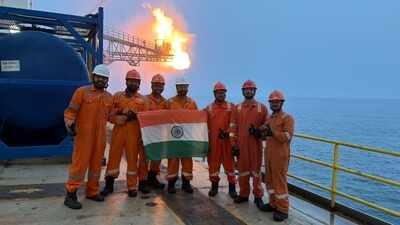
India’s search for greater domestic energy resources has received a significant boost with the discovery of natural gas in the deep waters of the Mahanadi Offshore Basin, off the coast of Odisha. State-owned Oil and Natural Gas Corporation (ONGC) made the discovery at an exploratory well around 43 kilometres off Konark, marking an important step in the country’s ongoing push to explore its offshore hydrocarbon potential.
The discovery was announced after gas was struck on September 18, 2026, at ONGC’s well MN-DW18-1-H-D, the first well drilled by the company in the Mahanadi Basin under the government’s Samudra Manthan deepwater exploration initiative.
What exactly has ONGC found?
The well was drilled to a target depth of 1,623 metres. Gas was encountered between 1,441 and 1,452 metres, and ONGC reported encouraging gas flow and sustained reservoir pressure after the well was tested. The drilling operation began on July 25 using the Platinum Explorer, a deepwater drillship.
The location of the discovery is particularly notable. At about 43 kilometres from the Odisha coast, the well is relatively close to shore compared with many deepwater discoveries. This could potentially make future development and transportation of the gas more manageable, if further appraisal confirms that the discovery is commercially viable.
What is Samudra Manthan?
The discovery comes under Samudra Manthan, the government’s initiative to accelerate exploration in India’s offshore and deepwater areas. The programme is part of the broader effort to expand domestic oil and gas production and reduce India’s dependence on imported energy.
The Mahanadi Basin is considered an important offshore exploration region because of its geological potential. Finding gas in the basin provides encouraging information for further exploration, although one successful well does not by itself establish the size of an entire gas field.
A boost to India’s energy ambitions
Natural gas is used across several sectors, including electricity generation, fertiliser production, industries and households. Increasing domestic production could therefore contribute to India’s efforts to strengthen its energy security and reduce exposure to international energy-price fluctuations.
The discovery also demonstrates the growing importance of offshore exploration in India’s energy strategy. As easily accessible onshore resources become more limited, deeper offshore areas are increasingly being explored with advanced drilling technology.
However, it is important not to confuse a gas discovery with confirmed commercial production.
ONGC has not yet disclosed the estimated reserves, recoverable volume or a commercial production timeline. Further appraisal, testing and economic evaluation will determine whether the discovery can support a commercially viable development.
Why proximity to the coast matters
If the discovery eventually moves into production, its location could offer an infrastructure advantage. ONGC has indicated that the find, along with other discoveries in the region, could potentially be developed through shared facilities, subject to applicable rules and commercial assessment. Such infrastructure sharing could help reduce development time and costs.
For Odisha, the discovery also adds another dimension to the state’s growing importance in India’s eastern energy landscape.
A discovery, not yet the final chapter
The Mahanadi gas find is undoubtedly an encouraging development for India’s offshore exploration programme, but its ultimate significance will depend on what the next stages of evaluation reveal.
For now, the key achievement is clear: ONGC has confirmed natural gas in a deepwater well off Odisha, opening another possibility in India’s search for indigenous energy resources.
What lies beneath the Mahanadi Basin may become clearer with further exploration and appraisal. If the discovery proves commercially viable, it could eventually become part of India’s domestic gas supply network. For now, it represents an important exploration milestone and another step into the largely untapped potential of India’s offshore energy frontier.