

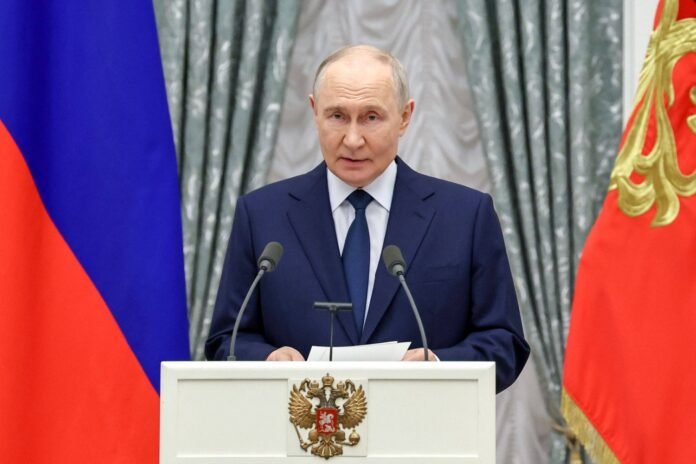
For more than two decades, Vladimir Putin has been one of the most consequential figures in Russian and international politics. From his early career in Soviet intelligence to the Kremlin, he has remained at the centre of Russia’s political system through periods of economic change, military conflict and growing tensions with the West.
As Russia’s ruling United Russia party has once again secured a large parliamentary majority in the September 2026 elections, attention has returned to the man who has dominated Russian politics for more than 25 years.
From Leningrad to the KGB
Vladimir Vladimirovich Putin was born on October 7, 1952, in Leningrad, now St Petersburg. He studied law at Leningrad State University and joined the KGB, the Soviet Union’s security and intelligence agency, after graduating in 1975.
Putin spent around 15 years in the KGB, including several years stationed in Dresden, East Germany. He left active service in 1990 and entered public administration in St Petersburg. There, he worked with Anatoly Sobchak, the city’s reformist mayor and one of Putin’s political mentors. By 1994, Putin had become first deputy mayor.
His career then moved rapidly to Moscow. In 1998, President Boris Yeltsin appointed him director of the Federal Security Service (FSB), the main domestic successor to the KGB. The following year, Putin became prime minister. On December 31, 1999, Yeltsin resigned and Putin became acting president.
The rise to the Kremlin
Putin won his first presidential election in March 2000. He served two consecutive presidential terms until 2008, when Dmitry Medvedev became president and Putin became prime minister. Putin returned to the presidency in 2012 and was re-elected in 2018.
A 2020 constitutional change allowed him to seek additional presidential terms. He won the 2024 presidential election with 87.97% of the vote, according to Russia’s Central Election Commission.
His supporters associate his early years in power with greater political stability and economic improvement following the upheaval of the 1990s. At the same time, his years in power have also been marked by growing restrictions on political opposition and independent media, as well as major confrontations with neighbouring countries and Western governments.
How popular is Putin in Russia?
Putin continues to record high approval and trust figures in Russian opinion polls, although polling results should be understood within Russia’s broader political and media environment.
The independent Levada Center reported that 76% of respondents approved of Putin’s performance in August 2026, based on a representative survey of 1,600 adults conducted across 50 Russian regions.
Russia’s state-run VCIOM reported an approval rating of 70.1% and a trust rating of 74.2% in its September 2026 survey.
These figures indicate substantial reported support, but they do not by themselves establish the reasons for that support or settle questions surrounding Russia’s political environment.
United Russia’s latest election victory
Russia held its latest parliamentary elections over three days, ending on September 20, 2026. The election was the first parliamentary vote since Russia’s full-scale invasion of Ukraine in 2022.
According to Russia’s Central Election Commission, with more than 95% of votes counted, United Russia won 57.83% of the party-list vote and was projected to take 355 of the State Duma’s 450 seats. That gives the party a constitutional majority and increases its representation compared with the 2021 election, when it received 49.8% of the vote.
Other parties entering the Duma included the Communist Party with 13.8% and 40 seats, LDPR with 25 seats and New People with 20 seats.
The election has also drawn criticism from opposition figures and Western governments. International observers from the OSCE were not invited, while the anti-war Yabloko party was prevented from contesting the national vote. Critics therefore questioned the competitiveness of the election. Russian authorities have defended the electoral process.
A political career still unfolding
Putin’s journey from a young KGB officer in Soviet-era Leningrad to Russia’s president has spanned the collapse of the Soviet Union, the turbulent 1990s, the country’s economic transformation, conflicts in Chechnya and Georgia, the annexation of Crimea, and the continuing war in Ukraine.
The latest parliamentary result does not constitute a new presidential election for Putin. Rather, it is a victory for United Russia, the party that supports him, and strengthens its position in Russia’s lower house.
More than a quarter-century after he first entered the Kremlin, Vladimir Putin remains at the centre of Russia’s political system, while the country’s relationship with Ukraine, Europe and the United States continues to shape his presidency and Russia’s place in the world.