

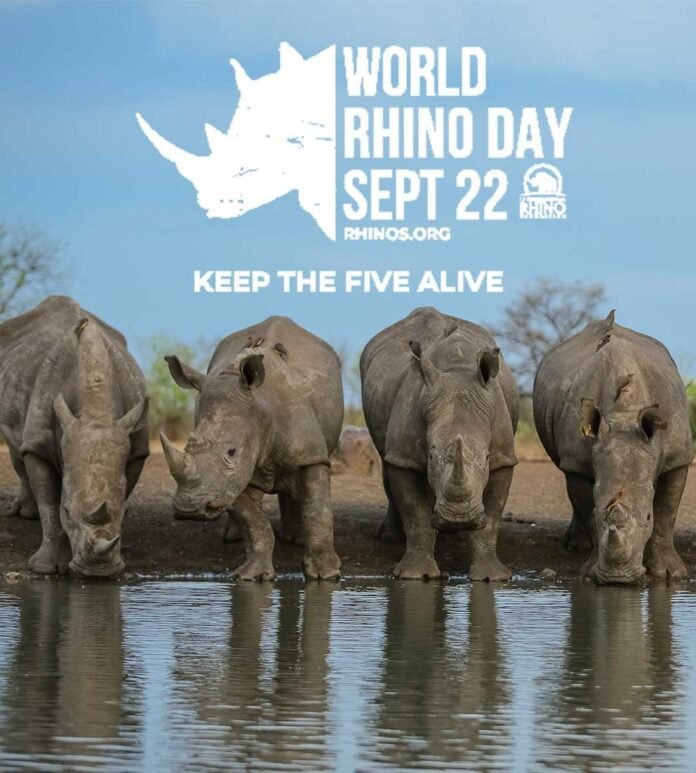
Every year on September 22, World Rhino Day turns attention towards one of the world’s most recognisable yet threatened animals. With their massive bodies, thick skin and distinctive horns, rhinoceroses have survived for millions of years. Today, however, their future depends increasingly on human efforts to protect them.
World Rhino Day celebrates all five living species of rhinoceros: the black rhino, white rhino, greater one-horned rhino, Sumatran rhino and Javan rhino. The day was first announced by WWF-South Africa in 2010 and became an international conservation observance the following year.
Five species, one conservation challenge
Rhinos are found naturally in parts of Africa and Asia, but their populations and habitats have been dramatically reduced over the years.
The greater one-horned rhinoceros, also known as the Indian rhino, is particularly significant for India. Once found across large parts of the Indian subcontinent, it now survives mainly in protected areas of India and Nepal. In India, Kaziranga National Park, Orang National Park, Pobitora Wildlife Sanctuary and Jaldapara National Park are among the important landscapes supporting the species.
The other Asian species face an even more precarious future. The Javan rhinoceros is among the world’s rarest large mammals and survives in a single remaining wild population in Indonesia’s Ujung Kulon National Park. It is classified as Critically Endangered.
The threat behind the horn
One of the biggest dangers to rhinos has been illegal poaching driven by demand for their horns.
A persistent myth in some traditional medicine markets has claimed that rhino horn possesses medicinal or curative properties. Scientific evidence does not support these claims. Rhino horn is primarily made of keratin, the same structural protein found in human hair and fingernails.
The illegal trade has also become connected with organised criminal networks, making rhino conservation not merely a wildlife issue but an international law-enforcement challenge. South African conservation assessments continue to identify poaching as a major threat to both black and white rhino populations.
India’s conservation story
India’s greater one-horned rhino offers an important example of what sustained conservation can achieve.
The species once faced severe population decline because of hunting and habitat loss. Protection of national parks, stronger anti-poaching measures, habitat management and carefully managed translocation programmes have helped populations recover.
But recovery does not mean the threat has disappeared. Habitat fragmentation, human-wildlife interactions, climate-related pressures and the continuing international demand for wildlife products remain concerns.
Conservation therefore cannot end with protecting an animal inside a national park. It also requires protecting its habitat and involving communities living around protected landscapes.
Why rhinos matter
Rhinos are more than symbols of wildlife conservation. As large herbivores, they influence vegetation and the structure of their ecosystems. Their grazing and movement can affect plant communities and create ecological opportunities for other species.
Protecting rhinos consequently means protecting entire landscapes and the many plants and animals that share those landscapes.
A day to replace myths with awareness
World Rhino Day is ultimately about more than celebrating an extraordinary animal. It is about understanding why rhinos are threatened and what can be done to change that reality.
Conservation organisations, zoos, schools and communities mark the day through awareness programmes, educational activities, fundraising and campaigns against the illegal wildlife trade.
The story of the rhino carries a larger lesson about conservation. Saving a species requires more than admiration. It requires science, habitat protection, law enforcement, responsible tourism, community participation and a willingness to challenge the myths that fuel illegal trade.
On World Rhino Day, the message is simple: a horn should never be worth more than a life.
The future of these ancient giants depends on ensuring that generations to come can encounter rhinos not only in photographs and history books, but alive, wild and where they belong.