

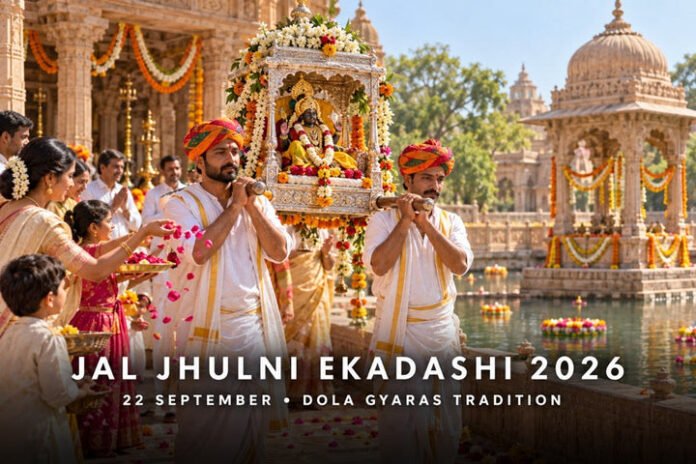
Every festival in the Indian calendar carries a story, but some traditions are experienced not merely through prayer, but through movement, music and community. Jal Jhulni Ekadashi, popularly known in Rajasthan as Dol Gyaras, is one such celebration. Observed during the Shukla Paksha Ekadashi of Bhadrapada, the festival is marked by the ceremonial journey of the deity from the temple to a nearby water body.
In 2026, Jal Jhulni Ekadashi falls on Tuesday, September 22. It is also known by the names Parivartini Ekadashi, Parsva Ekadashi and Dol Gyaras. The name Parivartini refers to the traditional belief that Lord Vishnu changes his posture during his cosmic sleep, while Jal Jhulni and Dol Gyaras reflect the distinctive regional tradition of taking the deity in a decorated palanquin to water.
The meaning behind the festival
Jal Jhulni Ekadashi falls during Chaturmas, the four-month period traditionally associated with Lord Vishnu’s cosmic sleep. According to Vaishnava tradition, on this Ekadashi, Vishnu is believed to turn or change his sleeping posture, giving the observance its name Parivartini Ekadashi.
The day is also associated in devotional traditions with Lord Vamana, the fifth incarnation of Vishnu. The Vamana-Bali episode forms an important part of the vrat tradition associated with this Ekadashi. In different regions, however, the deity and form worshipped can vary. In Rajasthan, the festival has acquired a particularly distinctive identity through the worship and procession of local temple deities, often in Vaishnava and Krishna traditions.
Why is it called Jal Jhulni?
The most striking ritual gives the festival its name.
On this day, the idol or image of the presiding deity is beautifully decorated and placed in a doli or palanquin. Devotees then carry the deity in a ceremonial procession towards a pond, lake, river or other sacred water body. There, the deity is traditionally offered a ceremonial bath or symbolic water ritual before being brought back to the temple.
The tradition connects the deity with water at a time when the monsoon season is drawing towards its later phase. It also turns a temple ritual into a collective community celebration, with processions, devotional singing, drums and decorated palanquins filling the streets.
The practice is particularly prominent in Rajasthan. The state’s Department of Devasthan records Jal Jhoolni as a major festival at the Diggi Kalyan Ji temple, where around 50,000 pilgrims have been recorded visiting the village for the celebration.
A tradition deeply woven into Rajasthan’s culture
At several places in Rajasthan, Jal Jhulni Ekadashi is not simply a day of fasting. It becomes a public religious and cultural event.
One notable example comes from Pushkar, where Rajasthan’s official documentation records the traditional procession of the idol of Varaha to the sacred waters of Pushkar for a bath around Jal Jhulni Ekadashi. This tradition was already associated with the Varaha temple in historical records and demonstrates how the festival became connected with different local temple traditions.
The decorated dolis, devotional songs, temple processions and gatherings of devotees give the festival a distinctly visual character. In many towns, people gather along the procession route to seek darshan and participate in the celebrations.
Fasting, worship and devotion
Like other Ekadashis, Jal Jhulni Ekadashi is traditionally observed through fasting, prayers and worship of Lord Vishnu. Devotees may offer flowers, fruits, Tulsi leaves and other customary offerings. Many observe a fast according to their personal religious practice, while others follow a simpler satvik diet.
The fast is traditionally broken on the following day, Dwadashi, after the prescribed parana period. Since exact timings vary according to location and panchang calculations, devotees generally follow their local calendar for the appropriate time.
More than a ritual
The deeper significance of Jal Jhulni Ekadashi lies in the way it brings temple, deity and community together.
The deity who ordinarily resides within the sanctum is symbolically taken outside, carried through the streets and brought to the waters. The journey transforms the festival into a shared experience, allowing an entire community to participate in the worship.
In Rajasthan, where water has always held profound cultural and ecological significance, the imagery of taking the deity to a pond or lake carries an added resonance. It connects faith with the landscape and with the traditional water bodies around which settlements developed.
Jal Jhulni Ekadashi is therefore both a Vaishnava religious observance and a vibrant regional tradition. Its palanquins, processions, music and rituals preserve a living cultural memory that has continued across generations.
As the decorated doli moves towards the water and devotees follow with folded hands, Jal Jhulni Ekadashi offers a beautiful reminder that in India’s living traditions, faith is not confined to temple walls. Sometimes, it travels with the people, through the streets and towards the waters.