

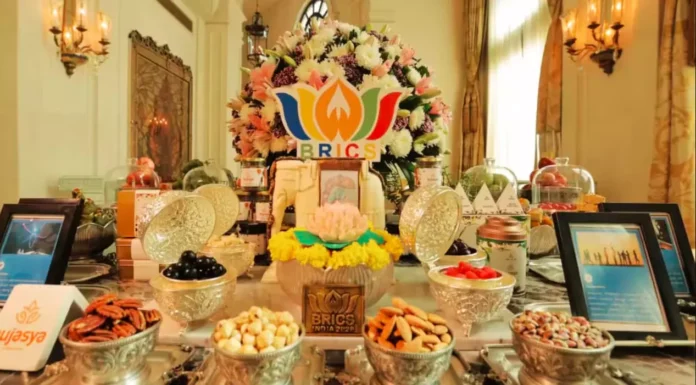
The BRICS Summit in New Delhi may have brought world leaders together around diplomacy, economics and global cooperation, but one of its most talked-about moments came from something much simpler: the dinner table.
At the gala dinner hosted by Prime Minister Narendra Modi at Bharat Mandapam, visiting leaders and dignitaries were served an entirely vegetarian Indian menu. What followed was an unexpected political debate over whether the absence of meat represented India accurately.
But perhaps the more interesting question is this: Why should an all-vegetarian Indian meal be seen as a limitation at all?
India is a country where food is inseparable from geography, history, community, season and tradition. Its culinary identity is not represented by one plate or one dietary preference. It includes meat and fish, but it also includes an extraordinary vegetarian tradition that stretches across centuries and regions. The BRICS dinner chose to put that tradition in the spotlight.
And it did so rather beautifully.
A vegetarian menu, but hardly a limited one
The BRICS dinner was not simply a collection of familiar vegetarian dishes. It was designed as a culinary journey through different parts of India, combining traditional preparations with contemporary presentation.
The starters included Khandvi Mille-Feuille, an elegant interpretation of Gujarat’s beloved khandvi, prepared with steamed gram-flour rolls, mustard, coconut and curry leaves, and served with kesar mango, microgreens and yoghurt dressing.
Then came Khumb Galouti, a vegetarian interpretation of the famous galouti kebab tradition of Awadh, made with mushrooms and served with sheermal.
The main course continued that journey.
There was Paneer Lababdar, with cottage cheese in a rich shallot and tomato gravy; Gucchi Marmik, featuring Himalayan morel mushrooms, saffron and almonds; Carrot Bean Poriyal, bringing the flavours of South India; Thakkali Belle Saaru, a light lentil-based preparation; Millet Pulao; and Beetroot Raita.
The desserts added another distinctly Indian touch. Guests could choose between Old Delhi Fruit Cream with Jalebi and Shahtoot Phirni, a slow-cooked phirni featuring mulberries and gold leaf.
In other words, this was not a menu built around the idea of what vegetarians cannot eat. It was built around what Indian vegetarian cuisine can offer.
From Gujarat to Kashmir, Awadh to the South
Perhaps the strongest aspect of the menu was its geography.
A single dinner brought together Gujarat’s khandvi, the culinary legacy of Awadh through galouti, Himalayan gucchi, South Indian poriyal and saaru, North Indian paneer preparations, Delhi’s jalebi and a traditional phirni.
That is precisely what makes Indian cuisine so fascinating.
A vegetarian menu in India does not necessarily mean repetitive food. Depending on where one travels, vegetarian cooking can mean completely different ingredients, techniques, textures and flavours.
The BRICS menu managed to communicate that diversity without needing a lengthy explanation.
Millets take centre stage
Another important element was the emphasis on millets, or Shree Anna.
Millets were incorporated into the meal as part of India’s larger culinary and sustainability narrative. The menu highlighted their nutritional value, relatively lower resource requirements and relevance to climate-resilient agriculture. Different millet varieties were incorporated across the meal, including pearl millet in the pulao and other millets in the accompanying preparations and dessert.
This made the meal more than a showcase of luxury ingredients. It also connected India’s traditional food grains with a contemporary global conversation around nutrition, sustainability and resilient agriculture.
There is no single Indian food identity
The criticism surrounding the dinner largely stems from a legitimate observation: India is indeed a country with enormous dietary diversity, and millions of Indians eat meat, fish and eggs.
But acknowledging that reality does not require dismissing India’s vegetarian traditions.
One diplomatic dinner cannot, and does not need to, represent every Indian’s plate.
A country’s cuisine can be introduced to the world through different themes on different occasions. Sometimes it can be coastal seafood. Sometimes it can be the richness of Mughlai cuisine. Sometimes it can be the food of India’s tribal communities. And sometimes, as at the BRICS dinner, it can be the extraordinary depth of Indian vegetarian cooking.
The choice of vegetarian food therefore need not be interpreted as an attempt to rewrite India’s culinary identity. It can simply be understood as one carefully curated expression of it.
Food diplomacy is also cultural diplomacy
International dinners are rarely just about feeding guests. They are opportunities for countries to communicate something about themselves.
At the BRICS dinner, India’s message came through ingredients, recipes and presentation.
The menu introduced international guests to foods ranging from gram flour and paneer to Himalayan morels, millets, regional vegetables and traditional Indian desserts. The evening also featured a special cultural performance, further turning the dinner into an expression of India’s cultural heritage.
The response from supporters of the menu reflected exactly this point. Industrialist Harsh Goenka, for instance, defended the decision and described the spread as a culinary journey across India, highlighting its regional breadth. Union Minister Kiren Rijiju also said the guests relished the Indian vegetarian cuisine.
And perhaps that is the better way to look at the evening.
Not as a question of vegetarian versus non-vegetarian, but as an opportunity to ask how much of India can fit on one dinner table.
The answer, as the BRICS menu demonstrated, is quite a lot.
From the delicate textures of khandvi to the richness of galouti, from Himalayan gucchi to South Indian flavours, from millet to jalebi and phirni, the dinner presented an India that was regional, contemporary, traditional and unmistakably diverse.
India’s food story is too large to fit into one menu.
But for one evening at Bharat Mandapam, the country chose to tell one particularly beautiful chapter of it.
And there was absolutely nothing wrong with that!