

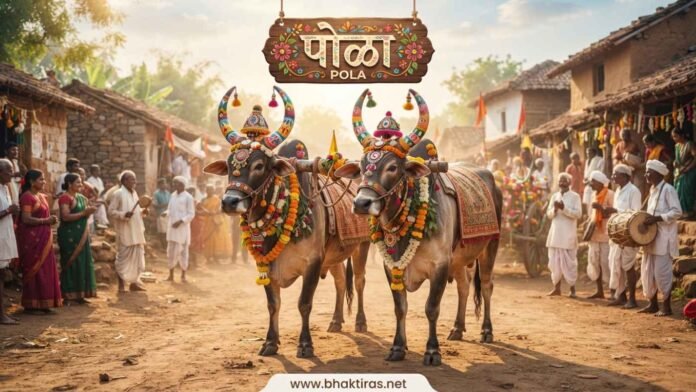
In India’s agricultural heartlands, festivals have traditionally reflected the rhythms of farming, the changing seasons and the relationship between people, animals and the land. Pola, also known as Bail Pola, is one such festival. Celebrated primarily in Maharashtra and also observed in parts of Madhya Pradesh, Chhattisgarh, Karnataka and Telangana, the festival is dedicated especially to the bulls and bullocks that have traditionally played an important role in agricultural life.
The festival is essentially an expression of gratitude. Farmers honour the animals that help them plough fields and carry out agricultural work, giving them a day of rest, care and celebration.
Where is Pola celebrated?
Pola has its strongest association with Maharashtra, particularly its rural and farming communities. It is also celebrated in parts of Madhya Pradesh and Chhattisgarh, while similar observances are found in other parts of central and southern India. Maharashtra Tourism identifies Maharashtra, Madhya Pradesh, Chhattisgarh, Karnataka and Telangana among the states where the festival is observed.
In Madhya Pradesh, for instance, Pola is celebrated in Balaghat district, where the festival is closely associated with agricultural traditions and the worship of bulls.
The festival is generally observed on Amavasya, or the new moon day, during the month of Shravan in the traditional Hindu calendar. In some regions and traditions, it is associated with Bhadrapada Amavasya, reflecting regional differences in calendar observance.
The story and history behind Pola
Pola is deeply rooted in India’s agricultural traditions. For generations, bulls and bullocks were indispensable to farming households, helping farmers plough fields and perform other agricultural tasks.
The festival provides an annual occasion to recognise this contribution. Rather than being treated simply as working animals, the bullocks are honoured as important members of the farming household.
There is also a popular mythological association with Lord Krishna and the demon Polasur. According to the tradition cited by Maharashtra Tourism, young Krishna defeated Polasur on this day.
The festival’s deeper cultural significance, however, lies in the relationship between farmers and their animals and the dependence of agricultural life on this partnership.
How is Pola celebrated?
The day begins with special care for the cattle. Farmers wash their bulls and bullocks, often giving them oil massages and preparing them for the day’s celebrations.
Their horns are decorated or coloured, while their bodies are adorned with flowers, garlands, colourful cloth, ornaments, bells and other decorations. New ropes and decorated accessories are also traditionally used.
The animals are then worshipped by their owners. Puja, offerings and aarti form an important part of the celebration. The bulls are given special food and are not made to perform their usual agricultural work. The day is therefore also a period of rest for the animals that spend much of the agricultural season working alongside farmers.
The traditional Pola procession
One of the most colourful aspects of the festival is the procession of decorated bulls.
In villages, farmers bring their decorated animals together and take them through the settlement. Music, drums and community celebrations accompany the procession in many places. In some villages, competitions and other community events are also organised around the festival.
The procession transforms the festival from a household ritual into a community celebration, bringing farmers and their families together.
Role of women and families
Pola is also a family-centred festival. Women traditionally decorate their homes with rangoli and torans, prepare festive food and participate in the worship of the animals. According to the Ministry of Tourism’s Utsav platform, family members may seek the blessings of the bulls by touching their feet after the animals have been worshipped.
Children also participate in the celebrations. In some regions, they play with or worship wooden bull figures, often representing Nandi. The tradition gives the festival a strong connection with younger generations and helps pass agricultural customs and cultural values from one generation to another.
Food and festive traditions
Like many Indian festivals, Pola is accompanied by special food prepared at home. Puran Poli, a traditional Maharashtrian sweet flatbread, is particularly associated with the celebration. Other festive dishes and sweets are also prepared by families.
The preparation and sharing of food add another dimension to the festival, bringing families and communities together after the agricultural rituals.
Why are bulls central to the festival?
The bull occupies a special place in India’s agricultural and cultural traditions. Before the widespread use of mechanised farming, bullocks were central to many farming activities. Their strength was essential for ploughing fields and other forms of agricultural labour.
Pola acknowledges this contribution through a dedicated day of care, worship and rest.
The festival also carries a wider message about the relationship between humans and animals. By recognising the contribution of cattle to farming and livelihoods, Pola reflects the idea that agriculture is not sustained by human effort alone but through a relationship between farmers, animals, land and nature.
Pola in changing times
Agricultural practices have changed considerably with the introduction of tractors and modern machinery. Yet Pola continues to be celebrated in many rural communities.
Its survival demonstrates that the festival is not solely about the practical role once played by bullocks in agriculture. It has also become an expression of cultural memory, gratitude, family tradition and rural identity.
In places such as Balaghat, celebrations continue to include decorated bulls, worship, children’s activities, cultural programmes and community gatherings.
A festival of gratitude
At its heart, Pola is a simple but meaningful celebration: farmers pause from their daily agricultural routine to thank the animals that have shared their labour.
The decorated horns, flower garlands, bells, processions, prayers and festive meals are expressions of that gratitude. More broadly, the festival celebrates the connection between farming communities and the natural world on which their livelihoods depend.
In an era of rapidly changing agriculture, Pola remains a reminder of an older relationship between farmer, animal and field, one in which the contribution of the bullock was not merely recognised as part of agricultural work but honoured as an essential part of rural life.