

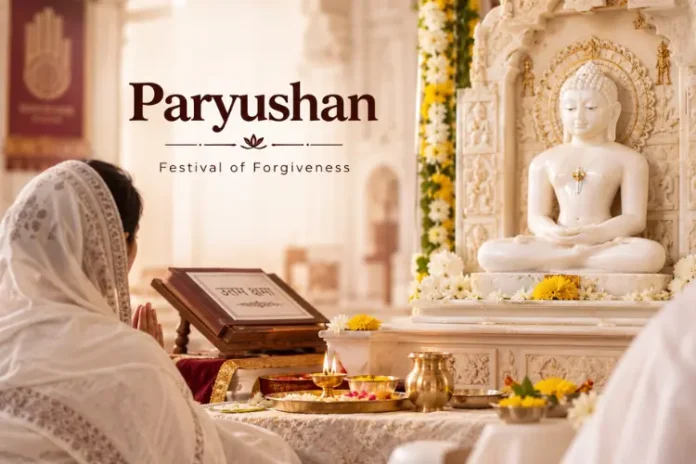
The Shvetambar Jain community begins Paryushan Parva today, September 8, 2026, marking eight days dedicated to spiritual discipline, self-reflection, fasting, prayer and forgiveness. The festival will conclude on September 15 with Samvatsari, regarded as the most important day of Paryushan and the Jain community’s annual day of seeking and granting forgiveness.
Paryushan is among the most significant religious observances in Jainism. Unlike festivals centred primarily on celebration and social gatherings, Paryushan is a period of turning inward. The word is associated with staying close to the self and one’s spiritual practice. During these days, Jains consciously reduce worldly distractions and devote greater time to prayer, religious study, meditation, fasting, self-discipline and introspection. The underlying objective is self-purification and the shedding of karmic attachments through restraint and awareness.
For the Shvetambar tradition, Paryushan lasts for eight days. The period gives devotees an opportunity to examine their thoughts, words and actions over the past year and consciously work towards correcting themselves. Jain philosophy places great emphasis on overcoming emotions such as anger, pride, deceit and greed, which are seen as obstacles on the path towards spiritual liberation. Paryushan therefore becomes a time to practise restraint and strengthen the principles of ahimsa, truth, non-attachment and self-control.
How is Paryushan observed?
Fasting is one of the most visible forms of Paryushan observance, although the nature and duration of fasting vary from person to person. Some devotees observe complete fasts, while others undertake practices such as Ekasan or Biyasan, in which food is taken only once or twice within prescribed limits. Ayambil, another form of austerity, involves eating a simple, restricted diet without many of the usual tastes and ingredients. Those undertaking rigorous tapasya do so according to their capacity and with appropriate religious guidance.
Food itself becomes part of the discipline. Many practising Jains observe restrictions that include avoiding root vegetables and following prescribed timings for eating. Some observe Chauvihar, refraining from food and, according to the particular practice, water after sunset. These practices are not simply dietary restrictions but are intended to cultivate restraint, mindfulness and control over one’s desires.
Prayer and religious study occupy an important place during the eight days. Jain temples and community centres organise pravachans, Swadhyay, Pujas and Pratikraman, allowing devotees to listen to religious teachings, study scriptures and reflect on their conduct. Pratikraman is particularly significant. It involves reviewing one’s actions, recognising mistakes, expressing remorse and resolving to avoid repeating them. Community programmes may differ from one place to another, but spiritual study and self-reflection remain central to the observance.
For Shvetambar Jains, the Kalpasutra also has an important place during Paryushan. Religious gatherings include its reading and worship, and accounts associated with the lives of the Tirthankaras, particularly Lord Mahavira, form an important part of the observance. In many communities, special religious programmes are organised around the reading and ceremonial presentation of the scripture.
The festival reaches its spiritual culmination on Samvatsari, the eighth day. It is known as the day of forgiveness and is considered the most important day of Paryushan. Devotees undertake Samvatsari Pratikraman, reflecting upon their conduct throughout the year and seeking forgiveness for harm caused knowingly or unknowingly through thoughts, words or actions.
A central expression of this tradition is “Micchami Dukkadam.” On Samvatsari, Jains greet family members, friends, relatives and others with this expression, asking forgiveness for any hurt or wrongdoing they may have caused. The practice extends beyond immediate relationships and reflects the broader Jain belief in compassion and non-violence towards all living beings. It is a powerful reminder that forgiveness is not merely about saying sorry but about acknowledging one’s mistakes, letting go of resentment and resolving to live with greater awareness.
Paryushan is therefore both an individual and a community observance. Families come together for prayers, religious discourses and rituals, while temples and Jain organisations conduct collective programmes. At the same time, the deeper focus remains personal: examining one’s own conduct rather than judging others.
The festival’s significance lies in this emphasis on inner transformation rather than outward celebration. Through fasting, silence, prayer, study, meditation, charity, restraint and forgiveness, devotees seek to reduce attachment and negative emotions and move closer to the ideals taught by Jain philosophy.
As the Shvetambar Jain community begins Paryushan today, the eight-day period offers a reminder that spirituality can also be expressed through simplicity, self-discipline and introspection. Its final message of Micchami Dukkadam extends that reflection into everyday relationships, encouraging people to acknowledge mistakes, forgive one another and begin again with greater compassion.