

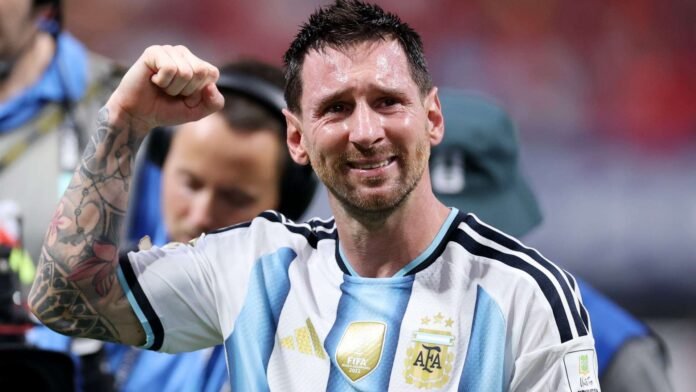
There are footballers who win trophies, footballers who break records and footballers who become legends. Then there is Lionel Messi, a player whose journey has become something much larger than football itself. On August 31, 2026, Messi announced his retirement from international football at the age of 39, bringing an emotional end to a 21-year journey with Argentina. His farewell came after Argentina reached the 2026 FIFA World Cup final, where they lost 1–0 to Spain. Yet even in defeat, Messi leaves the international stage as a World Cup winner, a multiple-time Copa América champion and one of the most influential footballers the world has ever seen.
But the story of Lionel Messi did not begin in a stadium filled with thousands of cheering supporters. It began in Rosario, Argentina, with a small boy who loved football.
Born on June 24, 1987, Messi grew up in a football-loving family. His father, Jorge Messi, worked in a steel factory and coached a local youth team, while his grandmother Celia played an especially important role in encouraging his passion for football. Messi began playing at a very young age and joined Newell’s Old Boys as a child. His extraordinary ability quickly became apparent. Even among other talented young players, he seemed different.
But his path was far from easy.
As a child, Messi was diagnosed with a growth hormone deficiency. His treatment was expensive, creating a significant financial challenge for his family. At just 13, he moved from Argentina to Spain after Barcelona offered to take responsibility for his treatment and development. Leaving home at such a young age meant leaving behind his family, friends and familiar surroundings to pursue a dream in a completely different country. Messi himself has spoken about the sacrifices involved in leaving Argentina and starting a new life in Spain.
Barcelona became the place where the boy from Rosario grew into a global phenomenon.
He progressed through the club’s youth system before making his first-team debut and eventually becoming the centre of one of the greatest eras in the history of modern football. His extraordinary dribbling, vision, passing, finishing and ability to seemingly control a match transformed him into much more than a star. He became an institution.
Yet his international journey was considerably more complicated.
For years, Messi carried the enormous expectations of an entire nation. Argentina had not won a major senior international trophy during much of his prime, and every disappointment seemed to intensify the criticism surrounding him. Argentina lost the 2014 World Cup final to Germany, followed by consecutive Copa América final defeats in 2015 and 2016. After the 2016 Copa América final, Messi briefly announced his retirement from international football, devastated by another defeat.
But he came back.
And that comeback changed everything.
In 2021, Messi finally won his first major senior international trophy when Argentina defeated Brazil in the Copa América final. In 2022 came the defining achievement of his career: the FIFA World Cup in Qatar. Messi scored seven goals during the tournament and produced one of the most memorable World Cup campaigns of his career as Argentina defeated France in a dramatic final. He lifted the trophy that had eluded him for so long.
Argentina then won the Copa América again in 2024, adding another major international title to Messi’s extraordinary collection. By the time he reached the 2026 World Cup, the player who had once been questioned for not winning with Argentina had become the leader of a generation that had restored the country’s belief.
That is perhaps the most inspiring part of Messi’s story: he did not escape failure. He went through it.
His career repeatedly demonstrated that talent alone is not enough. Talent has to survive disappointment. Dreams have to survive criticism. And success often arrives only after the point at which giving up seems easiest.
Messi has expressed this philosophy in words that have become closely associated with his journey: “You have to fight to reach your dream. You have to sacrifice and work hard for it.”
Another of his oft-quoted thoughts captures the humility that has accompanied his extraordinary career: “I prefer to win titles with the team ahead of individual awards.” He has also said that he would rather be remembered as a good person than simply as the best footballer in the world.
On August 31, 2026, those words acquired a new meaning.
Messi announced his retirement from Argentina through a handwritten message posted on Instagram. He revealed that he had actually written the farewell shortly after Argentina’s World Cup final defeat to Spain on July 19. He waited before making it public. The recent death of his father, Jorge Messi, on August 8 made him even more certain that the time had come to close this chapter.
His announcement was not the triumphant farewell of someone leaving after another trophy. It was something more human. He acknowledged that the decision hurt, but said he understood that the time had come. He reflected on the years spent wearing Argentina’s shirt and expressed pride in everything he and his teammates had experienced together.
And that is what makes the ending of Messi’s international career so powerful.
The little boy who once left Rosario because he needed medical treatment became the man who carried Argentina’s hopes on his shoulders. The teenager who moved across continents became a global icon. The player once criticised for failing to win with his country eventually delivered the World Cup his nation had waited decades for. The footballer who experienced heartbreaking defeats returned again and again until victory finally came.
His international career ends with 207 appearances and 125 goals for Argentina, along with a World Cup, two Copa América titles, Olympic gold and a legacy that cannot be measured by numbers alone.
Messi is stepping away from Argentina, but he is not leaving football. He remains active with Inter Miami at club level. What he is leaving behind, however, is an extraordinary lesson.
Sometimes the greatest victories are not the trophies we lift. They are the moments when we choose to continue after losing.
Messi’s story is the story of a boy who was told by circumstances that his dream would be difficult, who left home to chase it, endured years of criticism and heartbreak, failed on the biggest stages and still returned to try again.
And when the final chapter eventually came, he could look back with the one thing every dreamer ultimately seeks: the knowledge that he had given everything.
Perhaps that is Lionel Messi’s greatest legacy.
Not simply that he became one of the greatest footballers in history, but that he showed millions of people what it looks like to keep believing in a dream long after the world has given you reasons not to.