

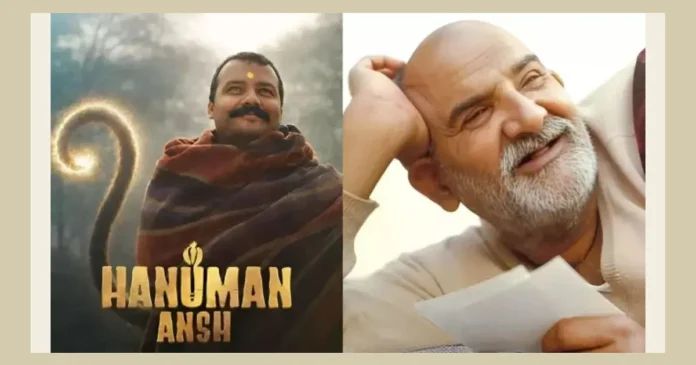
In an industry where box-office success is often associated with massive budgets, superstar faces and aggressive marketing campaigns, Hanuman Ansh has emerged as a remarkable exception. Made on a reported budget of around ₹2 crore, the film entered theatres without the scale or promotional machinery of a conventional Bollywood release. Yet, what began as a quiet theatrical opening has gradually transformed into one of the most surprising box-office stories of 2026. By August 31, the film had crossed the ₹40 crore mark in India net, turning a modestly made spiritual drama into a phenomenal sleeper hit.
But the story of Hanuman Ansh is not simply about numbers. At its heart is a deeply human story of grief, faith and the search for God.
The film follows a young boy, Lakshman Das, whose world changes after the death of his mother. Unable to accept her loss, the child sets out in search of God, hoping that somewhere on this spiritual journey he might find answers to his grief. His search takes him across the country, where he encounters different paths of spirituality. Eventually, his journey leads towards the man devotees would come to know as Neem Karoli Baba, one of India’s most revered spiritual figures. The film explores how a grieving child’s search for the divine gradually transforms into a life devoted to love, service, feeding others and chanting the name of Ram.
What makes the film particularly interesting is that it does not approach spirituality through the spectacle of a conventional mythological film. There are no grand VFX-heavy sequences designed simply to overwhelm the viewer. Instead, Hanuman Ansh chooses intimacy. It attempts to understand the human being behind the saint and the emotional journey that shaped him.
The film has been written and directed by Vishal Chaturvedi, who had reportedly carried the idea of telling Neem Karoli Baba’s story for nearly two decades. His approach was shaped by extensive research into Baba’s life, teachings and stories associated with him. Chaturvedi also appears among the film’s producers, alongside Anupriya Nagar, Namrata G. Singh and Ragini Sona. The film has been produced under Swambhu Media Network.
The casting of the film has also contributed to its grounded quality. Shobhinaw Satyaa plays Neem Karoli Baba, while Vihaan Shedge portrays the younger Maharaj Ji. The supporting cast includes Chandan Anand, Purnima Tiwari, Anil Rastogi, Hunny Bakshi and several others. Satyaa’s connection with the project is particularly interesting. He was initially associated with the film as an assistant director before eventually taking on the role of Neem Karoli Baba himself.
And then comes the film’s music, perhaps one of its most powerful elements.
The bhajans in Hanuman Ansh do not feel like they have been inserted merely as background music. They become part of the emotional language of the film. The devotional compositions, traditional sounds and earthy vocals create an atmosphere that many viewers have found deeply moving. Among the voices associated with the film is Suneel Lodhi, a visually impaired singer from Bundelkhand whose raw devotional singing had already found a huge audience online. His bhajan More Sankat Ke Kataiya went viral, eventually receiving millions of views, and his journey brought him to a Mumbai recording studio for Hanuman Ansh. His song Maine Tere Hi Bharose has particularly attracted appreciation for its soulful and unpolished quality.
That authenticity is perhaps the secret of the film’s appeal.
Hanuman Ansh does not feel like a film desperately trying to prove how spiritual it is. It allows its story, silences, music and characters to create that atmosphere. For many viewers, the experience has been less about watching a conventional biopic and more about sitting with questions of faith, loss, devotion and what it truly means to serve another human being.
The audience response has been extraordinary considering where the film began. It opened to only around ₹10 lakh on its first day and initially appeared to be struggling. But instead of disappearing after the opening weekend, the film slowly gathered momentum. Viewers began recommending it to one another, social media conversations grew and positive word of mouth brought increasingly larger audiences into theatres. By its fourth week, the film was registering a remarkable resurgence and had crossed ₹40 crore in India net.
Its success is even more striking because Hanuman Ansh did not rely on a conventional massive promotional campaign. Reports indicate that its grassroots outreach included religious gatherings and bhandaras, while spiritual figures such as Premanand Ji Maharaj also played a role in generating awareness around the film. Instead of depending entirely on expensive advertising, the film found its audience through conversations, recommendations and faith-based communities.
That makes Hanuman Ansh an unusual box-office phenomenon. A film made for a fraction of the budgets of contemporary Bollywood spectacles has managed to create a much larger conversation simply because audiences connected with what it was trying to say.
Perhaps the most beautiful thing about the film’s journey is that its central character is himself a seeker.
Lakshman Das begins by searching for God because he has lost his mother. Along the way, he discovers that perhaps the search for God is not only about finding the divine somewhere outside oneself. It is also about love, compassion, feeding the hungry, serving humanity and seeing divinity in others.
That message seems to have travelled beyond the screen.
Hanuman Ansh has become a reminder that cinema does not always need enormous sets, expensive stars or spectacular visual effects to create an impact. Sometimes, a sincere story, honest performances and music that reaches somewhere deeper are enough.
In a year crowded with big releases, Hanuman Ansh has quietly carved out its own space. Its box-office journey is impressive, but its deeper achievement may be the conversations it has started and the emotions it has awakened. From a ₹2-crore production to a film crossing ₹40 crore, its journey is not merely a story of commercial success.
It is a story of faith finding its audience.