

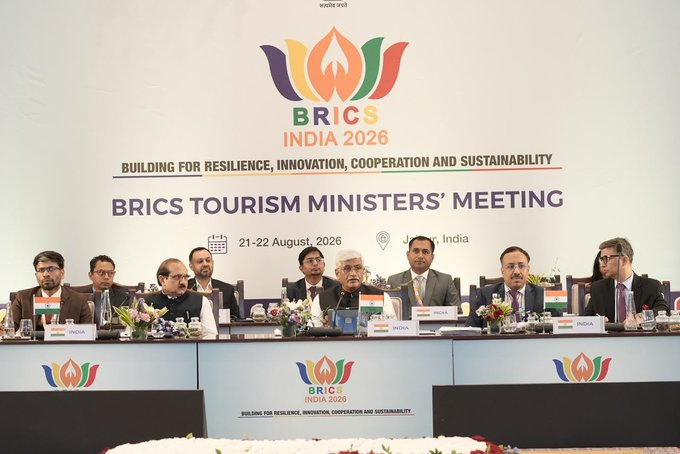
The BRICS Tourism Ministers’ Meeting under India’s 2026 Chairship concluded in Jaipur on August 21 with the adoption of the BRICS Tourism Ministers’ Communiqué 2026, also known as the Jaipur Declaration. The declaration provides a framework for deeper cooperation among BRICS member states in tourism and reflects India’s effort to place tourism at the centre of economic growth, cultural exchange and sustainable development.
The meeting was chaired by Union Minister for Culture and Tourism Gajendra Singh Shekhawat and marked the culmination of the BRICS Tourism Track under India’s Chairship. The track was guided by India’s broader 2026 BRICS theme, “Building for Resilience, Innovation, Cooperation and Sustainability.”
Representatives from nine BRICS member states participated in the ministerial meeting, including Brazil, Iran, South Africa and the United Arab Emirates, along with heads of delegation from China, Ethiopia, Indonesia and Russia.
The Jaipur Declaration is built around four key priorities identified through the BRICS Tourism Working Group during India’s Chairship. These are Artificial Intelligence and Tourism, Sustainability and Responsible Tourism, Tourism Skilling and Capacity Building, and Tourism Exchanges and Seamless Travel Facilitation. Together, these priorities seek to make tourism more technologically enabled, environmentally responsible, accessible and beneficial to local communities.
Artificial intelligence emerged as an important area of cooperation. With AI increasingly influencing travel planning, destination management, customer services and tourism marketing, BRICS countries are looking at ways to use the technology more effectively in the sector. Shekhawat stressed the need for greater and more effective use of AI in tourism, signalling the importance of technological innovation in shaping the future of travel.
Sustainability was another major pillar of the declaration. The discussions emphasised responsible tourism and the need to protect natural and cultural heritage while ensuring that tourism contributes to local economies. The approach places greater emphasis on community-based tourism, allowing the benefits of tourism to reach towns, villages and remote regions rather than remaining concentrated only in major tourist cities.
Addressing the meeting, Shekhawat highlighted the wide range of livelihoods connected to tourism, including hotels and homestays, taxi operators, tourist guides, artisans, weavers, farmers and entrepreneurs. He said tourism has the potential to extend economic opportunities beyond major urban centres and contribute to India’s vision of Viksit Bharat by 2047.
The declaration also places emphasis on tourism skilling and capacity building. As the sector evolves through digital technology, changing traveller expectations and new forms of tourism, developing a skilled workforce will be essential. Cooperation among BRICS countries in training, knowledge exchange and capacity building could help strengthen employment opportunities while improving the quality of tourism services.
Another important area is seamless travel and tourism exchanges. Easier travel between BRICS destinations can encourage greater movement of tourists, strengthen people-to-people connections and create new opportunities for the hospitality and travel industries. The declaration seeks stronger cooperation in this area while encouraging the exchange of tourism data, experiences and best practices among member countries.
The ministerial meeting also provided an opportunity for India to deepen bilateral tourism relations. On the sidelines, India held discussions with Brazil, Iran, South Africa and the UAE, creating opportunities to explore country-specific cooperation alongside the broader BRICS framework.
Jaipur itself became part of the tourism diplomacy surrounding the meeting. Delegates were introduced to traditional arts, crafts and community-based tourism initiatives, highlighting India’s effort to showcase tourism not merely as sightseeing but as an experience connected with local culture and communities. On August 22, ministers and delegates are scheduled to visit prominent Jaipur attractions including Hawa Mahal, City Palace and Amber Fort, offering them an opportunity to experience the city’s architectural and cultural heritage.
The Jaipur Declaration comes at a time when tourism is increasingly being viewed as an important contributor to economic development, employment and cultural understanding. For BRICS countries, cooperation in tourism can create opportunities to develop new tourism circuits, exchange expertise, promote lesser-known destinations and encourage more sustainable forms of travel.
For India, hosting the Tourism Ministers’ Meeting in Jaipur also highlights the country’s attempt to use its BRICS Chairship to promote its diverse tourism strengths, from heritage and culture to crafts, community experiences and emerging technology-driven tourism.
The adoption of the Jaipur Declaration therefore marks more than the conclusion of a ministerial meeting. It establishes a shared direction for BRICS tourism cooperation, combining technology with sustainability, skills with employment and travel with cultural exchange.
As global tourism continues to evolve, the declaration reflects a common ambition among BRICS nations: to build a tourism sector that is more resilient, innovative, responsible and inclusive, while allowing travel to become a stronger bridge between economies, communities and cultures.