

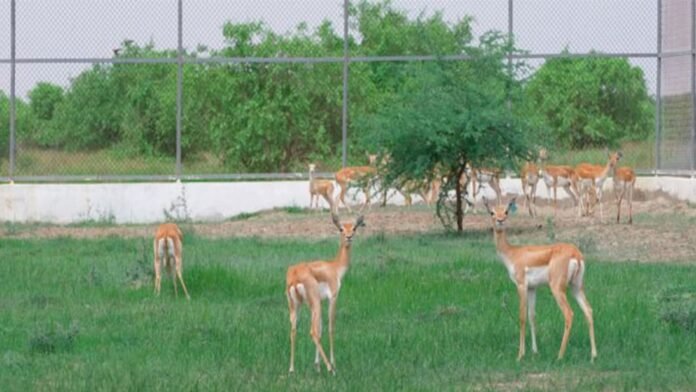
On a day when India celebrated 80 years of Independence, the Banni Grasslands of Kutch witnessed a quieter but significant return, 20 blackbucks were released into their natural habitat, marking an important step towards restoring the native wildlife of one of Gujarat’s most distinctive grassland ecosystems.
The rewilding initiative was carried out by the Gujarat Forest Department in collaboration with the Greens Zoological Rescue and Rehabilitation Centre (GZRRC), Vantara, the wildlife conservation initiative founded by Anant Ambani. The animals were released on August 15 as part of efforts to rebuild populations of native herbivores and strengthen the ecological balance of the Banni landscape.
The 20 blackbucks included five males and 15 females. They were brought from Vantara’s rescue and rehabilitation centre in Jamnagar before being released into the grasslands. The move forms part of a broader programme to restore native herbivore populations in suitable grassland habitats across Gujarat.
Why Banni matters
Spread across the Kutch region, the Banni Grasslands are among India’s important grassland landscapes and support a diverse range of flora and fauna. The ecosystem is particularly significant for pastoral communities as well as for wildlife that depends on open grassland habitats.
The return of blackbucks is therefore more than the release of 20 animals. It is an attempt to restore a native species to an ecosystem where herbivores play an important role in the functioning of the grassland food chain.
Blackbucks, scientifically known as Antilope cervicapra, are one of India’s most recognisable antelopes. Known for their distinctive dark-and-white colouring and the spiralling horns of males, they are closely associated with India’s open grasslands and semi-arid landscapes.
Rewilding a native species
Rewilding involves returning wildlife to suitable natural habitats and enabling populations to become part of functioning ecosystems. For the Banni landscape, restoring native herbivores can help strengthen ecological processes and biodiversity.
The current initiative is also significant because it is being viewed as the beginning of a larger wildlife restoration effort. According to reports, Gujarat plans to relocate more animals to suitable habitats as part of efforts to rebuild native wildlife populations.
A healthy herbivore population can also contribute to strengthening the prey base in a landscape. This could have wider implications for future conservation efforts, including projects involving the restoration of large carnivore populations.
An Independence Day with an ecological message
The timing of the release gave the conservation initiative a symbolic dimension. While Independence Day traditionally celebrates India’s freedom and achievements, the return of native wildlife to a natural landscape offered another interpretation of the occasion, one centred on protecting the country’s ecological heritage.
The Banni Grasslands are not merely an expanse of open land. They represent a complex relationship between wildlife, grasslands, pastoral communities and the landscape itself. Protecting such ecosystems requires maintaining this balance rather than viewing conservation only through the lens of individual species.
The release of the blackbucks therefore represents both a conservation intervention and a reminder of the importance of protecting India’s grassland habitats.
Restoring the grassland ecosystem
Wildlife conservation is often associated with forests and flagship species such as tigers and elephants. Grasslands, however, are equally important ecosystems supporting specialised plants, birds, reptiles, insects and mammals.
The reintroduction of blackbucks into Banni highlights the need to recognise these landscapes as valuable habitats in their own right. Restoring native herbivores can contribute to rebuilding ecological relationships that have been weakened over time.
For Gujarat, the release marks the beginning of a larger effort. For the blackbucks, it represents a return to the wild. And for the Banni Grasslands, it is a step towards restoring the richness of a landscape where wildlife and human communities have shared space for generations.
On India’s 80th Independence Day, 20 blackbucks found a new beginning in the Banni Grasslands, turning a national celebration into a moment of conservation and ecological restoration.