

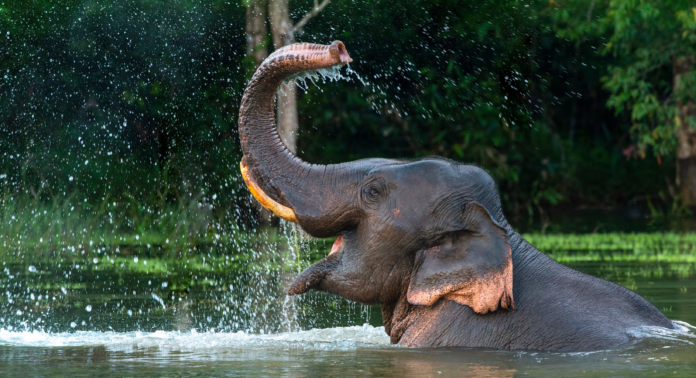
There is something about an elephant that makes us stop and look.
Perhaps it is their enormous presence. Perhaps it is the quiet way they walk through a forest, or the way a mother stays close to her calf. We call them gentle giants, but there is much more to elephants than their size. They are deeply social animals, form strong bonds with their herds, have individual personalities and even display playfulness and affection.
Every year, August 12 is observed as World Elephant Day, a day that began in 2012 to create greater awareness about the challenges faced by both Asian and African elephants.
But perhaps this day is not only about celebrating elephants.
It is about asking ourselves whether we have made enough space for them to simply live.
For centuries, elephants have been part of India’s forests, landscapes, culture and imagination. They appear in our mythology, temples, paintings, literature and folk traditions. Yet beyond all the symbolism, an elephant is a living being with a family, a memory, emotions and a natural place in the ecosystem.
And that place is becoming increasingly difficult to protect.
As human settlements, roads, railway tracks, farms and other forms of development expand, elephant habitats become fragmented. Their traditional movement routes can intersect with human settlements, creating conflict between people and wildlife. Elephants may enter agricultural fields in search of food, while communities living around forests can face crop losses, fear and sometimes serious danger.
The tragedy is that neither side necessarily chooses this conflict.
An elephant does not know that a forest boundary has been redrawn on a map. It only knows the landscape it has travelled through for generations.
Then there are threats created directly by humans.
Elephants have long been hunted for their ivory, and poaching continues to take thousands of elephants every year. Their tusks, which are part of their bodies and serve natural purposes, have made them targets for an illegal trade driven by human demand.
There is also another uncomfortable truth we need to acknowledge, the exploitation of elephants for entertainment and tourism.
Elephant rides, performances and certain tourist interactions may appear harmless to visitors. But activities that force elephants to perform unnatural behaviours or submit to repeated human contact can involve fear, pain and suffering. Responsible tourism therefore means looking beyond the photograph and asking what the animal has gone through to make that moment possible.
Perhaps that is what World Elephant Day should make us think about.
Not just how beautiful elephants are.
But how vulnerable they can become when human needs constantly take priority.
Conservation cannot simply mean protecting elephants from a distance. It also means protecting the forests they depend on, keeping wildlife corridors functional, reducing human-elephant conflict, preventing poaching and ensuring that communities living alongside wildlife are not left alone to deal with the consequences.
It means learning to coexist.
Maybe there is something we can learn from the elephant itself.
They live in families. They protect their young. They stay close to their herd. They communicate, remember and care.
And perhaps, as humans, we need to remember something too:
The forests were not created for us alone.
The world does not belong only to the species that learned to build roads, cities and machines.
There are other lives here. Older lives. Quieter lives.
This World Elephant Day, let us celebrate the elephant not merely as a symbol of strength, wisdom or grandeur, but as a living being that deserves dignity and freedom.
Because the true measure of our progress may not be how much of nature we can conquer.
It may be how much of it we can learn to live alongside.