

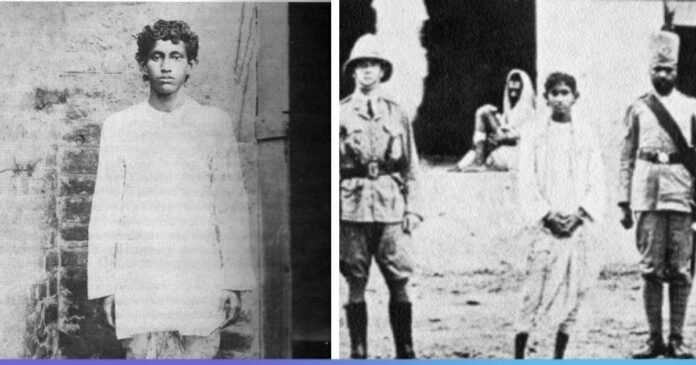
On August 11, India remembers Khudiram Bose, one of the youngest revolutionaries of the freedom struggle, on his 119th martyrdom day. More than a century after his execution, his name continues to evoke the courage, conviction and sacrifice of a young man who chose to dedicate his life to India’s struggle against British rule. Across the country, programmes are being organised to pay tribute to the revolutionary whose life remains an important chapter in India’s freedom movement.
Born on December 3, 1889, in Midnapore, Bengal, Khudiram lost his parents at a young age and was raised by his elder sister. His exposure to the nationalist movement during his teenage years deeply influenced him. He became associated with revolutionary activities and joined the Anushilan Samiti, a secret revolutionary organisation that was active in Bengal during the anti-colonial struggle.
At an age when most young people were still discovering their ambitions, Khudiram had already become deeply involved in the movement against British rule. The political atmosphere of Bengal at the beginning of the 20th century was charged with nationalist sentiment, particularly after the 1905 Partition of Bengal. For young revolutionaries like Khudiram, resistance to colonial rule became a personal mission.
His name became widely known following the Muzaffarpur bombing of April 30, 1908. Khudiram, along with fellow revolutionary Prafulla Chaki, was involved in an attempt to assassinate British magistrate Douglas Kingsford, who was regarded by revolutionaries as particularly harsh towards Indian nationalists.
The two revolutionaries targeted a carriage they believed was carrying Kingsford. However, Kingsford was not inside. The bombing instead killed two British women, Mrs and Miss Kennedy. The tragic outcome became a significant turning point in Khudiram’s life.
Prafulla Chaki later died by suicide while attempting to evade capture. Khudiram was arrested by the British police and subsequently brought to trial. He was sentenced to death and hanged at Muzaffarpur Central Jail on August 11, 1908, when he was only 18 years old.
It was the manner in which the young revolutionary faced his final moments that contributed to the enduring memory of Khudiram Bose. He confronted death with remarkable composure, becoming a symbol of youthful courage and sacrifice in India’s freedom struggle.
Yet remembering Khudiram Bose today is not only about remembering how he died. It is also about asking what his life means to young Indians more than a century later.
The circumstances of India have changed dramatically. Khudiram’s generation lived under colonial rule and fought for political freedom. Today’s young Indians live in an independent country and face an entirely different set of responsibilities. The challenge is no longer to overthrow colonial rule, but to contribute towards building a stronger, more equitable and more confident society.
Young India today has opportunities that Khudiram’s generation could scarcely have imagined. Technology has made knowledge accessible at an unprecedented scale. Young people can learn, create businesses, express ideas, pursue unconventional careers and participate in public conversations through digital platforms. At the same time, this enormous connectivity brings new responsibilities. Misinformation, online hostility and impulsive outrage can spread as quickly as genuine knowledge and constructive ideas.
This is where Khudiram’s story can still offer a meaningful lesson: youthful energy becomes powerful when it is guided by purpose.
His courage should not be understood merely as a call for rebellion. It can instead be remembered as an example of conviction, the ability of a young person to believe deeply in a cause and dedicate himself to it. For today’s youth, that sense of purpose can take very different forms: pursuing knowledge, serving communities, questioning injustice responsibly, building institutions, creating opportunities or contributing to India’s social and technological progress.
The meaning of courage has also evolved. In Khudiram’s time, courage meant standing against colonial authority despite the possibility of imprisonment or death. Today, courage can mean standing against misinformation, refusing to participate in hatred, speaking responsibly, pursuing truth and taking responsibility for the society one wants to improve.
The younger generation does not need to imitate the methods of freedom fighters. It needs to understand the values behind their commitment, discipline, conviction, sacrifice and a sense of responsibility towards something larger than oneself.
Khudiram Bose was only 18 when he was executed, but his age did not prevent him from becoming a significant figure in India’s freedom struggle. His story is therefore also a reminder that young people have never been merely spectators in India’s history.
From the revolutionaries of the freedom movement to today’s students, innovators, entrepreneurs, artists, researchers and citizens, every generation has its own challenges and its own definition of courage.
On his 119th martyrdom day, Khudiram Bose is remembered not simply as a young man who gave his life, but as a symbol of the extraordinary force that youth can become when passion is combined with purpose.
His generation fought to win India’s freedom. The responsibility of today’s generation is to understand that freedom, use it wisely and build a future worthy of the sacrifices that made it possible.