

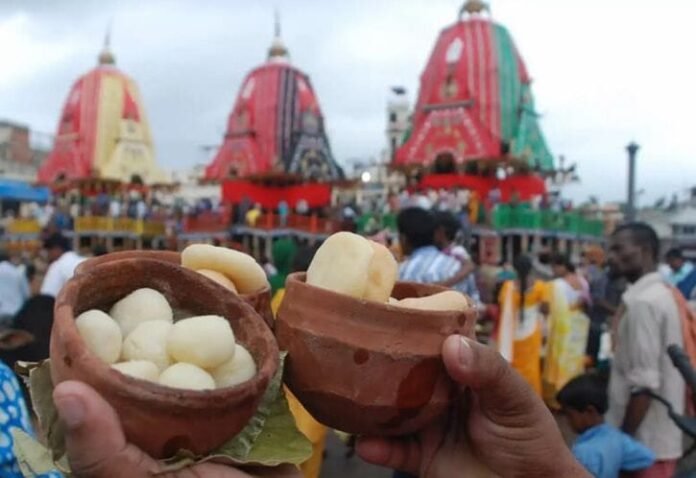
Rasgulla. Rosogolla. Rasagola.
Whatever you call it, the soft, spongy sweet soaked in sugar syrup is loved across India. But behind this familiar dessert lies a fascinating cultural debate: Where did rasgulla actually originate, Odisha or Bengal?
For many Indians, the immediate answer is Bengal. Kolkata’s famous sweet shops and the popularity of Bengali rosogolla have made the sweet almost synonymous with Bengal.
But travel to Odisha, particularly to Puri and the world of Lord Jagannath, and another story emerges.
Here, rasagola is not merely a sweet. It is connected with the traditions surrounding Lord Jagannath, Goddess Lakshmi and the annual Rath Yatra.
The Story Begins With Rath Yatra
Every year, Puri comes alive for the spectacular Rath Yatra, when Lord Jagannath, along with his elder brother Lord Balabhadra and sister Goddess Subhadra, leaves the Jagannath Temple and travels to the Gundicha Temple.
After spending several days there, the deities begin their return journey to the main temple.
But according to the traditional Odia narrative, Goddess Lakshmi does not accompany them.
When Lord Jagannath returns, Lakshmi is believed to be displeased with him for leaving her behind. During Niladri Bije, the final ritual of the Rath Yatra, she prevents him from entering the temple.
The traditional story then takes a sweet turn.
To persuade Goddess Lakshmi to forgive him and allow him back into the temple, Lord Jagannath offers her rasagola.
Thus, the sweet becomes part of a larger story of reconciliation between the divine couple.
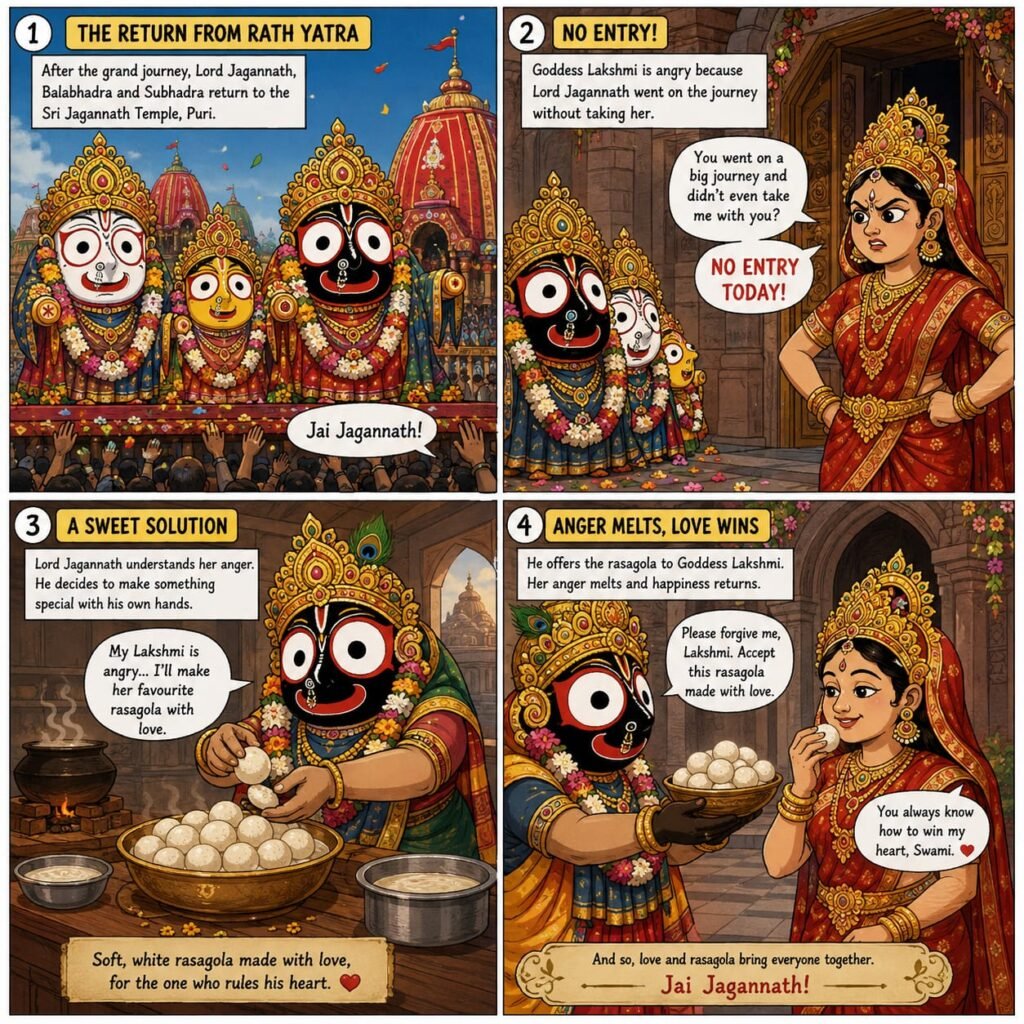
Why Is Rasagola Offered to Goddess Lakshmi?
The offering of rasagola during Niladri Bije is one of the traditions that gives the sweet its special place in Odisha’s cultural memory.
For devotees, the significance is not simply about food. The offering represents an attempt to pacify Goddess Lakshmi and seek reconciliation.
This association has also become an important part of Odisha’s efforts to highlight its traditional connection with rasagola.
However, it is important to distinguish religious tradition from documented culinary history. The Niladri Bije tradition establishes a strong cultural association between rasagola and Odisha, but it does not by itself establish the precise date or individual responsible for inventing the sweet.
So, Was Rasagola Invented in Odisha?
This is where the history becomes complicated.
Odia scholars and cultural historians have pointed to references to chhena-based preparations in older Odia literary traditions, including references associated with Balaram Das’s Dandi Ramayana, generally dated to the late 15th or early 16th century.
Such references are often cited in discussions about the antiquity of chhena-based sweets in Odisha. However, establishing that these references describe the modern rasagola exactly as it is prepared today is more difficult.
There is also no surviving historical document that conclusively identifies a particular person as the inventor of rasagola in medieval Odisha.
Therefore, it would be too strong to claim that history has definitively proved that modern rasagola was invented in Odisha on a particular date by a particular person.
What can be said more confidently is that Odisha has a deep cultural and religious association with rasagola, especially through the Jagannath tradition and Niladri Bije.
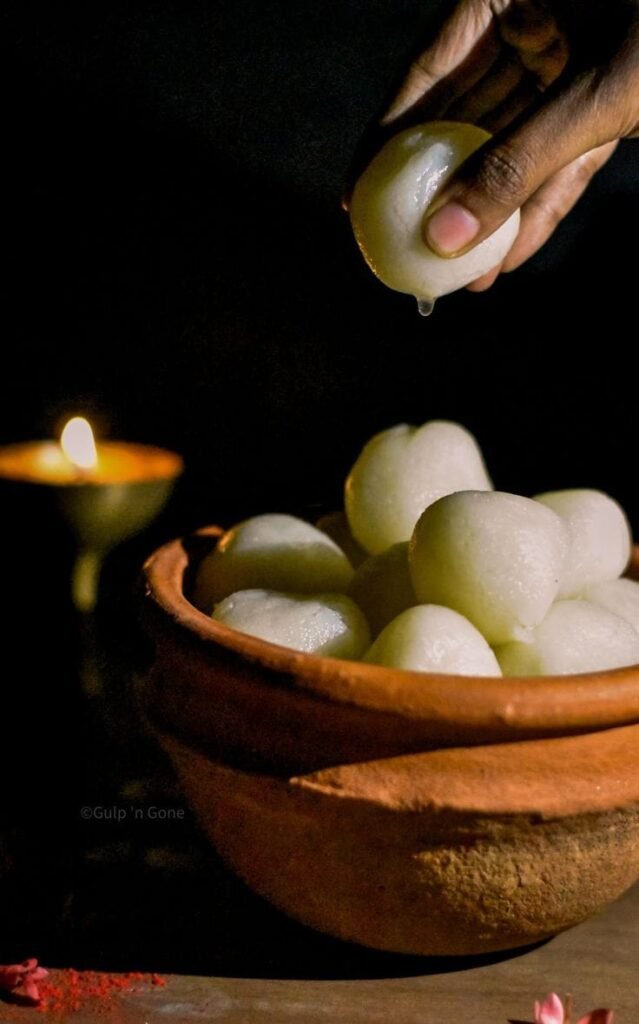
Then Comes Bengal’s Rosogolla
The Bengali story belongs to the 19th century.
The modern Kolkata-style rosogolla is strongly associated with confectioner Nobin Chandra Das, who is widely credited with developing the soft, spongy version of the sweet in Kolkata around the 1860s.
His experiments with chhena and sugar syrup helped establish the form of rosogolla that eventually became one of Bengal’s most recognisable sweets.
Kolkata’s thriving sweet-shop culture and the commercial popularity of rosogolla helped take the sweet far beyond Bengal.
This distinction is important.
Odisha has a traditional rasagola story rooted in Jagannath culture, while Bengal has a well-known 19th-century history surrounding the development and commercial popularisation of its rosogolla.
Rather than erasing one history in favour of the other, both deserve to be understood.
Odisha Rasagola and Banglar Rosogolla
Although the two sweets share similarities, regional versions can differ in their preparation, texture, colour and consistency.
Both are broadly associated with chhena and sugar syrup, but Odisha Rasagola and Banglar Rosogolla have developed their own culinary and cultural identities.
This is one reason the question of “who owns rasgulla?” cannot be answered simply by pointing to one recipe.
Food traditions evolve. Recipes travel between regions, communities adapt them and different places give them their own identity.
The GI Tags Changed the Conversation
The debate gained national attention in the 2010s.
In 2017, West Bengal received a Geographical Indication (GI) registration for “Banglar Rosogolla.”
Two years later, in 2019, “Odisha Rasagola” also received GI registration.
The two registrations recognise the distinct regional identities of the products. They should not be interpreted as a legal declaration that one state invented every version of rasgulla.
Instead, they recognise specific regional products and their associated traditions.
In other words, Bengal has its Banglar Rosogolla, while Odisha has its Odisha Rasagola.
Both have a legitimate place in India’s culinary heritage.
Why Does Everyone Associate Rasgulla With Bengal?
The answer is largely connected to popularity and commercialisation.
Kolkata developed a celebrated sweet-making culture, and rosogolla became one of its most recognisable culinary symbols. The growth of commercial sweet shops helped spread the Bengali version across India.
Odisha’s association, meanwhile, remained more closely linked with Jagannath culture, temple traditions and religious practices.
This difference in visibility may explain why many Indians have automatically associated rasgulla with Bengal without knowing about Odisha’s traditional connection with rasagola.
A Sweet With a Larger Story
Perhaps the most fascinating aspect of Odisha’s rasagola tradition is the story surrounding it.
Lord Jagannath leaves Puri with Balabhadra and Subhadra during Rath Yatra. Goddess Lakshmi remains behind. When Jagannath returns, she refuses to let him enter.
The offering of rasagola becomes part of the reconciliation.
In this story, food becomes more than nourishment or celebration. It becomes an expression of affection, apology and reconciliation.
Odisha also celebrates Rasagola Dibasa around the time of Niladri Bije to highlight the state’s traditional association with the sweet and its connection with Lord Jagannath.
So, Is Rasgulla Odia or Bengali?
Perhaps the most accurate answer is: the history is more complicated than choosing one winner.
Odisha has a longstanding cultural and religious association with rasagola, particularly through the Jagannath tradition and Niladri Bije.
Bengal has a well-documented 19th-century history associated with the development and commercial popularity of the modern Kolkata-style rosogolla, particularly through Nobin Chandra Das.
Therefore, saying simply that “rasgulla is Bengali” leaves out an important part of its history.
At the same time, claiming that every form of modern rasgulla was definitively invented in Odisha would also go beyond what the available historical evidence can establish.
The more nuanced story is that Odisha and Bengal have distinct rasagola and rosogolla traditions, shaped by different cultural histories.
It is easy to look at a rasgulla floating in sugar syrup and see only a dessert. But behind that little white ball is a story involving Puri, Lord Jagannath, Goddess Lakshmi, Rath Yatra, Niladri Bije, Odia traditions, Kolkata’s confectionery culture and the GI debate.
Perhaps that is what makes rasgulla so fascinating.
Its history cannot be reduced to a simple question of ownership.
In Odisha, it lives within a sacred tradition. In Bengal, it became a culinary icon that travelled across the country.
And somewhere between the temple rituals of Puri and the sweet shops of Kolkata lies the larger story of how Indian food traditions evolve, travel and acquire new identities.
So the next time you enjoy a rasgulla, remember that you are tasting more than a sweet.
You are tasting a piece of India’s layered culinary history, one that has been shared, adapted, celebrated and debated across generations.
(The writer of this article is Swagatika, a student of APS Jaipur)