

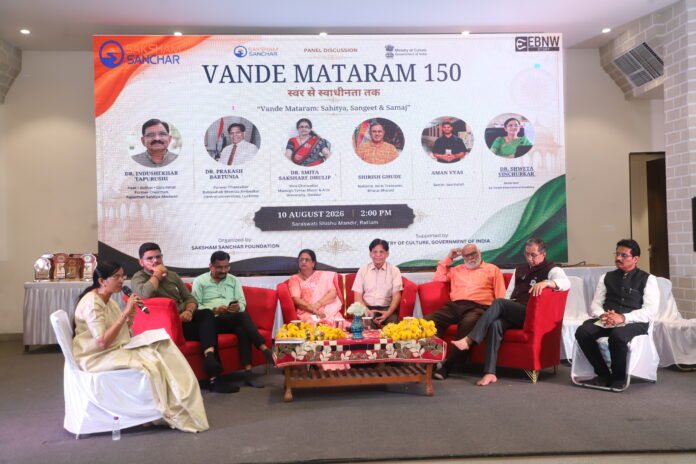
Ratlam event brings together historians, artists, journalists and students to reflect on the 150-year journey of Bankim Chandra Chattopadhyay’s iconic composition
Ratlam, August 10, 2026: A song that once echoed through India’s freedom struggle became the centre of a day-long conversation on history, literature, music, culture and national consciousness in Ratlam on Monday.
Marking 150 years of ‘Vande Mataram’, Saksham Sanchar Foundation, in collaboration with the Ministry of Culture, Government of India, organised ‘Vande Mataram 150, From Melody to Freedom’ at Saraswati Shishu Mandir, Ratlam. The programme brought together scholars, artists, journalists, cultural practitioners, teachers and a large number of students and young participants to revisit the journey of Vande Mataram and explore what the iconic composition means to a new generation.
The programme sought to go beyond remembering the song as a historical symbol and examine the literary, musical and cultural forces that transformed it into one of the enduring expressions of India’s national consciousness.
Tracing 150 Years of ‘Vande Mataram’
Discussions during the programme explored the historical origins of Vande Mataram, the contribution of Bankim Chandra Chattopadhyay, its association with the freedom movement and its role in shaping the idea of national consciousness in India.
Dr. Smita Sahasrabuddhe, Vice Chancellor of Mansingh Tomar Music and Arts University, Gwalior, reflected on Vande Mataram through the lens of music and art. She highlighted the emotional strength of the composition and its ability to connect generations, describing it as more than an arrangement of words and melodies, a cultural memory carried forward through music.
Dr. Prakash Bartuniya, former Vice Chancellor of Babasaheb Bhimrao Ambedkar University, Lucknow, spoke about the historical significance of the national song and its role in the development of national consciousness. He emphasised that nation-building is not shaped by institutions alone, but also by the values and ideas that create a sense of responsibility towards the country and society.
‘Anandamath’ and the Literary Context
The literary roots of Vande Mataram were explored in a special discussion by Indushekhar Tatpurush, who spoke about the 150-year journey of Anandamath and Vande Mataram.
The session examined Bankim Chandra Chattopadhyay’s literary vision, the significance of Anandamath and the wider cultural influence of Vande Mataram. The discussion underlined the importance of understanding the song within its literary and historical context rather than viewing it only as an isolated composition.
Why National Consciousness Matters to Young India
The contemporary relevance of Vande Mataram and the changing meaning of national consciousness were also discussed during the programme.
Senior journalist Aman Vyas highlighted the need to communicate national values and social responsibility to young people through the language and platforms they engage with in today’s digital age.
He emphasised that responsibility towards the nation extends beyond emotion and sentiment and is also reflected in an individual’s understanding of and commitment to their responsibilities towards society and the country.
Music, Literature, Society and the Next Generation
A key segment of the programme was the panel discussion titled ‘Vande Mataram at 150 Years: Music, Literature and Society’.
The discussion touched upon Indian nationalism, Anandamath and the cultural renaissance, the presence of Vande Mataram across Indian languages, education and national values, and the responsibilities of young citizens.
The panel was moderated by Dr. Shweta Vinchurkar of Sai Shree International Academy. Students participated actively in the session, putting questions to the experts and engaging in discussions on history, culture and contemporary India.
Students Turn History into Art and Expression
For the students, the programme was not limited to lectures and discussions. Essay writing, slogan writing and painting competitions provided them with a platform to interpret Vande Mataram, the freedom movement, Indian culture, nation-building and national consciousness through their own creative perspectives.
The initiative encouraged students to look at history not merely as something to be studied, but as a subject that can be questioned, interpreted and expressed through their own voices.
Storytelling, Film and Cultural Performances
A film/documentary tracing the historical journey and significance of Vande Mataram was screened during the programme, followed by a discussion and review session with participants.
Cultural performances further brought together different expressions of Indian art, heritage and national sentiment.
A special storytelling session by Bharti Dixit offered another perspective on the journey of Vande Mataram. Through narrative, emotion and historical anecdotes, the session brought alive the story behind the song and its place in India’s collective memory.
150 Voices, One Rendition
The programme concluded with 150 students coming together for a collective rendition of ‘Vande Mataram’.
The collective singing brought the day’s discussions on history, culture, literature and national consciousness together in a single moment, as students gave voice to a composition whose journey spans a century and a half.
Distinguished guests and participants were also felicitated, while students who performed exceptionally in the various competitions were presented with awards.
The organisers said that ‘Vande Mataram 150, From Melody to Freedom’ was conceived as more than a commemorative programme. It was an effort to create a dialogue between India’s historical memory and its younger generation, bringing together literature, music, culture and contemporary ideas of national responsibility.
As Vande Mataram completes 150 years, the programme offered a reminder that remembering history is only one part of preserving it. The larger task lies in understanding its values, engaging with its legacy and carrying its lessons into the India of tomorrow.
Programme Details:
Date: August 10, 2026
Venue: Saraswati Shishu Mandir, Ratlam, Madhya Pradesh
Organiser: Saksham Sanchar Foundation
In collaboration with: Ministry of Culture, Government of India