

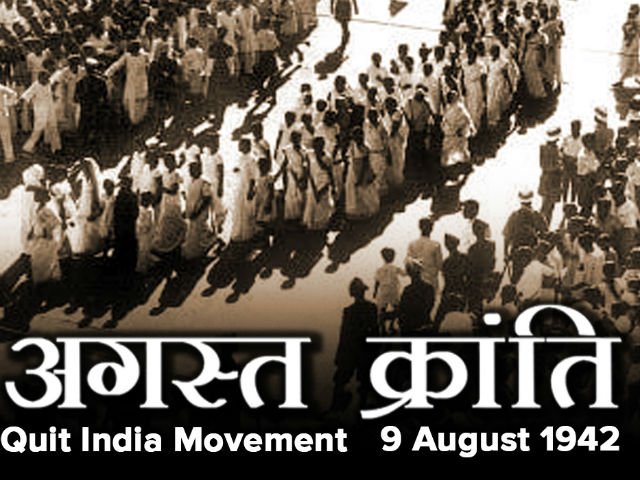
On 8 August 1942, at the Gowalia Tank Maidan in Bombay (now Mumbai), India took one of the most decisive steps towards freedom. The All India Congress Committee passed the historic Quit India Resolution, launching a mass movement that would come to be known as the August Kranti or Quit India Movement.
The message was simple but powerful: the British must leave India.
Mahatma Gandhi gave the nation a call that would become one of the defining slogans of India’s freedom struggle: “Do or Die.” He urged Indians to fight for independence with courage and determination, making it clear that the time had come for India to achieve freedom.
Why Did the August Kranti Begin?
By 1942, the world was in the middle of the Second World War. Britain had involved India in the war without consulting Indian leaders or the Indian people. At the same time, India’s demand for independence had grown stronger.
The failure of the Cripps Mission earlier in 1942 further disappointed Indian nationalists. The proposals offered by the British government did not provide immediate independence, and the Congress leadership concluded that waiting was no longer an option.
The atmosphere was also changing within India. After decades of protests, movements, sacrifices and political negotiations, there was growing frustration with British rule.
The Quit India Movement emerged from this moment of political urgency.
“Do or Die”
On 8 August 1942, Gandhi addressed the gathering at Gowalia Tank Maidan. His message was not a call to violence but a call for determined resistance.
“Do or Die” captured the spirit of the moment. Gandhi asked Indians to remain committed to freedom and to refuse to accept colonial rule.
The next morning, however, the British government moved swiftly. Gandhi and other major Congress leaders, including Jawaharlal Nehru, Sardar Vallabhbhai Patel, Maulana Abul Kalam Azad and others, were arrested.
The British authorities believed that arresting the leadership would bring the movement to an end.
They were wrong.
When the People Took Over
With most of the prominent leaders behind bars, the movement became increasingly decentralised. Students, workers, farmers, women and ordinary citizens stepped forward.
Across different parts of India, people organised protests, strikes and demonstrations. Underground networks helped circulate messages and nationalist literature. In several places, local groups challenged British administrative authority.
Young leaders and activists also played important roles. Aruna Asaf Ali famously hoisted the Indian national flag at Gowalia Tank Maidan after many senior leaders had been arrested, becoming one of the most recognisable faces of the movement.
The movement also saw the emergence of underground radio and communication networks. Usha Mehta, along with her associates, helped operate the secret Congress Radio, which broadcast nationalist messages when much of the mainstream political leadership had been imprisoned.
The British responded with arrests, censorship and force. Thousands of Indians were imprisoned, and many lost their lives during the suppression of the movement.
More Than a Political Movement
The significance of August Kranti goes beyond the events of August 1942.
It demonstrated that the demand for independence had moved far beyond the political leadership. Ordinary Indians were willing to participate, sacrifice and take enormous risks for the idea of a free India.
The movement also revealed the growing difficulty of governing India without Indian cooperation. Although the Quit India Movement was suppressed and did not immediately bring independence, it profoundly changed the political situation.
The British government increasingly understood that continuing colonial rule would not be sustainable indefinitely.
Five years later, India became independent.
Remembering August Kranti
Today, 8 August is remembered as August Kranti Day, commemorating the historic beginning of the Quit India Movement.
When we look back at that evening in 1942, it is easy to remember only the famous words, “Do or Die.” But the real story lies in what followed: thousands of ordinary people choosing courage over fear, sacrifice over comfort, and freedom over submission.
August Kranti reminds us that history is not made only by famous leaders. It is also made by students who took to the streets, workers who joined protests, women who carried messages, farmers who resisted authority, and countless unnamed Indians who refused to remain silent.
The freedom India achieved in 1947 was the result of decades of struggle. The Quit India Movement was one of its final and most powerful chapters, a moment when the demand for freedom became unmistakably clear:
India wanted the British to leave, and India would not stop asking until they did.