

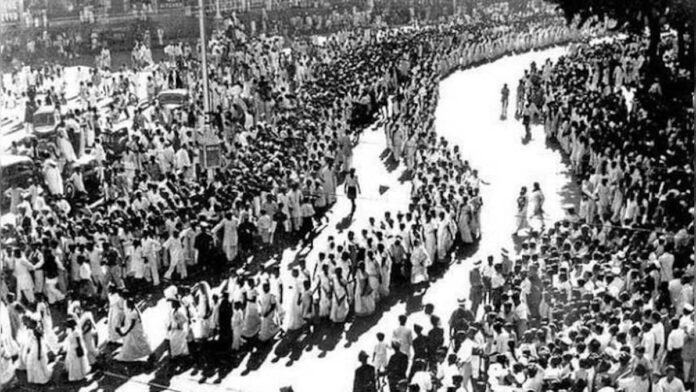
Every year, August 8 and 9 hold a special place in India’s freedom struggle. In 1942, these two days marked the beginning of one of the most powerful mass movements against British rule, the Quit India Movement, also known as the Bharat Chhodo Andolan or August Kranti. Its demand was uncompromising: an immediate end to British rule and complete independence for India.
The movement emerged during the Second World War, when India was being drawn into the war effort without the consent of its elected Indian representatives. The failure of the Cripps Mission in 1942, which did not offer an immediate transfer of power, further intensified political frustration. The Indian National Congress subsequently decided that the time had come for a final mass struggle for independence.
The Historic Call of August 8
On August 8, 1942, the All India Congress Committee (AICC) met in Bombay, at what is today known as August Kranti Maidan. The Congress formally adopted the Quit India Resolution, calling for the withdrawal of British power from India.
Mahatma Gandhi addressed the gathering and delivered his famous “Do or Die” call. His message was that Indians must remain committed to achieving freedom and be prepared to sacrifice their lives for the cause.
The phrase “Quit India” is generally credited to socialist leader Yusuf Meherally, who had coined the slogan before it was adopted by the Congress leadership.
August 9: The Crackdown and Mass Uprising
The British authorities responded swiftly. In the early hours of August 9, Gandhi and other prominent Congress leaders, including Jawaharlal Nehru, Sardar Vallabhbhai Patel and Maulana Abul Kalam Azad, were arrested. The arrests were intended to prevent the movement from gaining momentum.
Instead, they had the opposite effect.
With the national leadership imprisoned, protests erupted across the country. Demonstrations, strikes, boycotts and acts of civil disobedience spread rapidly. In several places, protesters disrupted communications and transport infrastructure. Although Gandhi had called for a non-violent struggle, parts of the leaderless uprising witnessed violence and attacks on government property.
Women and young people played an important role in sustaining the movement. Aruna Asaf Ali became a prominent symbol after hoisting the national flag at Gowalia Tank Maidan on August 9. Underground networks also kept the movement alive. Usha Mehta, for instance, helped operate the clandestine Congress Radio, which broadcast messages of resistance despite British censorship.
In different parts of the country, local groups established parallel governments, including in places such as Ballia in Uttar Pradesh, Tamluk in Bengal and Satara in Maharashtra. These developments demonstrated the depth and geographical spread of the uprising.
Why the Movement Matters
The Quit India Movement was suppressed through arrests, censorship and extensive use of force, and Gandhi remained imprisoned until 1944. Yet its political impact was profound. The movement demonstrated that British rule could no longer rely on Indian cooperation and that the demand for independence had become a mass national aspiration.
The movement did not itself bring immediate independence. However, it significantly strengthened the pressure for Britain’s eventual withdrawal. Five years later, India became independent on August 15, 1947.
Today, August Kranti Diwas is observed to honour the countless people who participated in the movement and endured imprisonment, repression and sacrifice. The Government of India continues to commemorate its legacy as a defining chapter in the freedom struggle.
The Quit India Movement remains significant not simply because of the slogan “Do or Die,” but because it represented a moment when India’s freedom struggle became an unmistakable demand for the end of colonial rule. Its legacy lies in the courage, unity and sacrifice of ordinary Indians who transformed a political call into a nationwide movement for independence.