

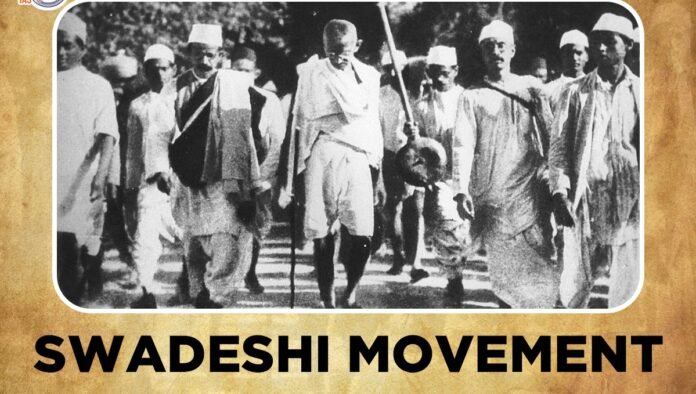
On August 7, 1905, India witnessed the beginning of a movement that would transform the idea of economic self-reliance into a powerful instrument of the freedom struggle. The Swadeshi Movement, born in opposition to the British partition of Bengal, urged Indians to reject foreign goods and embrace products made within the country.
More than a campaign against imported goods, Swadeshi became a movement of national consciousness. It connected economic choices with political freedom and gave ordinary Indians a way to participate in the struggle against colonial rule.
The Partition That Sparked a Movement
The immediate trigger for the movement was the partition of Bengal announced by Viceroy Lord Curzon in 1905. The decision, which came into effect on October 16, divided Bengal into two provinces. Indian nationalists strongly opposed the move, viewing it as an attempt to weaken the growing nationalist movement by dividing people along communal and administrative lines.
The response was swift. On August 7, 1905, a large meeting at Calcutta’s Town Hall formally adopted the resolution to boycott British goods. What began as a protest against the partition soon developed into a broader campaign for economic and political self-reliance.
The word Swadeshi itself means “of one’s own country”. Its philosophy was simple but powerful: India’s freedom could not be complete without strengthening its own economic foundations.
Boycott as an Act of Resistance
One of the movement’s most visible strategies was the boycott of foreign goods, particularly British textiles.
Imported cloth, including the famous Manchester-made textiles, became a symbol of colonial economic exploitation. Indians were encouraged to stop purchasing foreign products and instead support indigenous manufacturers, artisans and traders.
Public bonfires of foreign clothes became powerful demonstrations of resistance. At the same time, Indian-made textiles, soaps, matches and other goods were actively promoted.
This gave economic activity a political meaning. Choosing an Indian-made product became an expression of patriotism.
Building a Nation Through Education and Culture
Swadeshi was not limited to markets and consumer choices. Its leaders understood that true self-reliance required intellectual and cultural independence as well.
National schools and colleges were established to provide education outside the framework of the colonial system. The movement also encouraged Indian languages, literature, indigenous enterprise and cultural traditions.
Art, music and literature became important tools of mobilisation. Rabindranath Tagore played a significant role in transforming the movement into a cultural expression of unity. During the anti-partition protests, the tying of rakhis was used as a symbol of brotherhood and solidarity.
Patriotic songs, including Vande Mataram, became associated with the growing nationalist consciousness.
Lal-Bal-Pal and the Leadership of Swadeshi
The movement brought several prominent nationalist leaders to the forefront. Lala Lajpat Rai, Bal Gangadhar Tilak and Bipin Chandra Pal, popularly remembered together as Lal-Bal-Pal, advocated a more assertive form of nationalism.
Other important figures included Aurobindo Ghosh and Surendranath Banerjee, who helped shape the political and intellectual dimensions of the movement.
The Swadeshi Movement also contributed to the growth of indigenous enterprise. The idea was not merely to reject foreign goods but to create the capacity to produce Indian alternatives.
From Swadeshi to Swaraj
The philosophy of Swadeshi continued to influence India’s freedom struggle even after the movement’s initial phase.
Decades later, Mahatma Gandhi gave the idea a central place in his political philosophy. For Gandhi, Swadeshi was closely connected with Swaraj, self-rule. The spinning wheel, or charkha, became one of the most recognisable symbols of this philosophy.
Khadi and hand-spun cloth represented more than clothing. They symbolised dignity of labour, village-based production, economic independence and resistance to colonial economic structures.
The act of spinning became a form of participation in the freedom struggle, linking the individual household to the larger national movement.
A Legacy That Lives On
The Swadeshi Movement formally belonged to the freedom struggle of the early twentieth century, but its central idea remains relevant.
Its emphasis on indigenous production, local enterprise and economic self-reliance continues to resonate in contemporary India. The country’s handloom and handicraft traditions, in particular, carry forward an important part of this legacy.
Every handwoven textile purchased today supports a chain of traditional knowledge, artisan livelihoods and indigenous craftsmanship. In this sense, the spirit of Swadeshi survives not simply as a historical memory but through the continuing effort to value what is made in India.
August 7, therefore, carries a significance that extends beyond history. It marks both the beginning of a powerful nationalist movement and, today, National Handloom Day, a reminder of how closely India’s ideas of self-reliance, indigenous craftsmanship and national identity have been woven together.
The Swadeshi Movement taught India that resistance could begin with a choice: what we buy, what we make and what we choose to value.
More than a century later, that message still carries its own quiet power.