

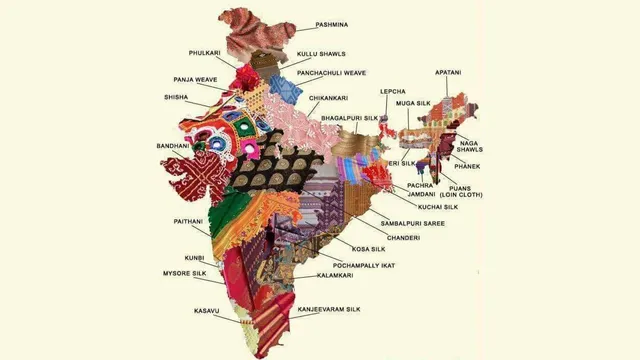
India’s textile heritage is as diverse as its landscape. From the shimmering silk of Banaras to the delicate Jamdani of Bengal, the golden Muga silk of Assam to the intricate Patola of Gujarat, every handloom carries a story of a place, a community and generations of craftsmanship.
For centuries, Indian weavers have transformed simple threads into textiles that are not merely beautiful but deeply connected to culture, tradition and identity. Each weave has its own vocabulary of colours, motifs, techniques and materials, often preserved and passed down through families. Together, they form one of the world’s richest living textile traditions.
Banarasi Silk: The Royal Weave of Uttar Pradesh
Few Indian textiles are as instantly recognisable as Banarasi silk. Woven in and around Varanasi, these luxurious fabrics are celebrated for their rich silk, elaborate zari work and intricate floral and Mughal-inspired motifs.
Traditionally woven with gold and silver-coloured zari, Banarasi textiles have long been associated with weddings, celebrations and royalty. Their detailed craftsmanship can make a single piece take weeks or even months to complete, depending on its complexity.
Chanderi: The Delicate Elegance of Madhya Pradesh
Known for its extraordinary lightness and translucent texture, Chanderi is often described as one of India’s most graceful handlooms. Originating from the historic town of Chanderi in Madhya Pradesh, the weave traditionally combines cotton and silk to create a fabric that is light, airy and elegant.
Subtle zari borders and traditional motifs add to its understated beauty, making Chanderi equally suited to ceremonial occasions and refined everyday wear.
Maheshwari: Simplicity with a Royal Legacy
Another celebrated weave from Madhya Pradesh is Maheshwari, traditionally associated with the town of Maheshwar.
The textile is known for its lightweight cotton-silk composition, distinctive borders and geometric patterns. Its reversible borders and contrasting stripes give it a unique character, while its history is closely associated with the royal patronage of Ahilyabai Holkar.
Maheshwari represents a beautiful balance between simplicity and sophistication.
Pashmina: The Soft Luxury of Kashmir
From the mountains of Jammu and Kashmir comes Pashmina, one of the world’s most prized natural fibres. Traditionally obtained from the fine undercoat of high-altitude goats, genuine pashmina is exceptionally soft, warm and lightweight.
Its production involves highly skilled spinning, weaving and finishing techniques, many of which have been refined over generations. More than a luxury textile, Kashmiri pashmina represents a centuries-old craft tradition shaped by the region’s landscape and communities.
Kanchipuram Silk: The Queen of South Indian Silks
In Tamil Nadu, Kanchipuram silk occupies a special place in India’s textile heritage. Traditionally woven in Kanchipuram, these heavy silk sarees are famous for their bold contrasting borders, vibrant colours and traditional temple-inspired motifs.
The strength of the silk, richness of the colours and intricate zari work have made Kanchipuram sarees a treasured choice for weddings and major celebrations, particularly across South India.
Patola: Gujarat’s Double-Ikat Masterpiece
Patola is among India’s most technically demanding handwoven textiles. Traditionally associated with Patan in Gujarat, Patola is distinguished by the complex double-ikat technique.
Both the warp and weft threads are carefully tie-dyed before weaving so that the patterns align precisely when the fabric is woven. The result is an exceptionally sharp and intricate design that appears on both sides of the textile.
The painstaking process and extraordinary precision involved make Patola a symbol of Gujarat’s sophisticated weaving tradition.
Paithani: Maharashtra’s Peacock of Silk
Originating from Paithan in Maharashtra, Paithani is renowned for its luxurious silk, vivid colours and elaborate pallus.
The most recognisable designs include peacocks, parrots, flowers and geometric motifs. Traditional Paithani weaving is particularly celebrated for its intricate pallu and border work, often incorporating zari to create a rich, luminous appearance.
A Paithani is more than a saree, it is a piece of Maharashtra’s artistic heritage.
Jamdani: Bengal’s Poetry in Muslin
The delicate Jamdani tradition of Bengal is an extraordinary example of textile craftsmanship. Traditionally associated with fine muslin, Jamdani is recognised for its intricate floral and geometric motifs.
Rather than simply printing or embroidering the designs onto the fabric, artisans create many motifs directly during the weaving process. The result is an exceptionally detailed textile that appears almost weightless.
Jamdani’s painstaking craftsmanship has earned it recognition as an important traditional textile heritage.
Muga Silk: Assam’s Golden Thread
Few textiles have a natural identity as distinctive as Muga silk of Assam. Produced by the silkworm Antheraea assamensis, Muga is known for its naturally golden-yellow colour and remarkable durability.
Unlike many other silks, its lustre can become more pronounced with age and use. Closely associated with Assamese culture, Muga silk is traditionally used for garments worn during important occasions and ceremonies.
It is a textile where nature itself becomes part of the design.
Sambalpuri Ikat: Odisha’s Rhythmic Patterns
The Sambalpuri Ikat tradition of Odisha is known for its distinctive tie-and-dye weaving technique and strong cultural symbolism.
Artisans resist-dye sections of the yarn before weaving, creating characteristic patterns that include traditional motifs such as the conch shell, wheel and flowers. The vibrant colours and rhythmic geometric designs give Sambalpuri textiles a distinctive visual identity.
A Heritage Woven by Hand
From Kashmir to Kanyakumari and Gujarat to Assam, India’s handlooms demonstrate how geography, history and human creativity can come together through a single thread.
What makes these textiles truly remarkable is not simply their beauty. It is the knowledge behind them, the ability of a weaver to understand yarn, tension, colour, motif and rhythm, often using techniques inherited from generations before.
At a time when fashion is increasingly moving towards sustainability, craftsmanship and authenticity, Indian handlooms offer something that mass production cannot easily replicate: a human story woven into every metre of fabric.
National Handloom Day is therefore more than an occasion to admire beautiful textiles. It is a reminder to recognise the artisans behind them, support traditional weaving communities and ensure that these extraordinary skills continue to live on.
Because India’s handloom heritage is not something preserved only in museums.
It is still being woven, one thread, one loom and one generation at a time.