

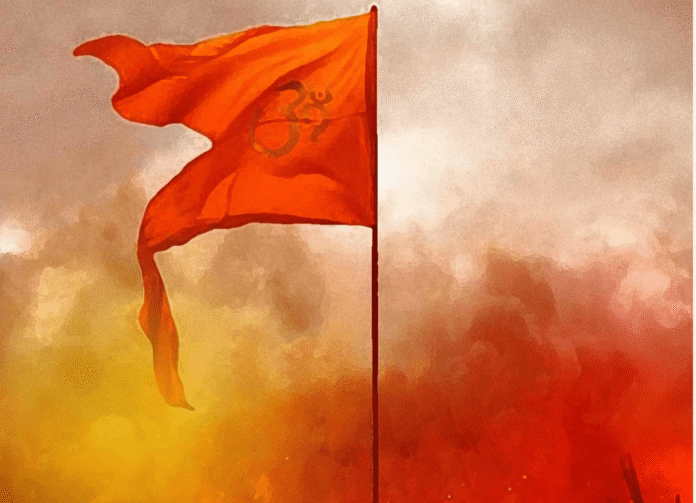
Unlike most organisations, the Rashtriya Swayamsevak Sangh (RSS) does not place an individual at the centre of its reverence. Instead, it bows before the Bhagwa Dhwaj (Saffron Flag), regarding it as its Guru. Every year on Guru Purnima, RSS swayamsevaks across the country gather to offer Guru Dakshina to the Bhagwa Dhwaj, a tradition that reflects the organisation’s philosophy of selfless service, discipline, and devotion to ideals rather than personalities.
The saffron flag has long occupied a revered place in Indian civilisation. Across centuries, it has symbolised sacrifice (tyaga), renunciation (vairagya), courage, purity, and the pursuit of truth. From ancient rishis and monks to warrior saints and freedom fighters, the saffron banner has represented the eternal values of dharma and national awakening. For the RSS, these timeless ideals are embodied in the Bhagwa Dhwaj.
The tradition dates back to the organisation’s founder, Dr. Keshav Baliram Hedgewar, who established the RSS in 1925. Dr. Hedgewar believed that while great leaders inspire generations, every individual is ultimately human and therefore fallible. Building an organisation around a person, he felt, could lead to personality cults, divisions, and dependence on individuals. Instead, he chose the Bhagwa Dhwaj as the eternal Guru, an unchanging symbol that inspires every swayamsevak equally and remains above personal ambition or authority.
This philosophy was later elaborated by Shri Madhavrao Sadashivrao Golwalkar, affectionately known as Guruji. In his writings and speeches, particularly in the book Bunch of Thoughts, Golwalkar explained that the Bhagwa Dhwaj represents the highest ideals of Indian civilisation and serves as a constant reminder of selfless dedication to the nation and society. The flag, he wrote, is not merely a piece of cloth but a symbol of values that transcend generations.
Every year on Guru Purnima, RSS shakhas observe the Guru Dakshina programme. The ceremony begins with the Bhagwa Dhwaj being respectfully hoisted. Swayamsevaks gather in disciplined formation, offer flowers before the flag, and bow in reverence. They then make voluntary monetary contributions, known as Guru Dakshina, placing them before the flag as an offering.
These contributions are not membership fees or compulsory donations. They are voluntary expressions of gratitude and commitment towards the ideals represented by the Bhagwa Dhwaj. Traditionally, the funds collected help support organisational activities, educational programmes, training camps, and various service initiatives undertaken by the RSS.
The ceremony is also accompanied by intellectual discussions (bauddhik), patriotic songs, and addresses by senior functionaries, who reflect on the meaning of Guru Purnima and the responsibilities of a swayamsevak. Rather than glorifying any individual, the focus remains on character-building, national service, discipline, and the timeless principles symbolised by the saffron flag.
The concept of a flag serving as a guru is unusual in modern organisational life, but it reflects a deeper philosophical idea rooted in Indian thought. By venerating a symbol instead of a person, the RSS seeks to emphasise that individuals come and go, while ideals endure. The Bhagwa Dhwaj neither seeks recognition nor exercises authority; it silently inspires commitment to sacrifice, humility, and service.
Within the broader Indian tradition, saffron has always been associated with renunciation and higher purpose. Saints who renounce worldly attachments wear saffron robes, and many historic kingdoms and spiritual traditions carried saffron banners as symbols of righteous duty. The RSS views its Bhagwa Dhwaj as an extension of this civilisational legacy rather than as a political emblem.
For swayamsevaks, Guru Purnima is therefore more than a ceremonial occasion. It is a day of introspection, a reminder to renew their dedication to society, strengthen their character, and place the nation above personal interests. The offering of Guru Dakshina symbolises not only financial contribution but also a pledge to live by the ideals represented by the saffron flag.
In choosing the Bhagwa Dhwaj as its Guru, the RSS adopted a tradition that places enduring values above individual personalities. For nearly a century, this distinctive practice has remained central to the organisation’s identity, expressing its belief that while leaders may inspire, it is timeless ideals that ultimately guide a nation’s journey.