

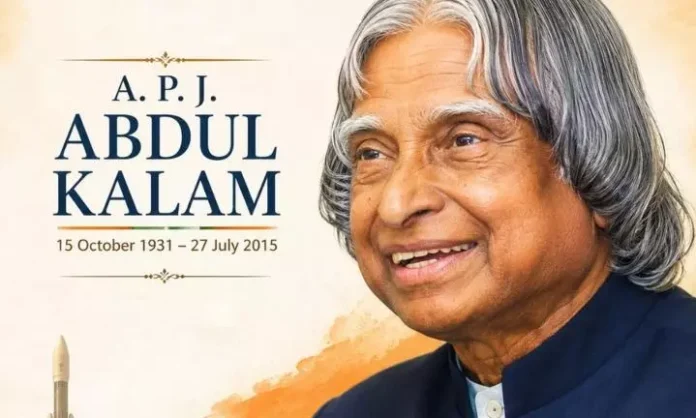
Every year on July 27, India remembers Dr A.P.J. Abdul Kalam, one of the nation’s most beloved leaders, visionary scientists and inspirational teachers. His death anniversary is not merely an occasion to mourn his passing but to celebrate a life dedicated to science, nation-building and the empowerment of young minds. Fondly known as the “Missile Man of India” and the “People’s President,” Dr Kalam left behind a legacy that continues to inspire millions across generations.
Born on October 15, 1931, in Rameswaram, Tamil Nadu, Avul Pakir Jainulabdeen Abdul Kalam came from a humble family. Despite financial hardships, he excelled academically and pursued his passion for science by studying aerospace engineering at the Madras Institute of Technology. His journey from a small coastal town to becoming one of India’s greatest scientists is often regarded as a testament to perseverance, hard work and determination.
Dr Kalam began his scientific career at the Defence Research and Development Organisation (DRDO) before moving to the Indian Space Research Organisation (ISRO), where he played a pivotal role in developing India’s first indigenous Satellite Launch Vehicle (SLV-III), which successfully placed the Rohini satellite into orbit in 1980. Later, he returned to DRDO and spearheaded the Integrated Guided Missile Development Programme (IGMDP), leading the development of strategic missile systems such as Agni and Prithvi. These achievements earned him the enduring title of the “Missile Man of India.”
His contributions extended beyond missile technology. Dr Kalam played a significant role in strengthening India’s strategic capabilities, including his involvement in the Pokhran-II nuclear tests conducted in 1998. His scientific leadership and vision contributed significantly to India’s self-reliance in defence and space technology.
In 2002, Dr Kalam was elected as the 11th President of India, serving until 2007. Unlike many of his predecessors, he became immensely popular among students and young people because of his simplicity, accessibility and unwavering belief in the power of education. He travelled extensively across the country, visiting schools, colleges and universities, encouraging students to dream big and work tirelessly to achieve their goals. His presidency was marked by humility, integrity and a deep commitment to national development, earning him the affectionate title of the “People’s President.”
Dr Kalam was also a prolific author whose books continue to inspire readers worldwide. Works such as Wings of Fire, his autobiography, Ignited Minds, India 2020, and Turning Points reflect his vision of a developed, self-reliant and knowledge-driven India. His famous belief that “Dream is not that which you see while sleeping; it is something that does not let you sleep” continues to motivate countless young Indians.
His extraordinary contributions were recognised with India’s highest civilian honour, the Bharat Ratna, in 1997, along with the Padma Bhushan and Padma Vibhushan. Yet, despite receiving the nation’s highest accolades, he remained remarkably humble, often describing himself simply as a teacher.
On July 27, 2015, Dr Kalam passed away after suffering a sudden cardiac arrest while delivering a lecture at the Indian Institute of Management (IIM) Shillong. Even in his final moments, he was doing what he loved most—interacting with students and inspiring them to shape a better future for the nation. His passing while addressing young minds symbolised the lifelong mission he had embraced.
More than a decade later, Dr A.P.J. Abdul Kalam’s legacy remains deeply woven into India’s scientific progress, educational aspirations and national consciousness. His life reminds us that greatness is not determined by one’s background but by one’s vision, dedication and service to society. On his death anniversary, the nation pays tribute to a scientist who strengthened India’s strategic capabilities, a President who connected with every citizen, and a teacher whose dreams continue to ignite millions of minds across the country.