

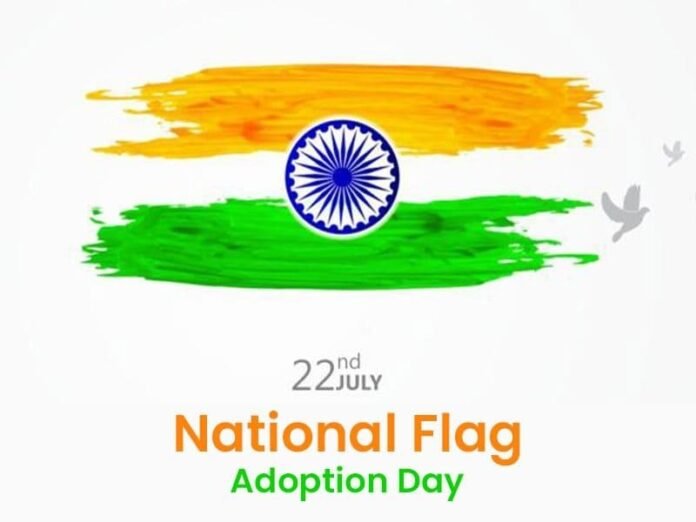
Every year on July 22, India observes National Flag Adoption Day, commemorating the historic moment in 1947 when the Constituent Assembly adopted the Tiranga as the National Flag of India. The decision came just over three weeks before the country attained Independence on August 15, 1947, giving free India a flag that would become the enduring symbol of its unity, sovereignty and democratic ideals.
More than a piece of cloth, the Tiranga represents the sacrifices of countless freedom fighters, the aspirations of a newly independent nation and the values enshrined in the Constitution. As India continues its journey as the world’s largest democracy, National Flag Adoption Day serves as a reminder of the ideals that the Tricolour embodies.
The Historic Adoption
On July 22, 1947, the Constituent Assembly formally adopted the Indian National Flag during its session in New Delhi. Presenting the resolution, Jawaharlal Nehru described the flag not as the emblem of a political party but as the flag of the entire nation. The design was based on the flag used during the freedom movement, with one significant modification—the Ashoka Chakra replaced the spinning wheel (Charkha) at the centre.
The Tricolour was first officially unfurled as the National Flag on August 15, 1947, marking India’s emergence as an independent nation.
The Designer Behind the Tiranga
The design of India’s National Flag is largely credited to Pingali Venkayya, a freedom fighter, agriculturist and flag enthusiast from present-day Andhra Pradesh. Over several years, he developed multiple flag designs for the Indian national movement.
The final design adopted by the Constituent Assembly retained the tricolour pattern while replacing the Charkha with the navy-blue Ashoka Chakra, making it a symbol of progress, justice and continuous movement.
Meaning of the Tiranga
The Indian National Flag consists of three horizontal bands of equal width:
●Saffron (Top): Symbolises courage, sacrifice and selflessness.
●White (Middle): Represents truth, peace and purity.
●Green (Bottom): Signifies faith, fertility, prosperity and the nation’s relationship with nature.
At the centre of the white band is the navy-blue Ashoka Chakra, a wheel with 24 spokes, inspired by the Lion Capital of Ashoka at Sarnath. The Chakra represents righteousness (Dharma), justice and the constant movement towards progress. It reminds citizens that a nation must continue to move forward and never remain stagnant.
Specifications of the National Flag
The Indian National Flag has a length-to-width ratio of 3:2. The Ashoka Chakra is placed at the centre of the white band and is printed on both sides of the flag.
While the flag was traditionally made only from hand-spun and handwoven khadi, recent amendments to the Flag Code permit the use of machine-made and polyester flags under specified conditions.
Respecting the National Flag
The Flag Code of India, 2002, along with subsequent amendments, governs the proper display and handling of the National Flag. It allows citizens to hoist the Tiranga throughout the year, provided it is displayed with dignity and respect.
The Har Ghar Tiranga campaign has further strengthened public participation by encouraging citizens to proudly display the National Flag during Independence Day celebrations.
A Symbol Beyond Borders
Today, the Tiranga flies not only over government buildings and institutions but also atop Himalayan peaks, scientific expeditions, sports arenas and space missions. Whether carried by soldiers defending the nation’s borders, athletes representing India on global platforms or scientists achieving new milestones, the Tricolour continues to unite over 1.4 billion Indians under one identity.
As the nation marks National Flag Adoption Day, it is an opportunity to reflect on the values the Tiranga represents: freedom, unity, diversity, peace and the collective responsibility of every citizen to uphold the ideals of the Republic.